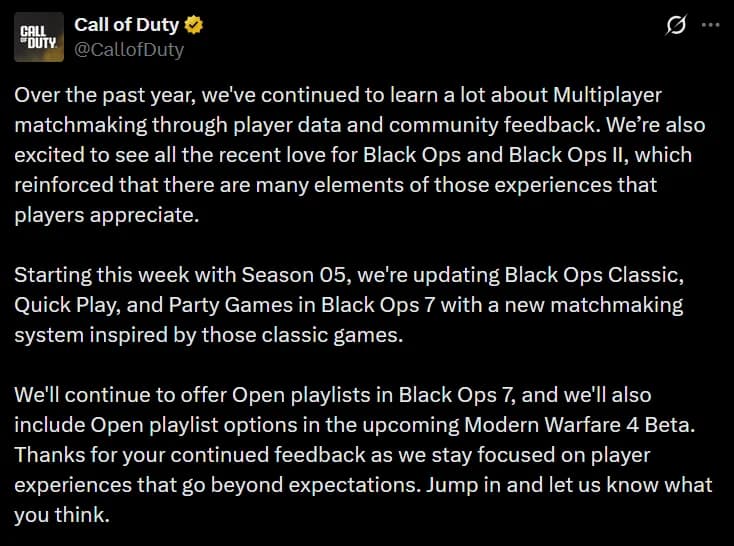
Activision explains Call of Duty matchmaking, skill is only one factor
Activision says matchmaking is a balancing act, not one hidden skill score. Ping, party size, population, and queue time can matter more than raw stats in the lobby you get.
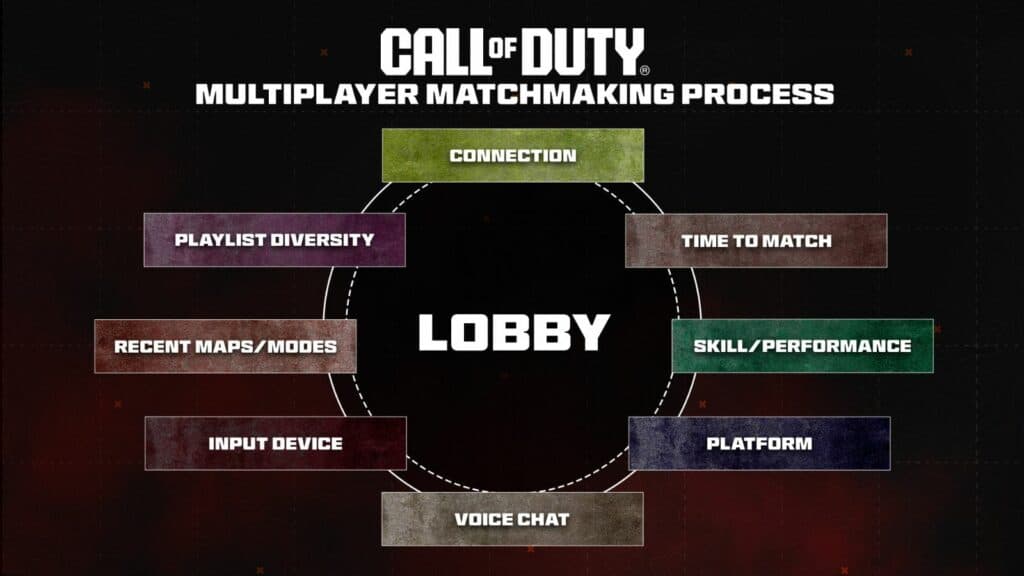
Activision’s latest matchmaking explainer lands on the complaint Call of Duty players know best: why one night feels playable and the next feels like a sweatfest. The answer is not a single hidden number, but a system that is constantly trading off skill, connection quality, party composition, and wait time to build a match that starts fast and actually works.
What Activision is saying about matchmaking
In January 2024, Activision published “An Inside Look at Matchmaking” to push back on the idea that one secret score decides every lobby. The company’s framing is much messier, and much more familiar to anyone who has bounced between great and terrible sessions: the game is trying to assemble a playable match, not just a perfectly equal one. That means skill matters, but so do ping, server location, queue pressure, and whether you are queuing alone or with a squad.
The important shift in Activision’s explanation is that matchmaking is described as a balancing act. A lobby can be a little more forgiving on skill if the connection is strong and the player pool is healthy. It can also become looser on connection or skill when the playlist is small and the system has to widen the search to keep wait times from dragging.
Why ping hits harder in Call of Duty than in slower shooters
Call of Duty lives on fast time-to-kill, which makes network quality feel personal very quickly. A tiny spike in latency can decide whether you win a gunfight, survive a corner peek, or trade shots cleanly. That is why players so often describe some matches as “off” even when their stats look normal: the lobby may have been playable on paper, but the connection made every duel feel slightly late.
Activision’s April 4, 2024 white paper series sharpened that point further. The first paper focused on ping, and the later paper centered on the role of skill in core multiplayer matchmaking. Taken together, the message is straightforward: skill is only one input, and connection quality is still a major part of the equation.
Why solo queue feels different from a stacked party
Party size changes what the system has to do. If you queue alone, matchmaking has more freedom to sort you into a lobby based on the available pool at that moment. If you queue with a squad, especially one made up of mixed-skill players, the system has to keep the group together while also finding opponents and teammates that fit the whole stack.
That is one of the clearest reasons two players with the same public stats can report very different experiences. A solo player in a healthy playlist may get cleaner match quality and faster fills, while a full squad can force the system to juggle more variables at once. The result is that the “same” matchmaking system can feel easier, harder, or simply stranger depending on whether you are alone, duoed, or running a full team.
Why off-peak hours feel sweatier or more inconsistent
Population changes everything. In a well-populated playlist, the system can be more selective because it has more players to choose from. When the playlist is smaller, or you are playing at an off-peak time, the search has to widen to keep queue times reasonable.
That tradeoff is why some sessions feel clean and others feel like they were stitched together from whoever was available. The game is not just deciding between hard and easy lobbies; it is deciding between a tighter match and a faster one. If you are in a quieter region, a niche mode, or a late-night queue, that tradeoff becomes much more obvious.
The myth of the rigged lobby
A difficult lobby does not automatically mean the game is punishing you for doing well. Activision’s own framing points to a mix of population, recent performance, ping, and server constraints instead of a single revenge mechanic. That distinction matters because a lobby can feel brutal for reasons that have nothing to do with a secret “you won too much” switch.
There is also a practical reason publishers keep some skill balancing in the system. IGN’s coverage of the matchmaking debate pointed out a simple reality that every multiplayer developer knows: players tend to quit matches or stop playing if they are getting blown out. That is exactly why matchmaking has to sit between fairness and friction instead of optimizing only one of them.
What happened when Activision experimented with turning SBMM off
Activision has also publicly said it experimented with turning off skill-based matchmaking in Call of Duty. The result, by the company’s own account, was not popular with players. That is a useful counterweight to the community fantasy that removing skill from the equation would automatically create better lobbies for everyone.
The experiment suggests the system is protecting more than competitive balance. If raw connection were the only priority, the experience might be faster but more chaotic, with blowouts and wildly uneven games becoming more common. Activision’s takeaway was that players disliked that version of matchmaking, which helps explain why the company keeps treating skill as one factor among several rather than as a switch to be flipped on or off.
How long this debate has been around
This argument is older than the current Call of Duty cycle. One historical line in the discussion places skill-based matchmaking in the franchise back to the Modern Warfare, or Call of Duty 4, era. Another puts matchmaking itself in Call of Duty 2 in 2005. That history matters because it explains why the community keeps revisiting the same complaint with new language: the system may not be new, but the franchise is bigger, more competitive, and more heavily tracked than it was when those early systems were first introduced.
That long timeline also changes how players interpret the lobby they get today. Stats are public, clips spread instantly, and every rough session gets compared against someone else’s highlight reel. In that environment, a ping issue or a party-size mismatch can look like a conspiracy when it is really the system trying to solve too many problems at once.
What you should actually expect from matchmaking now
The cleanest way to read Activision’s explanation is this: matchmaking is trying to balance skill, connection, party composition, server location, playlist population, and queue time at the same moment. It is not aiming for a single perfect number, and it is not pretending ping does not matter.
So when a match feels sweaty, the most useful question is not “is SBMM real?” It is “what else was the system juggling right then?” A solo queue during peak hours in a busy playlist will not feel like a stacked party in a smaller mode at midnight, and Activision’s own white papers make clear that those differences are part of the design. The lobby you get is the result of those tradeoffs, and in Call of Duty, that is usually the real story.
This article was produced by Prism’s automated news system from verified source data, official records, and press releases, then run through automated quality and moderation checks before publishing. The system is built and supervised by the people who set the standards it runs under. Read our full AI policy.
Did this article answer your question?