Black Ops 7 multiplayer is Call of Duty’s best in years
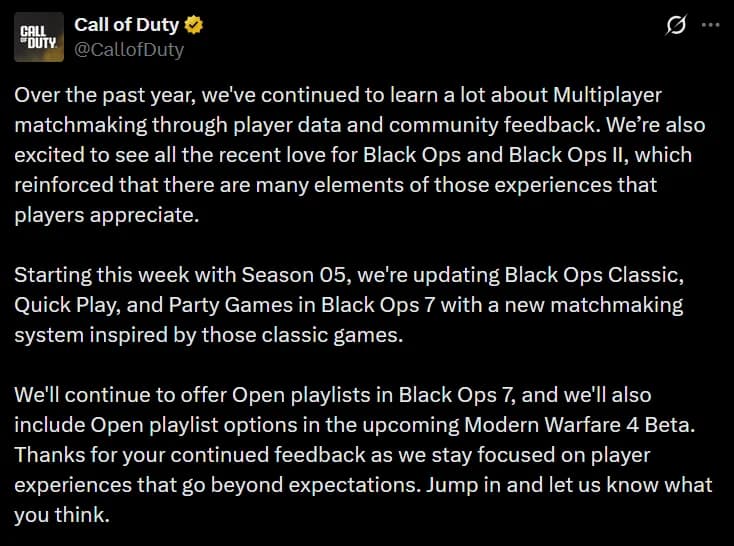
Black Ops 7’s multiplayer keeps winning on the basics: cleaner movement, faster reads, and a map pipeline that never goes stale.

Black Ops 7 opened with 18 multiplayer maps and kept feeding the playlist fast enough that the game never settled into a rut. That is the heart of the verdict around it: the conversation is not about damage control, but about a Call of Duty sandbox that finally feels clean, readable, and worth grinding for the long haul.
The movement model finally gets out of its own way
The biggest reason players keep circling back to Black Ops 7 multiplayer is movement. The game builds on Black Ops 6’s foundation, but it sharpens the edges instead of piling on more chaos, with next-level Omnimovement, a wall jump, and a changed approach to tactical sprint. In practice, that means gunfights feel smoother because players can read what is happening on screen without every duel turning into a blur of overextended mobility.
The tactical sprint change matters more than it sounds. It is no longer a default ability, and it has to be unlocked through a perk, which strips some of the constant speed abuse out of the base experience. That choice gives the game a more grounded rhythm, while the wall jump adds just enough route variety to keep movement expressive without drowning the map in nonsense. For a series that has spent years toggling between hyper-fast and overly sticky, Black Ops 7 lands in a sweet spot that makes every peek, chase, and re-challenge feel easier to follow.
Three lanes, better reads, less clutter
Treyarch and Activision have leaned hard into the three-lane map philosophy, and Black Ops 7 is another reminder that the old formula still works when the spaces are built with intent. That design approach gives lanes, mid-map power positions, and flank routes clear identities, which is exactly what competitive players want when they talk about map flow and spawn logic. When the geometry makes sense, the rest of the sandbox gets better because players can learn timing instead of fighting the map itself.
The launch package reflected that thinking from the beginning. Treyarch first framed the multiplayer lineup around 16 signature maps in the reveal, then prelaunch intel said 19 maps would arrive before Season 01, and the live game opened with 18 multiplayer maps. That kind of volume is not just a content flex, it is a map-flow decision, because it gives the playlist enough variety to keep teams adapting instead of repeating the same routes and spawn traps for weeks.
Players notice that difference immediately. A strong map pool does more than add locations to vote on between matches, it changes how often the game rewards timing, rotation discipline, and disciplined gunplay. In Black Ops 7, the structure of the maps is doing a lot of the heavy lifting that weaker recent entries left to chance.
The seasonal map cadence kept the sandbox alive
Black Ops 7 did not peak at launch and then fade. Season 02 arrived on February 5, 2026, Season 03 followed on April 2, 2026, and Season 04 still added five new and remastered multiplayer maps even as the cadence started to slow. The result is a multiplayer ecosystem that kept expanding instead of shrinking, which is one reason the game stayed relevant after the opening weeks.
The map count matters even more when you look at the broader seasonal pace. The multiplayer opinion that has formed around Black Ops 7 points to Season 1 and Season 2 each adding nine core maps, Season 3 bringing seven more, and Season 4 contributing five more. That is a lot of fresh space for players to master, and it helps explain why the game has remained a live competitive sandbox instead of a short-lived launch burst.
This is where the series’ best recent strengths start to stack. Better movement makes the fights cleaner. Better lane design makes the fights readable. A constant map drip keeps the whole thing from going stale. Put together, those choices create the feeling that every session still has something to learn, whether it is a new route, a better timing window, or a different way to control the center of a map.
Why the multiplayer goodwill outlasted the launch noise
Black Ops 7’s multiplayer reputation also looks stronger because the rest of the package took heavier hits. Launch-period reaction was rough on the campaign, which drew backlash for always-online requirements and a lack of solo-friendly features, while multiplayer and Zombies were the parts that got a more positive reception. Steam reviews skewed mixed, but the competitive side of the game kept its footing because the core systems were doing exactly what players wanted them to do.
Availability helped, too. Black Ops 7 landed day one on Game Pass Ultimate and PC Game Pass, which widened the audience testing its multiplayer from the first hour. That meant the mode had to make its case fast, and it did, not with one gimmick but with a set of decisions that made the sandbox feel better to inhabit match after match.
The clearest way to read the community verdict is this: Black Ops 7 feels like the first recent Call of Duty entry that trusts its own competitive language again. It does not chase novelty for its own sake. It trims tactical sprint out of the default kit, gives movement a cleaner ceiling with wall jumping, keeps maps coming in a steady stream, and holds the three-lane framework together long enough for players to actually enjoy mastering it.
That is why the opening conversation around 18 launch maps never really stayed about the number. It became about what those maps and movement choices let players do once they were inside the match. Black Ops 7’s multiplayer has stuck because it gets the basics right, and in Call of Duty, that is usually what turns a mixed launch into a lasting favorite.
This article was produced by Prism’s automated news system from verified source data, official records, and press releases, then run through automated quality and moderation checks before publishing. The system is built and supervised by the people who set the standards it runs under. Read our full AI policy.
Did this article answer your question?