Cronus Zen and XIM Matrix Labeled Cheating Tools by Activision, Here Are Safe Alternatives
Activision's Team RICOCHET called Cronus Zen and XIM Matrix "cheating tools" in its Black Ops 7 Season 2 update, and here's what's actually safe to use.
What Activision Actually Said, Word for Word
When Team RICOCHET dropped its Black Ops 7 Season 2 anti-cheat update on February 2, 2026, the language was unusually blunt. "These devices are not permitted in Call of Duty. They are cheating tools, even if they masquerade as accessibility devices." That single sentence ended years of ambiguity for players who had convinced themselves that buying a Cronus Zen from a big-box retailer made it somehow sanctioned. Their retail availability had led to genuine confusion around whether players were allowed to use them, and the official update addressed that confusion directly.
The rollout coincided with the launch of Ranked Play for Black Ops 7 and Warzone, and the timing was deliberate. In Ranked Play, cheating costs more than a win: it impacts Skill Rating (SR), momentum in a session, and confidence in the mode. Getting banned with SR on the line is a different kind of painful than a casual pub lobby, which is why this guide matters before you plug anything in.
What These Devices Actually Do
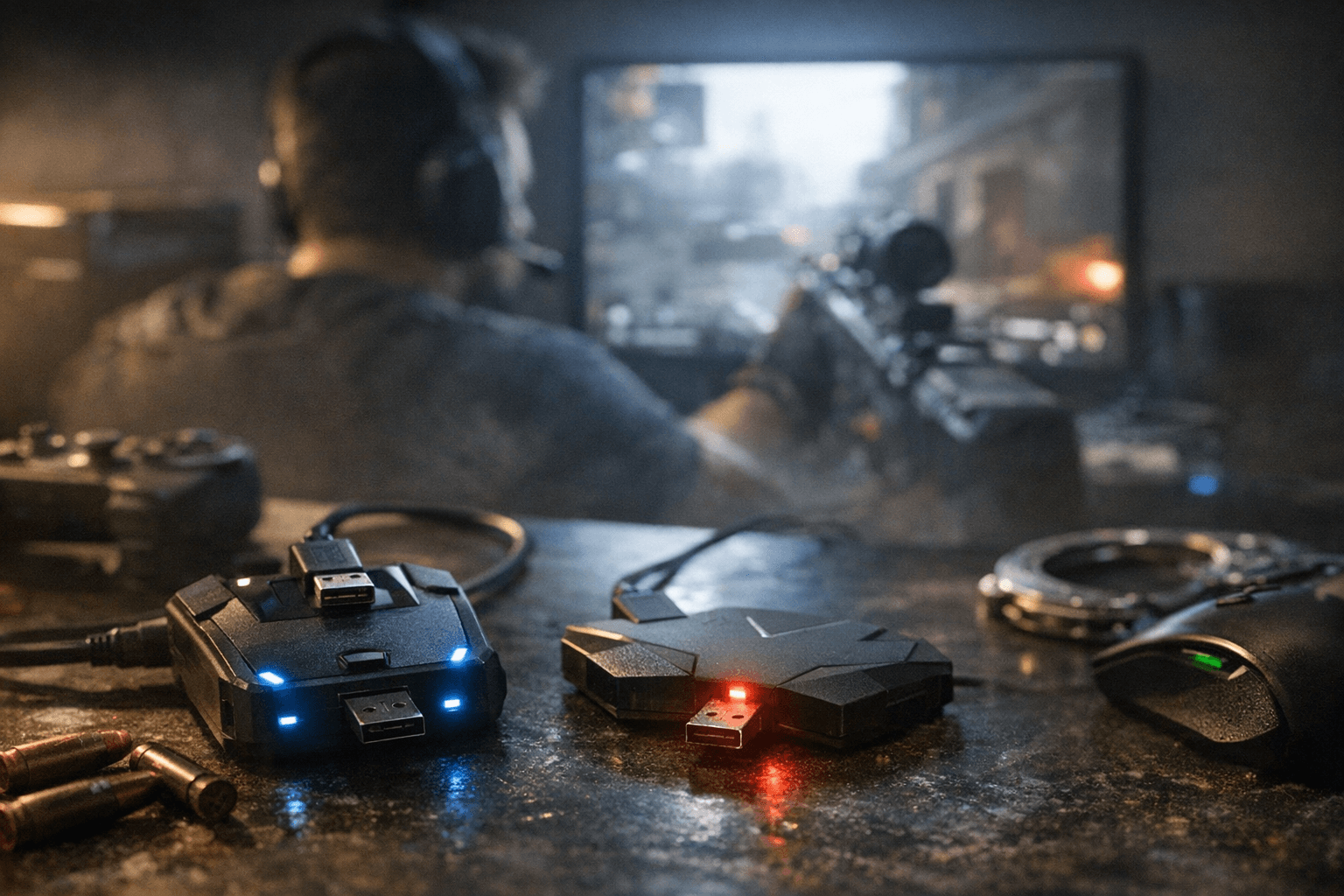
Cronus Zen and XIM Matrix are input-modifying devices that sit between a controller or keyboard and the console or PC. They can simulate machine-perfect aim and recoil control, removing advantages no human player can naturally achieve. The Cronus Zen is the more notorious of the two: it runs "GamePacks," community-built scripts that can automate recoil compensation on a per-weapon basis, trigger rapid-fire on semi-auto weapons, and manipulate the aim-stick curve to exploit aim assist in ways a thumb physically cannot. XIM Matrix converts mouse-and-keyboard input to controller signals, which by itself could be borderline acceptable, but its software stack allows the same macro and script injection that makes Cronus a problem.
These devices alter player inputs in ways that create unfair advantages and pose a persistent frustration to players. The community description Team RICOCHET used in its update nailed what this actually looks like in a gunfight: "losing a close gunfight to aim that never seems to miss, recoil that never kicks, or reactions that don't feel human."
How the Detection System Works Now
This is where it gets technically interesting, and where the "just buy a new adapter" crowd gets caught out. The new detections do not look at what hardware a player has connected. Instead, they study how inputs actually behave.
Since devices like Cronus Zen and XIM Matrix can be endlessly customized, there is no single clear fingerprint to target. Rather than chasing individual setups, the anti-cheat focuses on spotting broader patterns of machine-assisted behavior, allowing it to catch abuse even as scripts and configs evolve. That behavioral approach is significant. It means renaming your device, flashing a new firmware, or buying a rebranded clone from an off-brand seller does not protect you. If your inputs read like a machine because they are machine inputs, the system flags the behavior regardless of what hardware generated it.
The team stated: "These systems are designed to evolve, adapt, and expand until input modification devices no longer provide an advantage in Call of Duty." That is a long-game commitment, not a one-season patch. A new cloud-based attestation system built in partnership with Microsoft also now strengthens protection for Ranked Play by blocking tampered systems before matches even begin.
Myth-Busting: What the Policy Actually Means in Practice
A lot of misinformation circulates in community forums. Here is what the policy actually means translated into real scenarios:
*"Rapid-fire is just a button macro, not cheating."* Wrong. Rapid-fire that fires faster than a human thumb can physically press triggers an inhuman input pattern. That is precisely the behavior the behavioral detection targets, whether the device calls it a "macro" or a "turbo" function.
*"Recoil scripts just compensate for bad game design."* Also wrong, and this is the one Activision specifically called out. Automated recoil control that produces frame-perfect downward pull on every shot is not something any human achieves consistently. The consistency itself is the red flag the system measures.
*"XIM is just a keyboard-and-mouse adapter, which is allowed on PC."* On PC, native keyboard and mouse input is fine. What is not fine is using XIM Matrix to inject mouse acceleration curves that exploit the aim-assist bubble designed for controller players, or layering macros on top of mouse input. The device's capability to script and automate is the violation, not the input type conversion.
*"Accessibility devices are exempt."* Activision addressed this directly. Genuine accessibility hardware is supported and encouraged. Cronus Zen and XIM Matrix are not accessibility tools despite sometimes being marketed as such. The distinction is function: a device that remaps buttons for a player with limited mobility is not the same as a device that injects perfectly timed input sequences no human hand produces.
The Safe Alternatives List
If you need performance, accessibility improvements, or controller customization, these categories and products are policy-compliant:
- High-end licensed controllers: Xbox Elite Series 2, Sony DualSense Edge, Scuf Instinct Pro, and Razer Wolverine V3 Pro all offer paddle buttons, trigger stops, hair-trigger locks, and remappable inputs through manufacturer firmware. No third-party adapter, no script injection.
- Accessibility controllers: The Microsoft Xbox Adaptive Controller is explicitly supported and designed for players with limited mobility. Sony's sanctioned accessibility peripherals serve the same function. Neither device automates inputs; they remap them at the hardware level within normal human input ranges.
- Platform-level remapping: Windows' native Accessibility features, Xbox's built-in button mapping, and Steam Input all allow extensive controller remapping without touching a third-party adapter. These tools remap at the OS or platform layer and produce inputs indistinguishable from a standard controller.
- Legitimate performance hardware: A low-latency wired controller, a gaming mouse with a high polling rate (1,000 Hz or 8,000 Hz on flagship models), and a wired network connection or quality router all improve real performance without touching anti-cheat policy. These are the upgrades that actually develop your skill ceiling rather than automating around it.
- Manufacturer software suites: Razer Synapse, Scuf's companion app, and Xbox Accessories on Windows let you tune trigger sensitivity, thumbstick curves, and button assignments within documented, platform-approved limits.
What to Do If You Think You Were Banned in Error
If you received an enforcement action and believe it was a mistake, the process is straightforward but requires documentation. Compile a complete list of every peripheral connected to your system during gameplay: controller model, headset, capture card, USB hub, anything attached. Submit that list through Activision's official support channels with a detailed description of your setup. Do not submit through community Discord servers or third-party appeals sites; those have no connection to the enforcement team. The official support ticket is the only path.
Appeals are assessed case by case. If your input profile triggered the behavioral detection because of a legitimate setup quirk rather than an actual device violation, documentation of your hardware gives the enforcement team something concrete to review.
The Bottom Line
Top 250 player and content creator LunchTime called the Season 2 crackdown a "HUGE W," and community reaction broadly reflected relief from players who felt Cronus Zen and XIM Matrix had long eroded trust in Ranked Play matches. The enforcement update is not a permanent guarantee, and some community members remain skeptical about long-term effectiveness. But the shift to behavioral detection rather than hardware fingerprinting is a structurally smarter approach: it targets what the device does to your inputs rather than what the device looks like on a USB bus.
The safest position is also the most straightforward one: buy hardware from established controller manufacturers, remap through platform tools, and put your money into network quality and practice time. The Ranked Play ladder rewards mechanical skill. No adapter shortcut has ever actually built any.
This article was produced by Prism’s automated news system from verified source data, official records, and press releases, then run through automated quality and moderation checks before publishing. The system is built and supervised by the people who set the standards it runs under. Read our full AI policy.
Did this article answer your question?