Master Call of Duty With a Coach-Approved VOD Review Routine
Watching your own gameplay footage with a structured system separates players who plateau from those who actually climb.
Most players watch their clips to cringe or celebrate. Coaches watch them to build a case. There's a fundamental difference between passive replay-watching and a deliberate VOD review routine, and that gap is where real improvement lives. If you're putting in the hours on Call of Duty but your rank isn't moving, your mechanics aren't tightening, and you keep dying to the same situations, the problem probably isn't your aim. It's that you have no feedback loop. VOD review is that loop.
This guide walks you through a coach-informed approach to reviewing your own footage, built around the same core practices that structured coaching uses: timestamping key moments, identifying behavioral patterns across sessions, and testing hypotheses about what's actually costing you games.
Why VOD review works differently than just playing more
Repetition without reflection bakes in bad habits. Every time you push a corner the wrong way and die, then queue again immediately, your brain processes that death as variance rather than error. You move on. VOD review forces you to stop and ask a different question: not "did that work?" but "why did that happen, and does it happen again?"
The coach-informed model treats your gameplay like a dataset. One death to a pre-aimed angle is a data point. Five deaths to the same type of angle across three different maps is a pattern. You can't see that pattern in the moment, and you can't see it by playing more of the same way. You need footage, distance, and a system.
Setting up your review sessions
Before you can run a proper VOD review, you need to record consistently. On PC, tools like ShadowPlay or OBS can capture full sessions. On console, the built-in capture features work fine for clipping individual games. The goal is having full-game footage, not just highlight clips. Highlight clips only show you what went right. You need the full game to see the decisions that led to the moments that went wrong.
Keep sessions short and focused. A 20-minute review of one full game will teach you more than two hours of passively scrolling through a session. Pick one game per review, ideally one that felt off, a loss where you couldn't identify what went wrong, or a game where your stats looked fine but the team still got run over.
The timestamping method
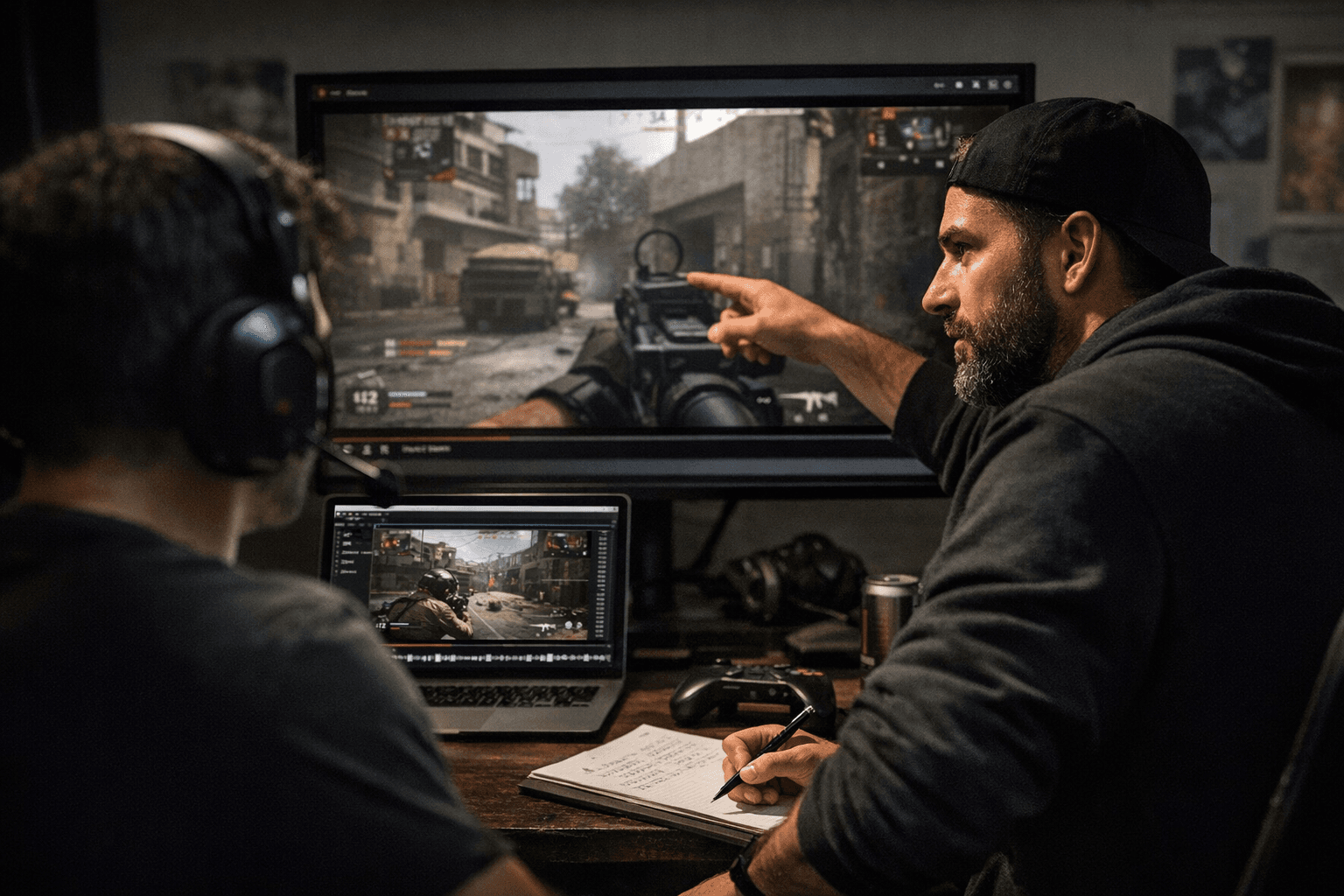
This is the single most important habit to build into your VOD routine. As you watch, pause and note the timestamp every time something happens that warrants examination. Don't try to analyze it in the moment. Just flag it and keep watching.
A good timestamp note captures three things: the time in the video, what happened, and one quick observation. Something like "4:32, died pushing B main, didn't check window first." That's it. Get through the whole game with your timestamp list before you start drawing conclusions. This prevents the common mistake of over-fixating on a single moment and missing the broader pattern.
After you've flagged the full game, look at your list. Group similar timestamps together. If you have four notes about dying in mid-range gunfights with an aggressive SMG loadout, that's a loadout-positioning mismatch worth investigating. If six of your timestamps involve you rotating late after an objective flip, that's a decision-making pattern rooted in map awareness.
Pattern identification across sessions
Single-session VOD review is useful. Multi-session review is where you actually start to understand yourself as a player. After three to five reviewed games, look at your timestamp archives together. Patterns that don't show up clearly in one game become undeniable across five.
Common patterns to look for in Call of Duty specifically:
- Consistent deaths from the same sightline or angle type, indicating a map knowledge gap
- Over-extending after getting a kill, suggesting you're playing kills instead of position
- Late rotations in objective modes like Hardpoint or Control, pointing to a priority issue
- Specific weapon matchups you're consistently losing, which may reflect a loadout or range management problem
- Tunneling on the wrong threat, missing the flanker while focused on the main push
The goal isn't to find everything wrong at once. It's to identify the two or three patterns that are costing you the most rounds per game and work on those specifically.
Building and testing hypotheses
Once you have a pattern, you build a hypothesis. This is where VOD review crosses into real coaching methodology. A hypothesis is a specific, testable statement: "I'm dying on rotation because I'm crossing open sightlines without smoking or timing them with teammate pressure."
The next step is to take that hypothesis into your next few sessions with an explicit intention to test it. Don't just play, play with that specific variable in mind. Then come back and review the footage again. Did the change reduce that category of death? Did a different problem become more visible now that the first one is partially corrected?
This iterative loop, review, identify, hypothesize, test, re-review, is what separates players who use VOD review as a vague self-improvement gesture from players who use it as an actual skill-development system. It mirrors how competitive teams work with their coaches, and it works at every level, from ranked grind to competitive league play.
Watching footage with audio off and audio on
One underused technique: watch the same segment twice, once with sound off and once with full audio. With sound off, you're forced to focus entirely on positioning, movement, and decision timing. You'll catch things you'd miss if the audio was guiding your attention.
Then watch it again with audio. You'll often realize you had information you didn't act on: a teammate calling a flank, a footstep you could have heard, a killstreak sound cue that should have told you to reposition. The audio pass reveals gaps between available information and actual decision-making, which is one of the hardest things to self-diagnose in real time.
Making it a routine, not a one-time fix
The biggest failure mode with VOD review is doing it once after a rough session, feeling like you "figured it out," and then not doing it again for two weeks. The routine has to be consistent to build the self-awareness that compounds over time.
A realistic cadence for most players: review one full game after every two or three sessions. That's enough to catch developing patterns without making the process feel like homework. Keep a running log of your timestamps and pattern notes, even just in a phone note or a simple spreadsheet. After a month, you'll have a documented map of your tendencies as a player, the kind of self-knowledge that most players never build because they're always looking forward to the next game instead of back at the last one.
The players who close the gap between where they are and where they want to be in Call of Duty aren't just grinding more lobbies. They're building evidence, testing ideas, and showing up to each session with a specific focus. VOD review is how you do that without a coach standing over your shoulder.
This article was produced by Prism’s automated news system from verified source data, official records, and press releases, then run through automated quality and moderation checks before publishing. The system is built and supervised by the people who set the standards it runs under. Read our full AI policy.
Did this article answer your question?