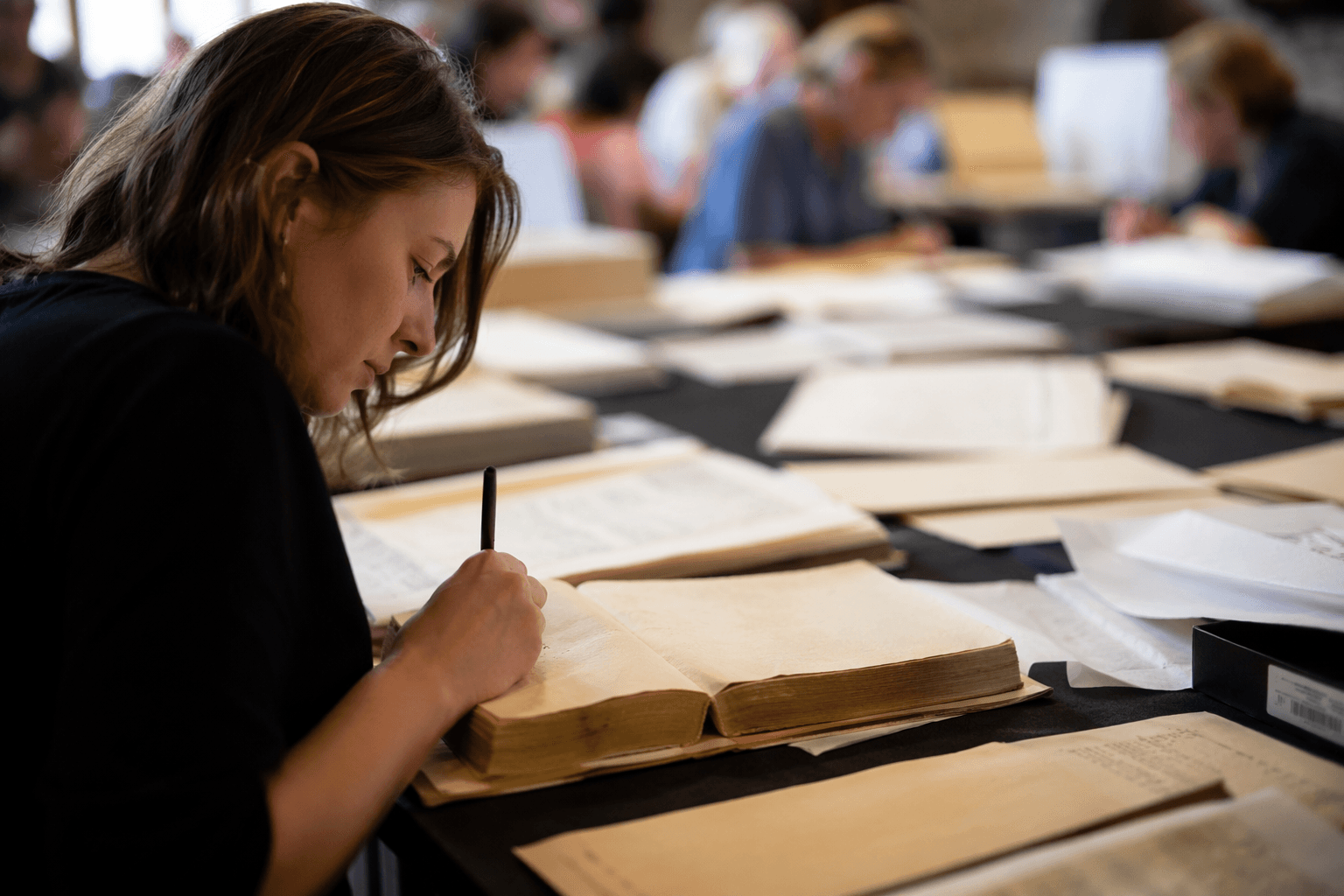
Sammy Little keeps calligraphy alive in America’s civic rituals
Sammy Little’s pen reaches from private practice to presidential ceremonies, showing how calligraphy still gives America’s public rituals their visual authority.

Sammy Little’s work lands in the places where a nation decides to look official. Her lettering has appeared at the Library of Congress, the Smithsonian Institution, the U.S. Supreme Court, and presidential inaugurations, turning a private craft into part of the country’s public face. That is the force of her story: calligraphy here is not decoration, it is civic memory made visible.
A hand that travels into public life
The profile at the center of this story treats Little less like a niche artisan and more like a keeper of public ritual. In one setting, calligraphy lives on envelopes, certificates, and keepsakes; in another, it carries the visual weight of state occasions and institutional history. Little moves between those worlds with the same tool, and that movement is what makes her work matter far beyond hobby circles.
Her career reaches into major American institutions because those settings still rely on the authority of the handwritten line. When a document, invitation, or ceremonial piece is meant to signal continuity, the human hand brings a kind of gravity that digital type cannot imitate. Little’s career shows that the difference is not nostalgia, but tone, precision, and the knowledge that a ceremony begins long before anyone enters the room.
A practice shaped by protocol
Little brings more than 30 years of professional experience to that work. Craft in America describes her as a calligrapher with deep experience, and her own website says she specializes in event-related calligraphy with a thorough knowledge of protocol and etiquette. That combination explains why her clients include The White House, the U.S. Supreme Court, and the Smithsonian Institution.
Those details matter because ceremonial lettering is not simply about beautiful strokes. It depends on timing, hierarchy, formal address, and the unglamorous discipline of getting every name, line break, and layout decision right. In Little’s case, the craft is inseparable from the rules of the setting, which is exactly why her work keeps finding a place in official America.
Calligraphy as civic memory
Craft in America’s Democracy episode, released in December 2020, frames Little’s practice as part of a larger conversation about democratic traditions and the historical record. The episode’s learning materials show her inscribing a quote from the Declaration of Independence, linking the act of writing to the nation’s founding language and to the classroom question of how craft can document events or commemorate ideals.
That framing makes Little’s lettering feel less like an isolated studio practice and more like a public act of preservation. If the Declaration stands for a shared political inheritance, then the handwritten rendering of its words becomes part of how that inheritance is remembered. The craft does not replace the document’s meaning, it gives that meaning a visual form that can be carried into schools, museums, and civic programs.
A working professional, not a romantic relic
Little’s own website places her inside a working professional network, not an isolated portrait of artistic devotion. It identifies her as a founding officer of the Washington Calligraphers Guild, a detail that points to the organized side of the field, where standards, community, and professional exchange still shape practice. The same site’s client list, which includes the White House and the U.S. Supreme Court, reinforces that this is a career built on repeated trust from institutions that care about presentation.
The Guild connection matters because it shows calligraphy as a living discipline with shared norms, not a solitary art form fading in the margins. Little has also served as a juror for the Graceful Envelope Contest, one of the Guild’s long-running public competitions. That role places her on the judging side of a field that continues to test technique, composition, and imagination in front of peers who know how much labor a strong envelope can hold.
The scale behind the elegance
A single elegant invitation can hide a surprising amount of labor. C-SPAN documented Little under contract to handwrite all 240 invitations for an event, a number that gives a concrete sense of how ceremonial calligraphy operates at scale. The result may look effortless to the person receiving the envelope, but the work behind it depends on consistency, pacing, and the physical stamina to repeat exacting forms for hours.
That kind of assignment also helps explain why ceremonial handwriting persists. When an institution wants a piece to feel personal, official, and singular at the same time, calligraphy remains the answer. It is one of the few crafts that can make mass-produced occasions feel individually addressed without losing the dignity of the whole.
Why the practice still holds power
The larger argument in Little’s story is simple: calligraphy still matters because public life still depends on symbols that feel made, not just printed. The Library of Congress, the Smithsonian, the U.S. Supreme Court, and presidential inaugurations are not casual backdrops. They are places where Americans perform continuity, and Little’s work helps give those performances a visible shape.
That is why her profile lands so strongly now. Digital communication dominates ordinary life, but institutions still reach for handwritten ceremony when they want seriousness, memory, and continuity to be felt in the object itself. Little stands at that intersection, where the pen is both tool and witness.
The title “Passing the Pen” fits because the craft survives through practice, standards, and the deliberate handoff of knowledge. Little’s career shows a discipline that can begin at a desk and end inside the country’s most formal rooms, carrying the same basic promise from one setting to the next. The ink changes shape, but the civic purpose stays the same.
This article was produced by Prism’s automated news system from verified source data, official records, and press releases, then run through automated quality and moderation checks before publishing. The system is built and supervised by the people who set the standards it runs under. Read our full AI policy.
Did this article answer your question?