Energy Observer Catamaran Showcases Zero-Emission Yachting in London
Energy Observer's London stop turns a famous catamaran into a reality check: solar, sail and hydrogen look promising, but cruising owners will feel the limits.
Energy Observer in London is more than a photo opportunity
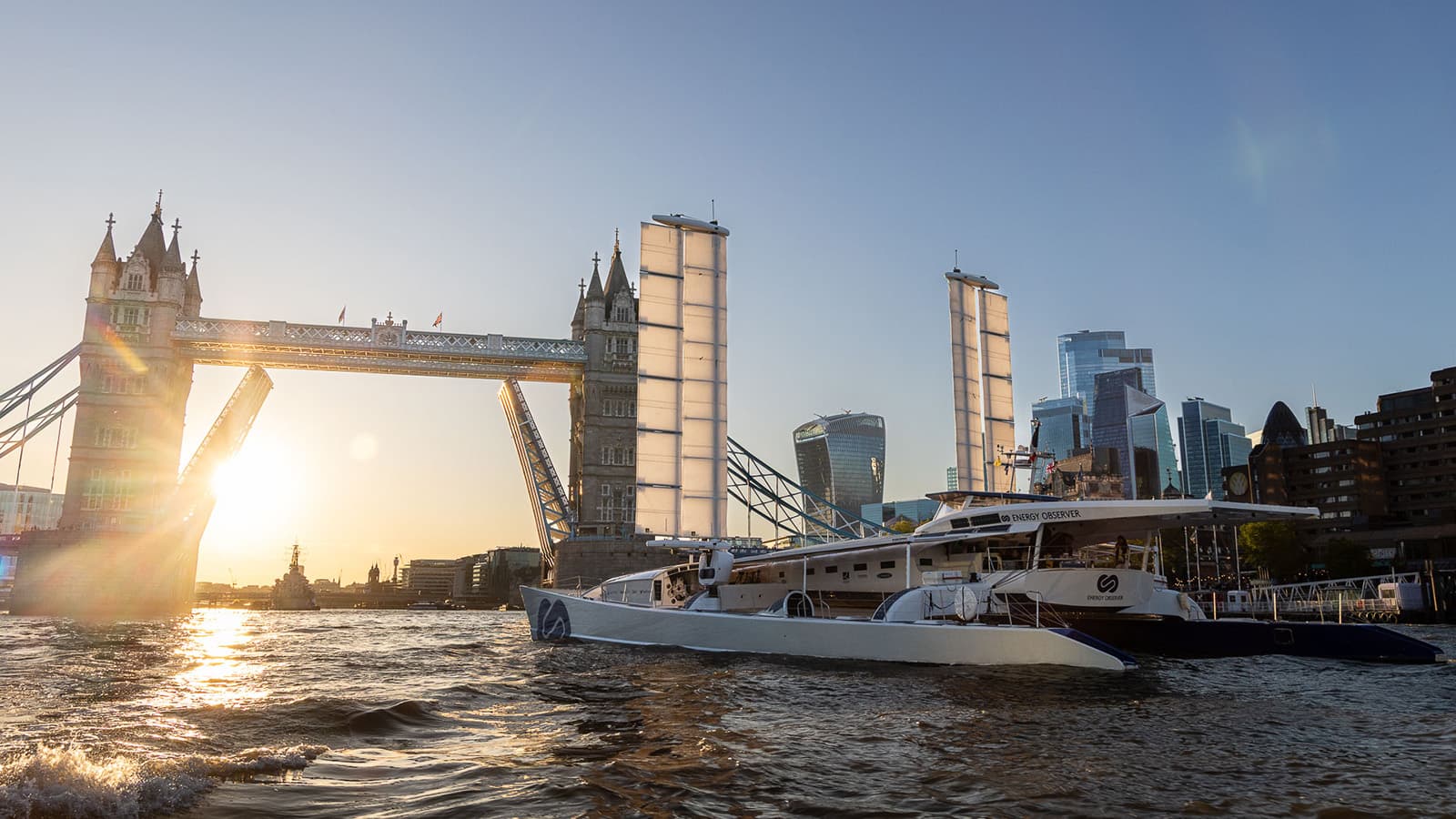
Victorien Erussard’s Energy Observer has the kind of name that turns heads in any marina, but the London stop makes the boat do something more useful than impress a crowd. Docked beneath Tower Bridge from 25 to 29 April 2026, the 30.5-metre catamaran is a live test of what zero-emission yachting can actually carry into normal boating life, and what still belongs in the prototype bay.
That is the real story here. Energy Observer is not just a sleek multihull with solar panels and wing-like sails. It is a working laboratory for how far renewables, hydrogen, and onboard energy management can go when range, refueling, complexity, and cost all matter at sea.
From racing catamaran to floating laboratory
Energy Observer’s history gives the project its credibility. The original catamaran was launched in 1983, later became the world’s fastest racing catamaran in 1994, and then entered a long reinvention that turned speed pedigree into clean-tech proof of concept. The modern project was born in 2013 from Erussard’s commitment to building a clean, high-performance catamaran, and he teamed up with explorer Jérôme Delafosse to push that idea into a full international energy-transition mission.
The rebuild was not a cosmetic refit. Energy Observer says EO1 was rethought, rebuilt, and equipped over four years by 40 dedicated engineers and technicians, with 250,000 hours of work behind the conversion. That scale matters because it tells readers what a serious zero-emission platform actually takes: not a simple retrofit, but a deeply integrated engineering program.
For catamaran owners, the lesson is immediate. A wide multihull platform gives designers room for solar arrays, tanks, control gear, and alternative propulsion systems that would be harder to place on many monohulls. That is why Energy Observer keeps coming up in conversations about where large cruising cats and future superyachts may be headed.
How the hydrogen system works at sea
The technical heart of the boat is simple to describe and difficult to replicate. CEA says the vessel’s energy system includes desalination, electrolysis, tanks, and a fuel cell. In practice, seawater is first desalinated and purified, then sent through an electrolyser, which splits the water into hydrogen and oxygen. The hydrogen is stored for later use, then converted back into electricity through the fuel cell when onboard demand rises or conditions change.
That storage step is what makes the system interesting for cruising. Solar and wind can cover short-term needs, but hydrogen acts as longer-duration backup when the boat needs energy beyond what the panels and sails can deliver in the moment. BPCE’s description adds a useful detail: the hydrogen is compressed and stored at 350 bar in 8 carbon-fiber tanks, which gives a clear sense of the engineering intensity involved.
For owner-operated catamarans, this is both inspiring and sobering. The upside is real, quieter energy at anchor, less dependence on diesel, and a path toward genuinely lower emissions. The downside is just as real, because desalination, electrolysis, high-pressure storage, and fuel-cell integration are not light-touch systems. They demand space, maintenance, budget, and shore-side support that most private cruisers will not want to manage soon.
What actually transfers to cruising cats
The easiest mistake is to assume the whole Energy Observer package is the takeaway. It is not. The transferable part for the next few years is the discipline of building a catamaran as an energy platform, not just a hull with an engine room.
- Use the catamaran’s wide deck and roof area for solar generation.
- Treat energy storage as a system, not an afterthought.
- Reduce generator dependence with careful load management.
- Pair renewables with practical onboard services, especially desalination and efficient hotel loads.
- Think in terms of endurance and autonomy, not just top speed.
What cruising cats can learn now:
The hydrogen side is the headline, but the more accessible lesson is integration. Energy Observer shows how every onboard choice, from generation to storage to consumption, has to be planned as a single chain. That is the part that is already influencing the next generation of bigger cruising cats, even if the full hydrogen package stays out of reach for most owners for now.
Why the London stop matters beyond the dock
The timing and setting give this visit extra weight. Energy Observer says the London call is intended to engage institutional and industrial partners, local decision-makers, energy-transition stakeholders, and the general public. The arrival on 25 April was marked by the opening of Tower Bridge, which gave the stop the kind of symbolic moment that travels well online and on news feeds.
But London is not just a showpiece berth. It sits inside a new global expedition running from 2025 to 2033 and structured around seven missions. Mission 1 focuses on carbon capture, storage, and reuse across Europe and the North Atlantic, which places the London visit inside a much longer program rather than a one-off publicity stop.
That broader campaign also explains why the boat matters to industry. Energy Observer says EO1 is the first ship in history to complete a round-the-world trip using 100% renewable energies and hydrogen produced onboard by seawater electrolysis. Toyota supports the vessel’s second voyage and provides hydrogen fuel-cell technology for zero-emission power, while EODev, created in 2019 as the project’s industrial spin-off, turns the lessons learned at sea into commercial technology.
A prototype with a practical message
Energy Observer works because it is both extraordinary and specific. It is a famous catamaran, but it is also a data platform, a partnership magnet, and a public demonstration of what clean marine power looks like when the engineering gets serious. That makes it especially relevant to catamaran buyers watching the market for the first signs of real change.
The message for the multihull world is not that every cruising cat will soon carry 8 carbon-fiber hydrogen tanks. It is that solar, storage, smart energy management, and cleaner propulsion are no longer theoretical, and the catamaran form is one of the best platforms for pushing those ideas forward. Energy Observer proves the concept, then quietly reminds everyone how hard the next step will be.
This article was produced by Prism’s automated news system from verified source data, official records, and press releases, then run through automated quality and moderation checks before publishing. The system is built and supervised by the people who set the standards it runs under. Read our full AI policy.
Did this article answer your question?