Eurocat 2026, stunning Carnac drone shots and tight multihull racing
Carnac’s drone shots match the intensity on the water, where Seguin and Muller Seguin topped both the raid and the F18 sheet at a tightly sailed Eurocat.

Carnac finally gets the full picture
Eurocat 2026 looked every bit the multihull showcase it has become: big breeze, sharp racing, and the kind of coastline that makes Carnac a natural stage for catamarans. Antoine Dujoncquoy’s images, helped by proper drone shots for the first time, reveal the venue’s full shape and the raid route that has already become one of the event’s calling cards.
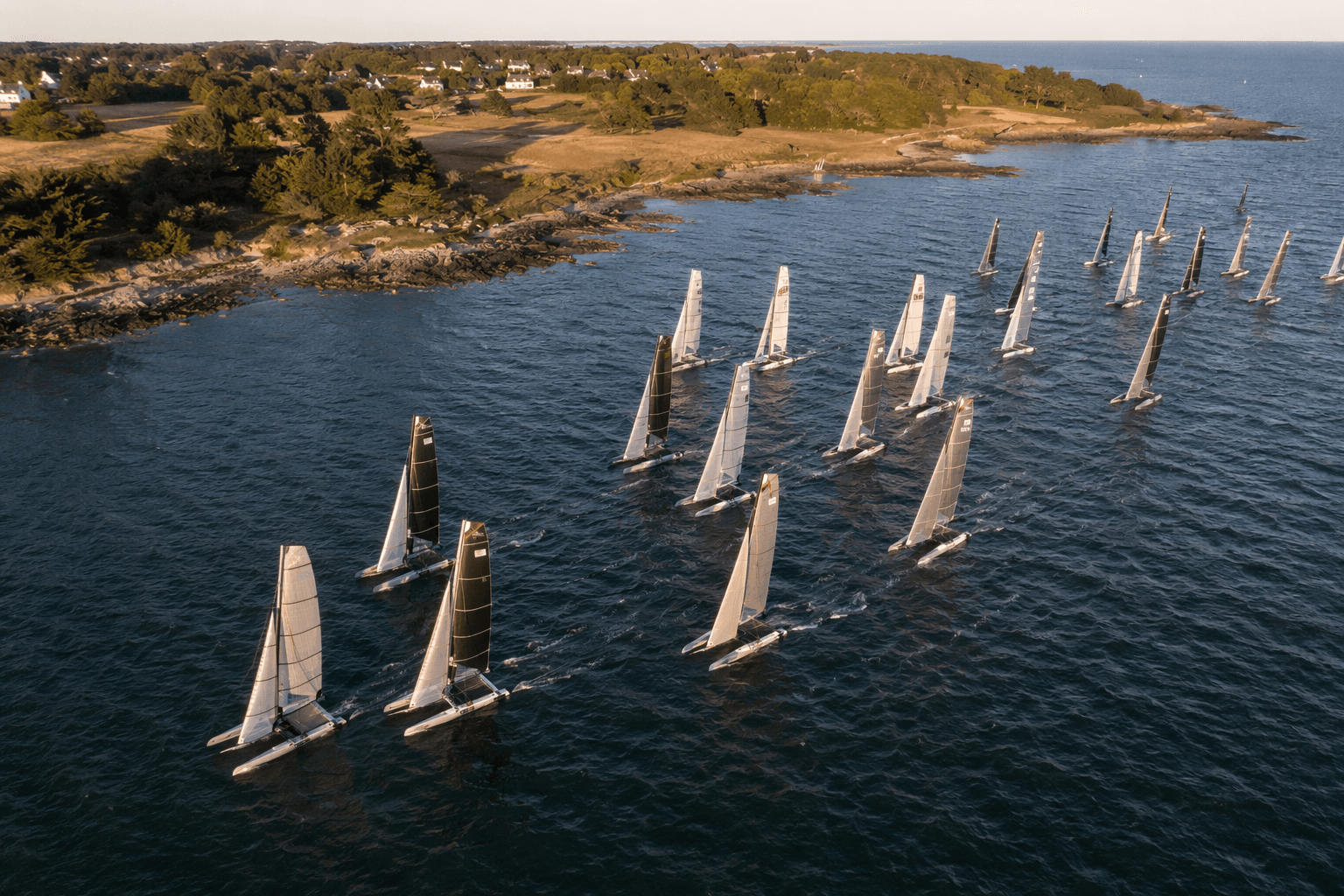
That visual story matters because Eurocat is never just about results. The Bay of Quiberon gives the regatta scale, speed and drama, while the beachside setting around the Grande Plage gives it a strong public face. This year’s third straight Village Sport & Environnement on the esplanade tied the racing to a broader community event on shore, which is exactly why Carnac keeps pulling sailors back.
Three days, one clear purpose
The 38th Eurocat ran from May 1 to May 3 at Yacht Club de Carnac, with three days of racing built around the club’s long-running role as a start-of-season fixture for European catamaran teams. The format is straightforward, but the draw is broad: established crews come for real competition, newer combinations come to measure themselves, and the raid day gives the whole regatta its signature test.
Pre-event expectations were high, with nearly 150 catamarans forecast. The on-water turnout confirmed the scale of the weekend, and the official F18 sheet alone shows 14 entries, with crews from France, Britain, Belgium and the Netherlands all in the mix. That spread is one of Eurocat’s strengths: it is local enough to feel familiar, but international enough to keep the standard honest.
The Grand Raid set the tone
If there was one day that defined the weekend, it was Saturday’s Grand Raid around Houat. A total of 124 crews started the raid in 20 to 22 knots of rain, a proper Carnac test that rewarded confidence, handling and the ability to stay clean through changing pressure. The breeze later eased to 12 to 15 knots, then dipped to a tricky 6 to 7 knots near La Vieille before filling in again after Houat.
That shift mattered because the raid was never just about raw pace. The teams that held their lanes, stayed patient through the lull and restarted cleanly were the ones that converted good boat speed into real separation. Damien Seguin and Youenn Muller Seguin did exactly that aboard Cirrus F18, taking the raid win ahead of Gordon Whitley and Vincent Barrelet on Nacra F20 Carbon, with Ghislain Melaine and Lucas Le Bayon third on another Cirrus F18.
Seguin said after the finish that the target was to win both the raid and the overall Eurocat, and the result showed that ambition was realistic rather than optimistic. When the wind is shifty and the course runs through a weather window like that, the best-prepared crews are often the ones that can combine downwind control with upwind discipline. Carnac rewarded that balance.
The F18 sheet tells you who really had the edge
The raid was the headline, but the official F18 results sheet is where the weekend’s competitive shape becomes clearest. After seven races and before jury review, Seguin and Muller Seguin led the 14-boat fleet with 36 points after discard. That margin put them well clear of the rest of the field and confirmed that their raid pace was backed up by consistent fleet performance.
Behind them, Ghislain Melaine and Lucas Le Bayon finished second on 53 points after discard, followed by Nicolas Bouveyron and Vincent Cuvillier on 59. Claire Joly and Antoine Runet were fourth on 96, which shows just how quickly the fleet spread once the leaders got the better of the wind shifts and key tactical calls.
The first-race sheet also gives a useful early snapshot of the front of the fleet. Seguin and Muller Seguin were already on top after race one, with Gordon Whitley and Vincent Barrelet second and Claire Joly and Antoine Runet third. That early order helps explain the final picture: the same names kept surfacing because the fastest combinations were not relying on a single breakout score, they were stacking solid races from the start.
What the numbers say about current multihull form
Eurocat’s results point to a few clear takeaways for the catamaran circuit. First, the sharpest teams are still those that can perform in mixed conditions, not just in one perfect breeze band. The raid demanded control in 20 to 22 knots, while the fleet races rewarded adaptability when the wind moved around and softened.
Second, the Cirrus F18 remains a serious benchmark in the class, with both the raid winners and the second-place raid team on that platform. Nacra F20 Carbon also showed well through Whitley and Barrelet’s raid podium, which underlines how competitive the top end remains when the course opens up and the breeze builds.
Third, Eurocat’s depth is real even in a 14-boat F18 list. The field included teams from Nantes, Locquirec, Jullouville, Brest, Vannes, Paris and Saint-Lunaire, plus Belgian and British entries, which gives the event a useful mix of regional loyalty and cross-border pressure. That combination is exactly what keeps a regatta relevant at the beginning of the season: familiar water, unfamiliar opposition, and enough variation to expose weaknesses fast.
Carnac is already looking ahead
Eurocat’s wider importance goes beyond one podium list or one dramatic raid. The event has long been a classic Carnac date, and the 2026 edition once again showed why the Bay of Quiberon works so well for this kind of racing. The setting is scenic, but the real draw is that the racing is meaningful: crews get a clear read on speed, handling and crew work before the season hardens into its next phase.
There is also more to come in Carnac itself. The Dart 18 World Championship is scheduled there for July 2026, which gives the town and the club another major multihull moment soon after Eurocat. For the European catamaran scene, that means the spring regatta is doing more than filling a weekend. It is setting the pace, showing who is sharp, and proving once again that Carnac remains one of the sport’s most complete stages.
This article was produced by Prism’s automated news system from verified source data, official records, and press releases, then run through automated quality and moderation checks before publishing. The system is built and supervised by the people who set the standards it runs under. Read our full AI policy.
Did this article answer your question?