Formula 18 catamarans balance speed and control with box rule racing
Formula 18 keeps multihull racing tight by capping size, weight, and materials, so builders can innovate without turning every regatta into an arms race.

Formula 18 works because it makes speed a contest of control, not just scale. The class began as a formal idea in 1993, when Olivier Bovyn and Pierre-Charles Barraud developed the International Formula 18 catamaran formula, and it was recognized as a class in 1996 before gaining International Class status in 2002. That timeline matters because the class was built as a rule framework that could evolve, not as a single frozen boat design.
A box rule that keeps the fleet honest
The heart of Formula 18 is the box rule. Instead of forcing every team into one identical mold, the class limits key dimensions and performance drivers, including length, beam, mast height, sail surfaces, weight, and permitted materials. That leaves room for builders to make design decisions and for sailors to win through tuning, crew work, and boat handling, but it shuts the door on a runaway size race.
That is the reason F18 keeps drawing serious racers and sailors who want high performance without endless escalation. The class rules documented in 2016, 2019, 2020, and 2025 repeat the same history, so the development story is not a retrospective gloss added later. It is part of the official class identity, anchored to the original 1993 formula and the later recognitions in 1996 and 2002.
Measurement is part of the game, not an afterthought
Formula 18 does not rely on trust alone. The International Formula 18 Class Association maintains measurement videos for sail measurement, mast length, and mast circumference, and its measurement materials point sailors toward sail measurement procedures and class measurement instructions. That kind of infrastructure tells you how the class thinks about fairness: repeatability and compliance are built into daily racing life.
US F18 Catamaran Class Assn., Inc. makes the same point in plainer terms. Its measurement guidance says class rules require an up-to-date measurement certificate so boats meet the class’s "box class rules" and stay in an equal and fair playing field. Starting in 2024, sailmakers and boat builders should be providing boats already certified, although certification can still add an extra charge. For a buyer, that means the cost of getting into the fleet is not just the sticker price of the boat, but also the paperwork and certification path attached to it.
The practical effect is simple: the rules shape where you spend money. In Formula 18, that often means paying attention to sail condition, mast setup, and small setup gains instead of chasing a larger platform. The box rule keeps the class from becoming a spending contest over hull size, while the measurement system keeps those limits real.
What the class looks like on the water
US Sailing lists Formula 18 as a multihull class built for both youth and adults, and its profile puts the U.S. membership at approximately 90 sailors. That gives the class a clear footprint without turning it into a closed club. F18 is not just for a narrow slice of elite crews; it is a racing ecosystem that spans age groups and ambitions.
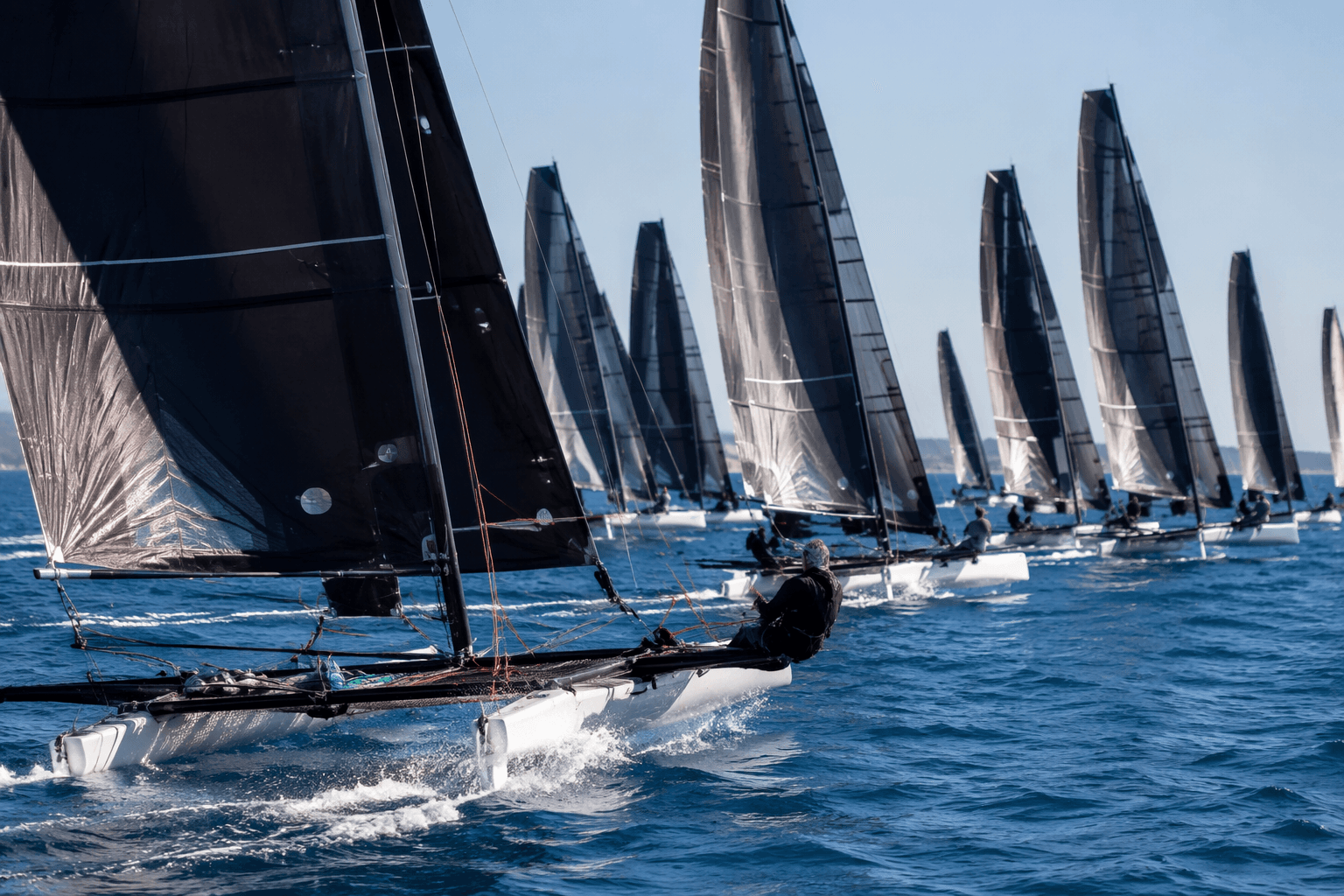
US F18 says the class’s current shape comes from growth and development since its founding in 1985, and describes today’s boat as both fast and sophisticated and also a very stable platform. That combination explains the class’s reach across professionals, club racers, and recreational weekend sailors. You get the appeal of a serious race boat without needing a fragile or overly specialized platform to enjoy it.
That stability is part of why Formula 18 works as a category for buyers. A boat that is fast but still stable can be easier to campaign across a season, and a rule set that keeps boats comparable helps older hulls stay relevant longer. The class’s box rule does not erase differences between boats, but it narrows them enough that used inventory remains meaningful and upgrades can be planned with intention.
The championship structure gives the class its backbone
The international stage matters here too. The Formula 18 World Championship began in 2000, and the inaugural event was held at CVB Erquy in France. The International Formula 18 Class Association also maintains a Hall of Fame page for F18 World Champions, which gives the class a formal record of its champions and a shared history across fleets.
That championship structure does more than collect trophies. It gives sailors and builders a common benchmark, so technical changes and tuning gains are measured against a known global standard. In a box-rule class, that kind of continuity is what keeps innovation from drifting into chaos.
Why Formula 18 still makes sense for buyers and racers
If you are deciding where to put money and time in a catamaran campaign, Formula 18 offers a rare balance. The rules are tight enough to preserve close racing, but open enough to let multiple builders and rig choices coexist. Certification, measurement, and the class’s published instructions keep the fleet comparable, which is exactly what protects confidence in both racing and resale.
That is the quiet strength of Formula 18. It does not promise perfection through sameness; it preserves speed by making sure speed still has to be earned.
This article was produced by Prism’s automated news system from verified source data, official records, and press releases, then run through automated quality and moderation checks before publishing. The system is built and supervised by the people who set the standards it runs under. Read our full AI policy.
Did this article answer your question?