Hemisphere revisited, the 44.2-metre catamaran born from one owner's dream
Born from one owner’s circumnavigation dream, Hemisphere still defines the large sailing catamaran debate by pairing record-setting volume with real ocean range.
The brief that became the reference point
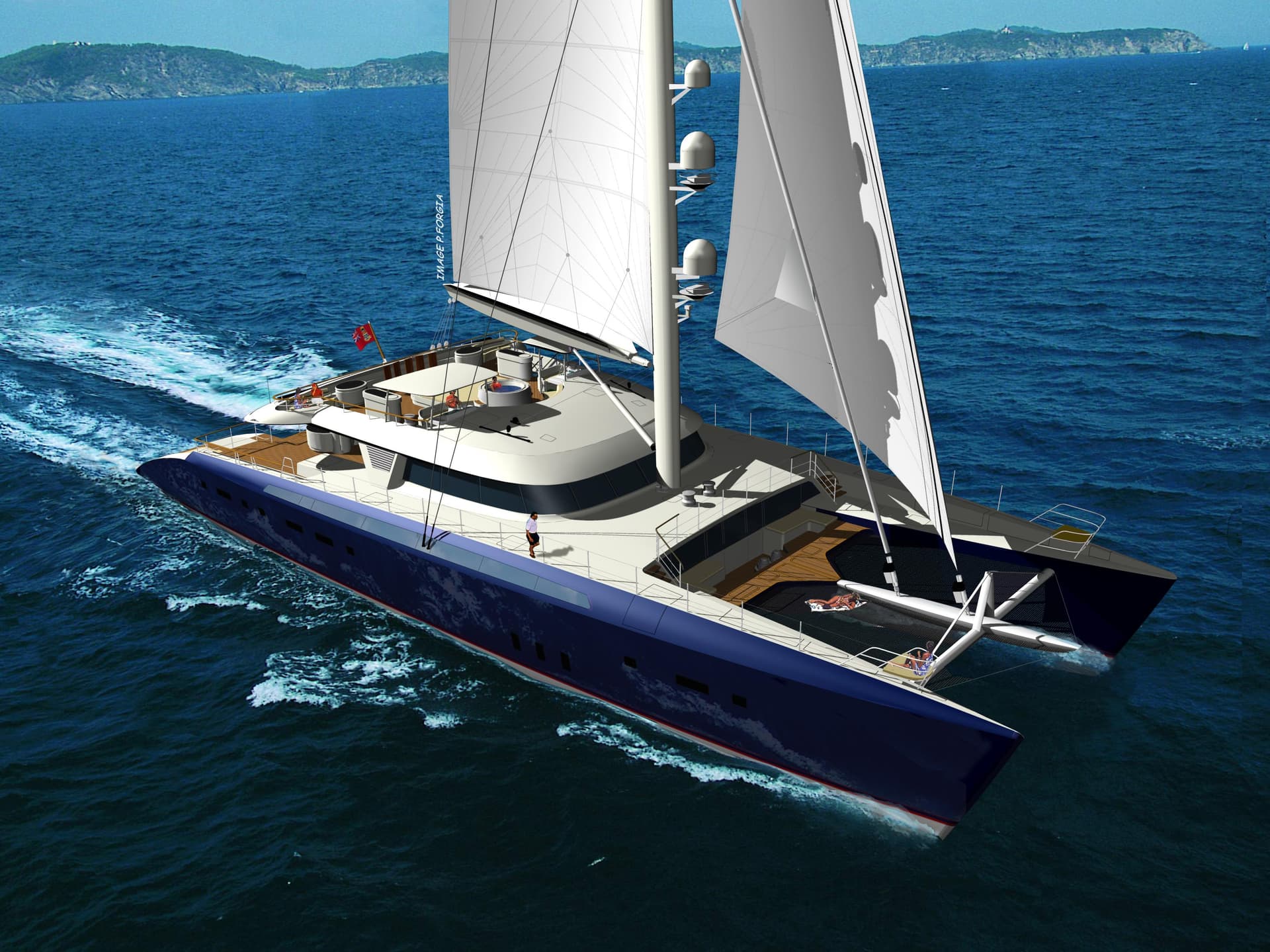
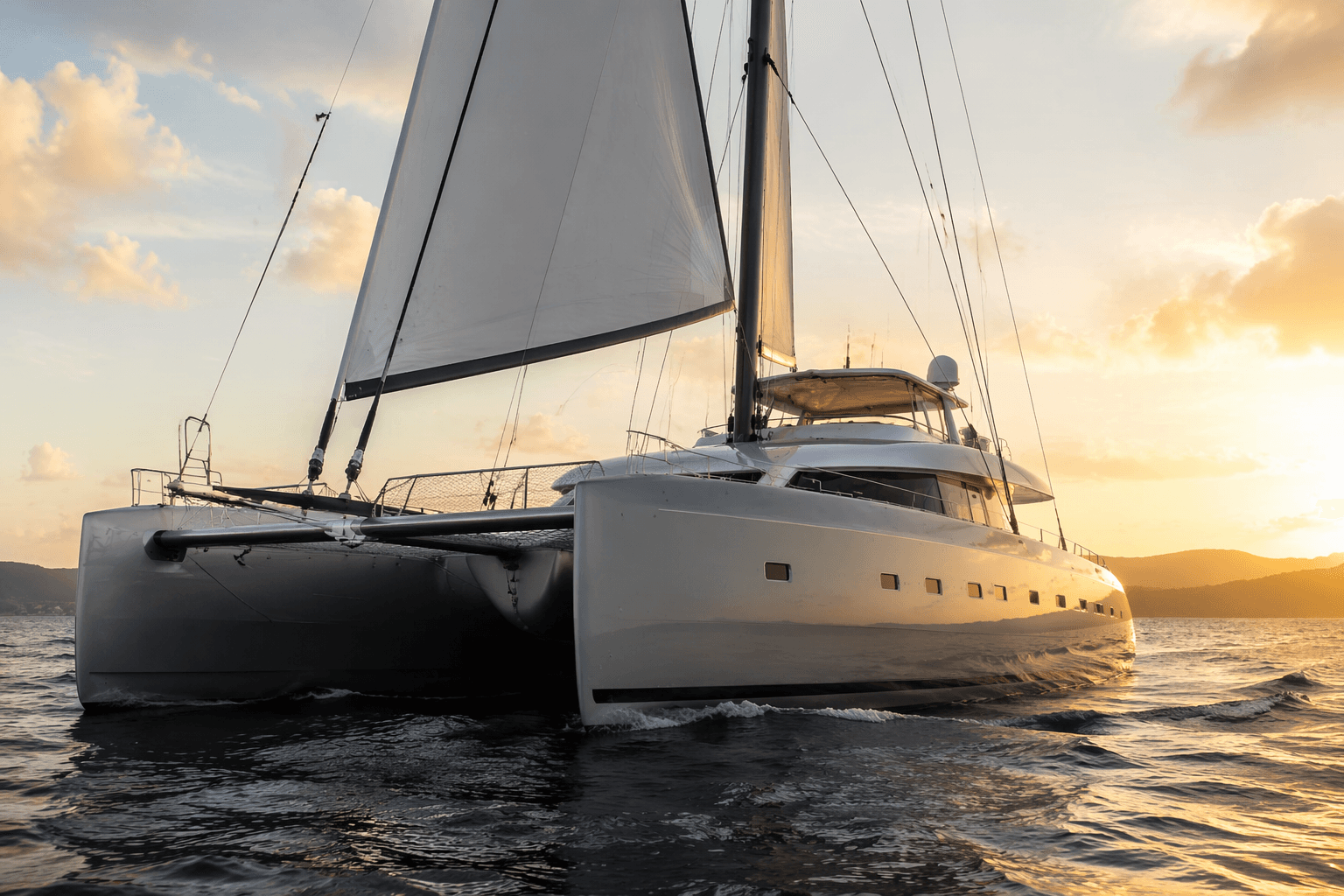
Hemisphere does not read like a yacht that was designed to fit a market. It reads like a yacht that bent the market around one owner’s dream: to sail the world without giving up the comfort, stability, and social space that only a catamaran can deliver. That is why the 44.2-metre Pendennis build still feels fresh in 2026, even after the launch parties, the Monaco debut, the awards, and the refits have long since become part of the boat’s legend.
The central question around Hemisphere has never really been whether she was big enough. It has been whether anyone has truly surpassed the combination she set in place, scale matched to purpose, rather than scale for its own sake. At 44.2 metres long, 16.6 metres wide, and 499 GT, she remains one of the most voluminous sailing catamarans afloat, and that balance of length, beam, and volume still gives her unusual staying power in a segment that keeps pushing for new superlatives.
A build shaped by one person’s vision
The project began in 2004, when the owner’s ambition was not a charter brochure or a showroom trend, but a circumnavigation. That single goal explains the unusually long design process and the level of customization that followed. Pendennis and the owner were not simply specifying accommodations and performance targets, they were building a platform meant to cross oceans, host life aboard, and do so with the calmness that catamarans promise but few deliver at this scale.
Finding the right naval architect took three months, and that search led to VPLP in Paris, where Marc Van Peteghem and Vincent Lauriot-Prévost became central to the project. Gavin Bladen, who has been with Hemisphere since her birth, then relocated from the Caribbean to Paris for a year and a half to work alongside the designers. That detail matters because Hemisphere was not a passive commission, it was a deeply collaborative build, shaped by constant refinement rather than fixed assumptions.
Why the hull still matters
In a market where large multihulls now compete on every possible metric, Hemisphere still stands out because she was conceived as an expeditionary private yacht first and a statement piece second. The boat offers genuine ocean range, privacy, and broad social spaces without surrendering the level sailing platform that makes catamarans so appealing in the first place. Many newer flagship multihulls chase the same blend of comfort and performance, but Hemisphere remains the reference point because she proved that the concept could be executed at serious superyacht scale.
That is the market lesson her story keeps teaching. Large sailing catamarans are not just volume machines, and Hemisphere was built to make that point unmistakable. Her sheer dimensions matter, but what matters more is the discipline behind them, a long design arc, a bespoke brief, and a platform intended to move comfortably through real water, not only through renderings and dockside conversations.
From UK sea trials to Monaco attention
By the time Hemisphere entered sea trials in the United Kingdom, SuperYacht Times was already describing her as the world’s largest luxury sailing catamaran, a title supported by her 44.2-metre length and just-under-500 GT volume. Delivery was expected in late July, and the buildup made clear that this was more than a yard milestone. It was a record-setting arrival.
When she appeared at the Monaco Yacht Show in 2011, the reaction confirmed the scale of the moment. SuperYacht Times described her as a VPLP-designed and Pendennis-built 44-metre sailing catamaran, and noted the broad response to Michael Leach’s elegant, spacious interior. The yacht’s Monaco debut was not simply a reveal, it was the moment the industry had to decide how seriously to take large sailing catamarans as a luxury category.
Recognition that outlasted the launch cycle
Pendennis launched Hemisphere in 2011 as the world’s largest privately owned sailing catamaran, and the yard has described that launch as one of the most unique and imposing in its history. The celebration in Falmouth underscored how much the yacht meant not only to the owner and the team, but to the local maritime community as well, with fireworks over the harbor marking the occasion.
The project’s design credentials were then sealed at the ShowBoats Design Awards 2012, where Hemisphere won both an Interior Layout Award and an Interior Design Award. Those honors matter because they confirm what Monaco had already suggested: the boat’s appeal was not only in size, but in the way the interior made that size feel usable, gracious, and properly resolved.
A yacht that keeps returning to the yard
Hemisphere returned to Pendennis for refit in November 2022, a reminder that the relationship between builder and yacht did not end at delivery. The vessel’s continued connection to the yard speaks to the care required by a project of this scale, and to the fact that landmark custom builds often live longest when the original team remains part of their story.
That continuity is part of Pendennis’s wider identity as well. The yard says it has completed more than 350 refit projects and over 30 custom builds overall, and Hemisphere sits squarely in the overlap between those two worlds. She is both a showpiece and a working yacht, the kind that needs periodic renewal precisely because she was built to be used hard and used well.
What charter listings reveal today
Current charter listings describe Hemisphere as accommodating up to 12 guests in five cabins, with a crew of 10. They also note a 2023 refit, a deck jacuzzi, and a shallow draft that opens access to harder-to-reach anchorages. Those details are revealing because they show how the yacht’s original vision still translates into practical appeal, not just archival prestige.
That is the part of the Hemisphere story the market has still not fully surpassed: the sense that a large sailing catamaran can be both a true voyaging machine and a remarkably civil place to live aboard. New flagship multihulls may be sleeker, flashier, or more aggressively optimized, but Hemisphere still sets the reference point because she was born from one owner’s dream and finished as a complete answer to it.
When she first drew attention in Falmouth and later in Monaco, the industry was seeing a record. Years later, it is still seeing the same thing, only with more context: a yacht whose scale made sense because the mission came first.
This article was produced by Prism’s automated news system from verified source data, official records, and press releases, then run through automated quality and moderation checks before publishing. The system is built and supervised by the people who set the standards it runs under. Read our full AI policy.
Know something we missed? Have a correction or additional information?
Submit a Tip