Lagoon links catamaran cruising to ocean protection on World Ocean Day
Lagoon used World Ocean Day to turn reef restoration into a measurable sales promise, not a slogan, with donations from every delivery funding coral work.
Lagoon chose World Ocean Day to make a blunt point: catamarans are not just about space, stability and bluewater comfort, they also come with a responsibility to the waters owners cross. In a June 2, 2026 message, the brand tied its ocean message to Coral Guardian, a French nonprofit founded in 2012, and to a donation model that sends money from every catamaran delivered into coral work. That puts this firmly in the realm of an ongoing program, not a one-day brand pose.
The timing matters. World Ocean Day’s 2026 action theme, Strong Marine Protected Areas for Our Blue Planet, is built around the 30x30 conservation goal and the High Seas Treaty, and the day itself has been building momentum since 2002 and has been officially recognized by the United Nations since 2008. The reef angle is the right one for a catamaran story because coral reefs cover less than 1% of the ocean floor but support about 25% of all marine creatures, which is exactly why they keep showing up in serious ocean protection campaigns.
Lagoon says its partnership with Coral Guardian had already helped restore more than 5,000 corals by June 2026, with the heaviest work centered on Hatamin reef in Indonesia’s Coral Triangle. Lagoon’s own December 2025 update said roughly 1,600 corals were replanted in the previous year and 3,543 more in the first half of 2025. Coral Guardian says it began restoring reefs around Hatamin Island in 2015 with the local NGO WES, and that the area was declared a Marine Protected Area in September 2019 at the organization’s request. That is the sort of detail owners can actually judge, because it shows where the money went and what changed on the water.
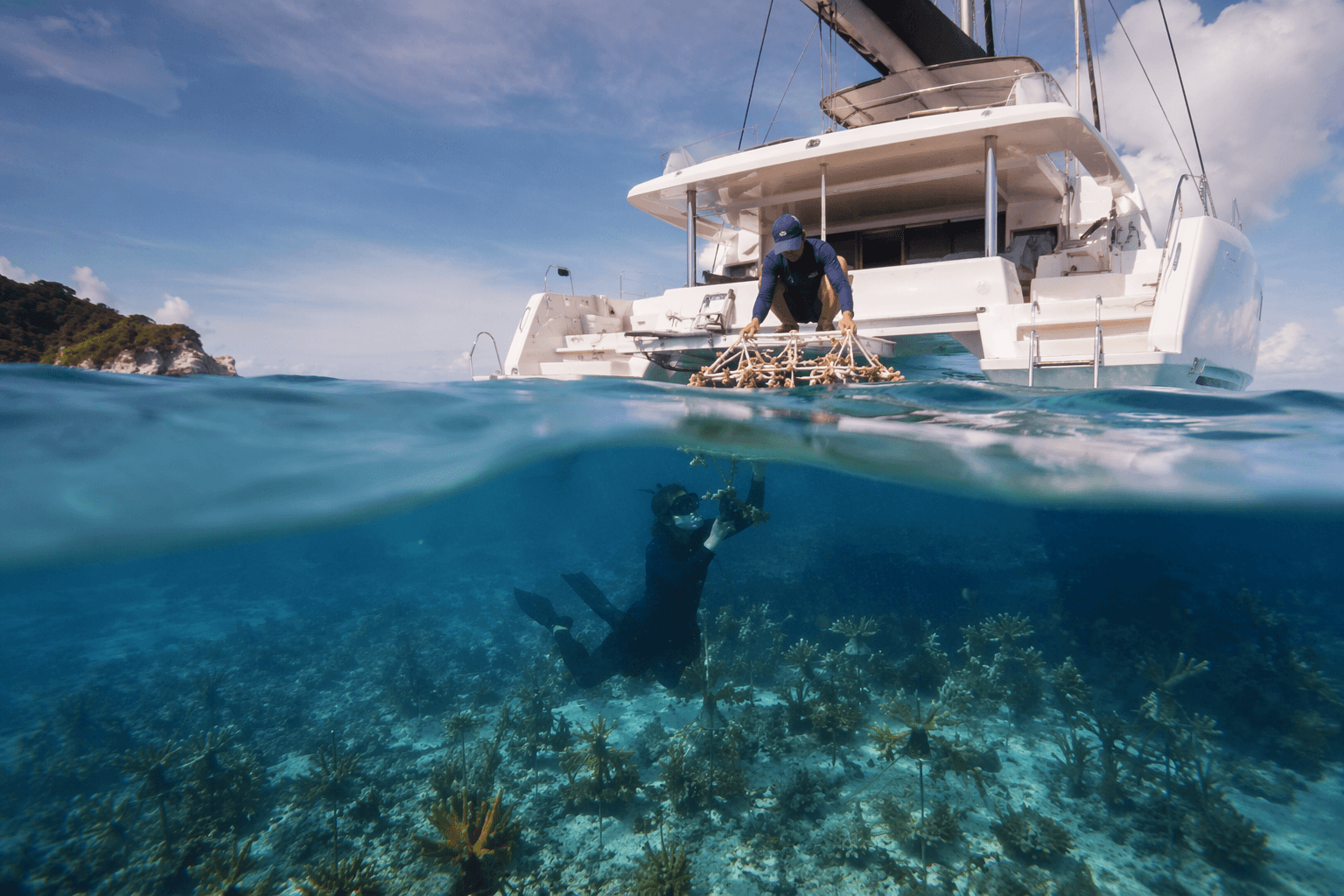
The charity’s reach is not limited to Indonesia. In Kenya, Coral Guardian says its REEL Kilifi project began in early 2024 with the Oceans Alive Foundation in the 12,000-hectare Kuruwitu coastal co-management area. The group says local coral protection there helped restore 30% of reefs and recover 400% of fish biomass, a reminder that reef repair is not just an ecological talking point, it can also affect fishing livelihoods in Kilifi County and beyond.
Lagoon folds that work into a broader Sailing for Change program that includes bio-sourced resin, 80% recycled fibreglass on the EIGHTY 2, ISO 14001 and ISO 50001 certifications at production sites, onboard solar panels, an eco-responsible kit delivered with every catamaran, and the NEO refit program for extending the life of older boats. On the numbers, this is more than a logo exercise. For owners, the real question is whether a Lagoon purchase now comes with a built-in stewardship lane, and Lagoon is making the case that it does.
This article was produced by Prism’s automated news system from verified source data, official records, and press releases, then run through automated quality and moderation checks before publishing. The system is built and supervised by the people who set the standards it runs under. Read our full AI policy.
Know something we missed? Have a correction or additional information?
Submit a Tip