Horizon prepares accessible PC68 catamaran with elevator and wheelchair access
Horizon’s PC68 is getting an elevator and wheelchair access, turning a familiar powercat into a practical test case for inclusive luxury aboard.
A different kind of PC68
Horizon Power Catamarans is turning its PC68 into something the premium multihull market still rarely sees: a yacht built with an elevator and wheelchair access as part of the design brief. That is a bigger shift than a single spec upgrade. It changes how people move through the boat, how they board, how they reach the main living spaces, and how confidently they can use a large yacht day after day.
For a brand that has made its name on owner-friendly layouts and easy circulation, the move feels like a logical next step. The PC68 is already one of the most substantial members of Horizon’s PC family, and now it is being asked to do something that speaks directly to modern cruising life: welcome more kinds of owners, guests, and family members without making anyone feel like they are working around the boat.
From charter roots to a larger idea of comfort
That instinct did not appear overnight. Richard Ford’s route into the business ran through charter work, first in the Caribbean and then alongside Leigh Ford. By 1986 he was working in charter, and by 1989 the two were operating together in the Caribbean, at a moment when catamarans were gaining ground as owners moved away from monohulls and toward boats that offered more space, more stability, and easier social living.
That background still shapes Horizon’s boats. The company’s history is rooted in practical cruising rather than flash for its own sake, which helps explain why Horizon powercats tend to emphasize living volume, straightforward movement, and layouts that work for real owners instead of only for showroom appeal. The fact that Horizon has now passed the $300 million mark in sales says just how far that approach has traveled.
Why the PC68 matters inside the Horizon line
The PC68 sits in a PC series that currently runs from the PC52 through the PC74, and Horizon describes that line as designed for owner operation while carrying features more often associated with much larger motor yachts. That combination matters here, because accessibility only becomes meaningful when it is built into a boat that still feels like a true luxury cruiser, not a stripped-down special project.
The PC68’s standard appeal is already broad. Horizon says the model offers a four-stateroom layout, with either an expansive open-plan salon or an on-deck master stateroom. It also includes an extended flybridge, a Portuguese deck seating area, and a folding stern section on the aft deck. Those are not decorative extras. They shape how people gather, how crew and guests circulate, and how much of the yacht feels usable at anchor, underway, or tied up for a long weekend.
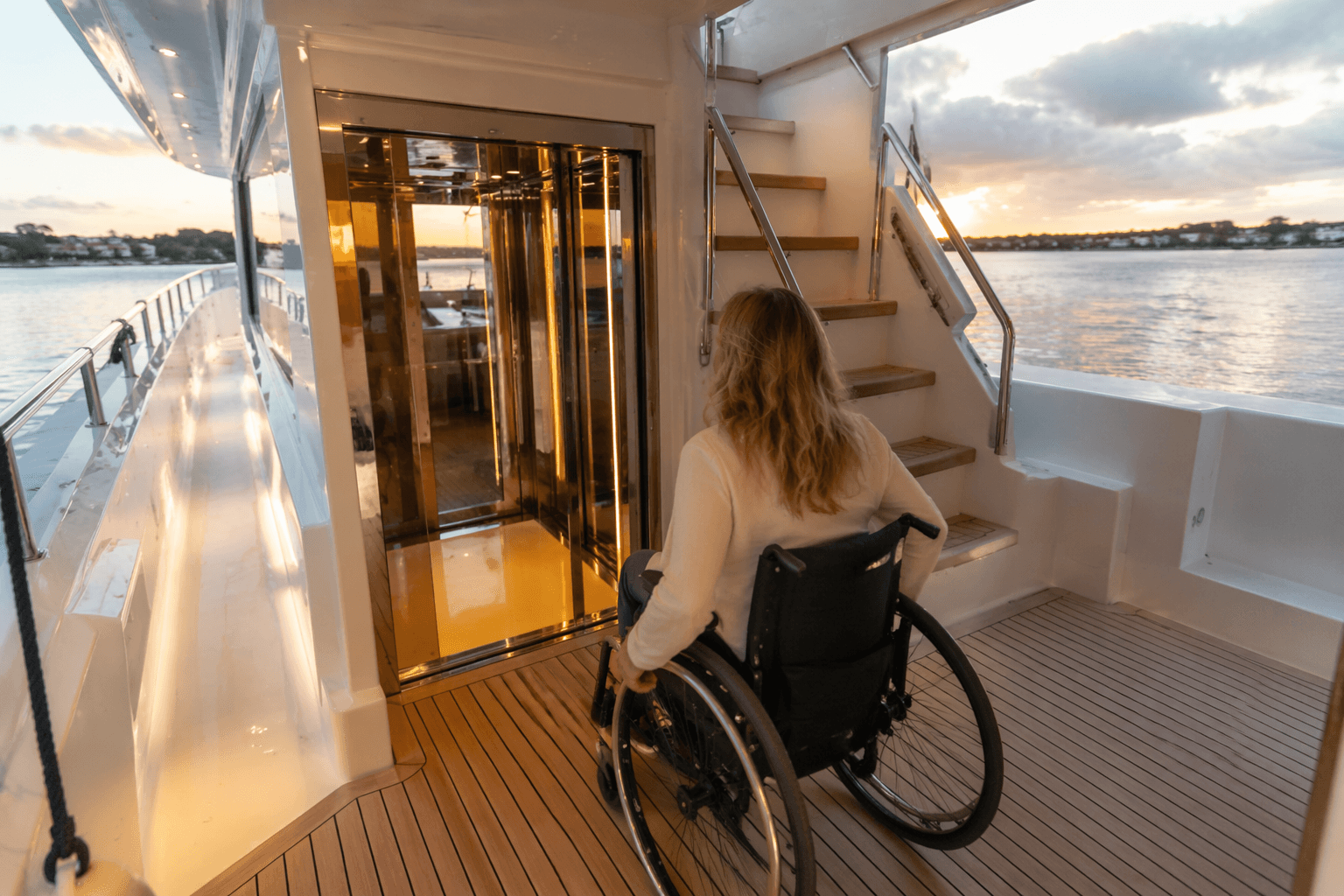
That is why the accessibility version is so interesting. An elevator and wheelchair access do not replace the familiar Horizon formula. They build on it, making the same generous interior plan reachable to a wider range of people and changing the daily rhythm aboard in concrete ways. Getting from deck to deck becomes less of a physical obstacle, boarding becomes less stressful, and movement through the yacht stops being defined by steps and thresholds.
What changes aboard when access is designed in
On a yacht like the PC68, accessibility is not just about one device or one doorway. It affects the whole experience of ownership. The elevator can turn what would otherwise be a vertical obstacle into a simple transition between levels, which matters on a boat built around multiple living zones. Wheelchair access changes the meaning of the salon, the flybridge, and the master accommodations because those spaces can now be part of the same uninterrupted flow.
That is where the value goes beyond compliance or novelty. A premium catamaran often sells the dream of easy, open living. An accessible PC68 makes that promise more literal. It creates a boat that can accommodate aging owners who want to stay on the water longer, multigenerational crews where one guest may have limited mobility, and couples who want to future-proof their cruising without giving up comfort or customization.
It also changes safety. A yacht designed for better movement is easier to use in motion, easier to navigate at dock, and easier to adapt when conditions are less than ideal. Wider access and a clearer path between spaces can reduce the feeling of negotiating the boat and replace it with something closer to normal, confident movement.
The show history that built the platform
The PC68 is not arriving in a vacuum. Horizon first showed the model at the 2023 Fort Lauderdale International Boat Show in offsite private viewing, and that same show drew more than 100,000 guests. The first on-deck master PC68 then made its worldwide debut at the 2024 Palm Beach International Boat Show, reinforcing the idea that Horizon has been using major events to test how far the platform can be pushed.
That matters because the PC68 has become a kind of proving ground for the line. Horizon says the popularity of the PC68 helped inspire the Portuguese Deck option later added to the PC60, which is a useful clue about how the company develops its designs. The PC68 is not just a single model. It is a reference point that feeds back into the wider range.
The same show circuit also tells a story about Horizon’s growth. In 2021, the company sold its 50th PowerCat yacht at the Fort Lauderdale International Boat Show, a milestone that also marked Horizon’s 10th Fort Lauderdale Boat Show anniversary. The brand that once used those events to establish its presence is now using them to refine the next phase of its design language.
What the accessible PC68 signals for the market
Accessible yacht design is still a niche in the broader market, but it is no longer invisible. Brokers and builders are increasingly marketing elevators, wheelchair-accessible layouts, and lift platforms as features that widen the circle of who can cruise. Academic and technical work on yacht accessibility has also shifted the conversation toward universal design and inclusion, which is a more ambitious idea than simply adding an accommodation after the fact.
That is what makes this PC68 worth watching. Horizon is not only adding access features to a big catamaran. It is testing whether a premium powercat can be both highly custom and genuinely inclusive, with the kind of liveability that serves owners over time instead of only on the first day aboard. The message from the PC68 is clear enough: the next standard in luxury multihulls may be measured not just by speed, beach clubs, or lounges, but by how completely the boat opens itself to the people who want to live on it.
The PC68 already represented Horizon’s blend of volume, customization, and owner-friendly design. With an elevator and wheelchair access, it becomes something more revealing, a sign that the future of premium powercats may belong to boats that make movement as thoughtful as the interiors themselves.
This article was produced by Prism’s automated news system from verified source data, official records, and press releases, then run through automated quality and moderation checks before publishing. The system is built and supervised by the people who set the standards it runs under. Read our full AI policy.
Know something we missed? Have a correction or additional information?
Submit a Tip