How to anchor a catamaran yacht safely in strong wind
A catamaran needs a different anchor routine than a monohull: set the bridle, control yaw, and give the beam room to swing. On Dragonfly, that is what keeps strong-wind nights quiet and foul-free.
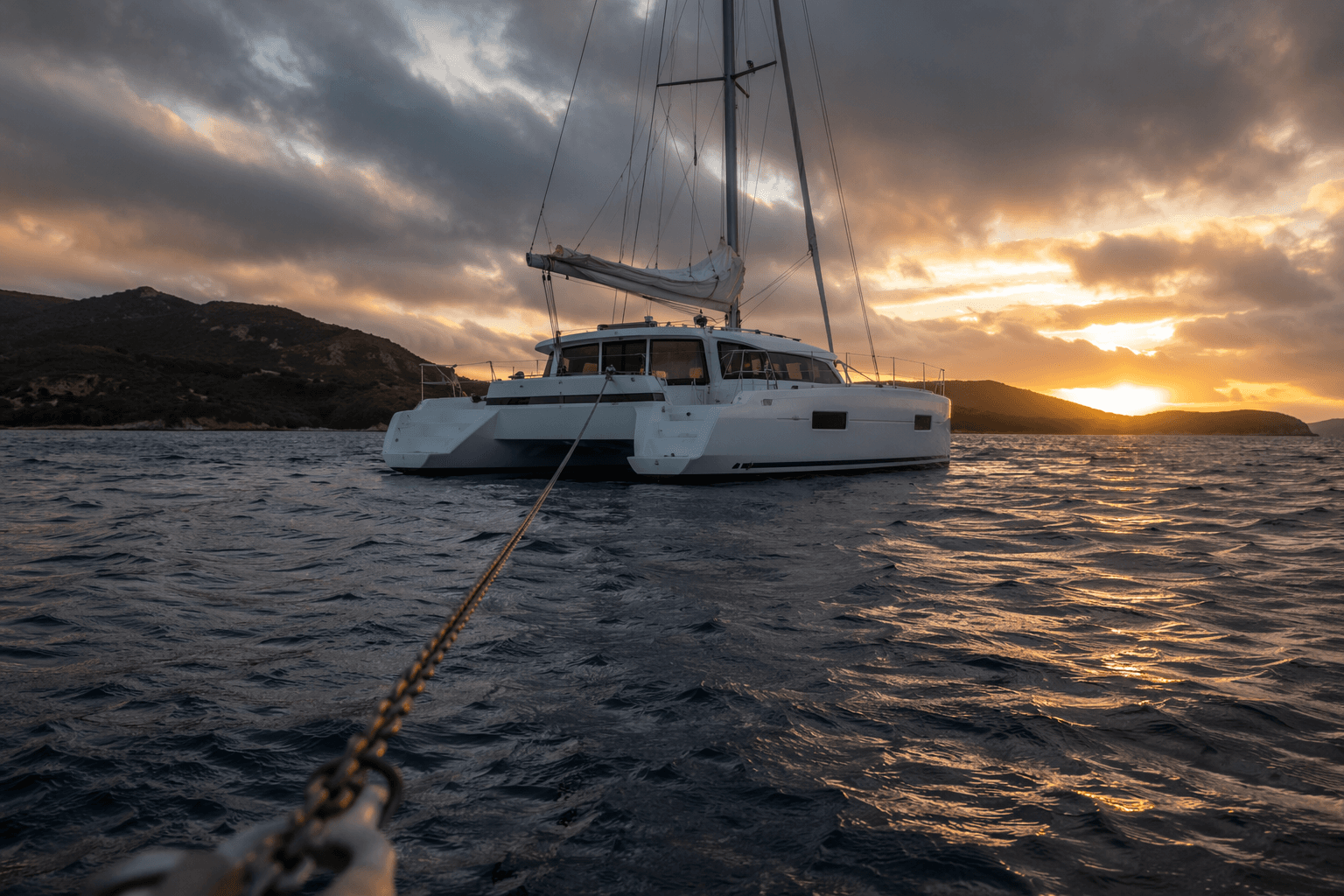
Dragonfly, a 41-foot Catana, settles best at anchor with its bow held on a bridle rather than left to sheer on the chain alone. The workable routine is simple but specific: pick a protected anchorage with room to swing, set the anchor while moving slowly in reverse, and let the bridle keep the bow centered when the wind starts loading the boat.
Why a catamaran needs its own anchor routine
The basic idea is familiar, but the loads are not. Catamarans have high topsides and shallow draught, so windage matters much more than it does on a monohull, and a cat can swing around completely differently at anchor or on a mooring buoy. The same boat that feels locked in once the anchor bites can also veer, sail around the anchor, or yaw hard if the setup is wrong.
The right approach is not to treat a cat like a monohull, but to play to the boat’s strengths. Cats are famous for shallow-water access, stability, and roomy living space, and bluewater-cruising multihulls can spend up to 90% of their time at anchor, so the anchoring routine gets repeated enough that small mistakes become expensive ones.
Build the ground tackle as a system
Anchor gear has to work as a complete system, and that matters even more on a wide-beam boat. On Dragonfly, the setup includes 200 feet of 3/8-inch chain and a Lofrans Cayman 88 windlass, with a cloth runner laid where the chain crosses the trampoline so it does not chew up the deck gear. The point is not just to have hardware on board, but to make the chain, windlass, and deck protection work together cleanly.
Anchor choice matters, but not in the old oversized-everything way. Modern-generation anchors have made anchoring simpler and safer than the old CQR-era standard, and Multihulls World's benchmark for many modern 35 lb, 15 kg anchors is a steady pull of a couple of tons. The useful distinction for cat owners is that steady load is usually manageable if the system is set correctly, while motion, snatch loads, and yaw are what start the trouble.
Set the boat up before the pull comes on
The launch sequence starts before the anchor touches bottom. Choose a protected anchorage with enough swinging room, and make sure the cat has beam clearance as well as depth clearance, because a wide boat does not just sit in one place, it occupies a broad arc as it moves. On a cat like Dragonfly, the two hulls and bridge deck change the load path, so the rode and bridle need room to settle without rubbing, twisting, or crossing themselves.
From there, the drop is done in slow reverse. On a twin-engine cat, the boat can be turned by using the engines in opposition, but at very low speed the rudders do very little, and Yachting Monthly puts efficient rudder operation at more than 2 knots. That is why helm-and-bow communication matters so much during the set: the person at the bow needs to pay out rode at the right pace while the helm keeps the stern lined up and the load smooth.
A practical deployment sequence looks like this:
1. Hold the cat in a protected spot with room to swing.
2. Begin the drop while moving slowly astern.
3. Keep the chain running cleanly over the cloth runner.
4. Coordinate every adjustment between helm and bow.
5. Back down carefully until the anchor is firmly set, then watch for yaw or sideways movement.
Rig the bridle so the bow stays centered
The bridle is the piece that makes a catamaran feel like a catamaran at anchor. It stabilizes the bow, and multihulls have used bridles for decades mainly to reduce veering and take load off the windlass. On Dragonfly, the bridle is a Y-shape, with one leg led to each hull, made from 1-inch three-strand nylon with a stainless chain hook at the apex.
The dimensions matter. Each leg is about 13 feet long, which gives the system enough reach and elasticity to snub the motion instead of transmitting every jerk straight into the chain. Elasticity is the key to the snubbing effect, and thin, long nylon sections are the best way to get it. That stretch is what helps a cat ride more quietly, because the load is spread across the beam instead of being dumped into one point on the windlass or bow fitting.
Watch for yaw, not just raw wind strength
The main enemy at anchor is not steady pull alone. The three big effects for multihulls at anchor are windage, yawing or veering, and horsing. That is the reason a cat can look fine in a straight-line pull and still start misbehaving when the wind shifts, the swell builds, or the hulls start competing for space near the chain.
Backing down in strong wind is where the difference becomes obvious. Cats can turn sideways in these conditions in a way that is generally less of a problem on a monohull. Once that begins, the answer is usually not brute force. It is to correct the setup, reduce veering, and keep the load path smooth so the boat is not sailing itself around the anchor.
The reward is the reason people choose cats
Catamarans have become so popular for charter and cruising because they combine space, comfort, and shallow-water access, but that same breadth and lightness is why anchoring has to be handled with care. When the bridle is right, the scope is appropriate, and the site gives the boat room to move, the result is a quiet night, no chain drama, and no surprise fouls.
This article was produced by Prism’s automated news system from verified source data, official records, and press releases, then run through automated quality and moderation checks before publishing. The system is built and supervised by the people who set the standards it runs under. Read our full AI policy.
Know something we missed? Have a correction or additional information?
Submit a Tip