Outremer’s light, fast catamaran philosophy still defines its boats
Outremer’s 40-year test case shows why light hulls, low windage and offshore speed still sell. The 45, 52 and 57 keep proving the formula still earns miles and trophies.
Outremer’s catamarans still read like a stress test of a simple idea: make the boat light, narrow and fast, then let the miles prove the point. That formula began in June 1984 in La Grande-Motte, when Gérard Danson and Daniel Cailloux launched a 40-foot offshore cruising catamaran and built a brand around seaworthiness instead of excess volume. Four decades later, the same priorities still shape the range, from the easy-to-handle 45 to the award-winning 52 and the new 57.
The original brief still sets the tone
Outremer’s history starts with a practical problem, not a marketing slogan. Danson, then a young architect from the Conati shipyard, joined technician Daniel Cailloux to build a 40-foot sailing catamaran with lightness, fine hulls and reduced windage at the center of the design brief. The first boat made such a strong case for the concept that a second was ordered before the first had even launched, which helped turn Atelier Outremer into a real business rather than a one-off experiment.
That early credibility mattered because serious ocean cruising was still closely associated with monohulls. Outremer answered with boats that were not just comfortable enough to live aboard, but quick enough to win offshore races and tough enough to build a reputation beyond the Mediterranean. The yard now says nearly 400 Outremer catamarans have sailed the world’s seas since 1984, while Multihulls World puts the figure at more than 400 boats on the seas and oceans. Either way, the fleet is large enough to show that this was never just a niche designer’s idea.
Why light, fast and narrow still matter offshore
The core Outremer argument has barely changed: speed offshore is a safety margin, not a vanity metric. That belief still separates the yard from the heavier, more volume-driven direction that has defined much of the cruising cat market. Instead of building around the biggest salon or the widest hulls, Outremer keeps pushing the same three fundamentals it started with, and the result is a boat that is meant to keep moving efficiently when the weather turns.
That philosophy is also why the yard describes itself as a blue-water sailing world leader. Its mission is to give sailors security, peace of mind and support at every stage of the sailing project, aboard a seaworthy catamaran built to last. The message is clear: Outremer is selling passage-making confidence as much as it is selling a platform, and the design brief still reflects that promise in the way the boats sail, carry load and handle offshore miles.
The owner experience follows the same logic. From the beginning, build-to-order flexibility let buyers specify cockpit style, coachroof shape and engine installation. That kind of involvement has remained part of the brand’s identity, and it explains why Outremer owners tend to talk about their boats as sailing tools first and floating apartments second. The current lineup continues to favor custom accommodation and long-range efficiency over pure interior volume.
The range still carries the same DNA
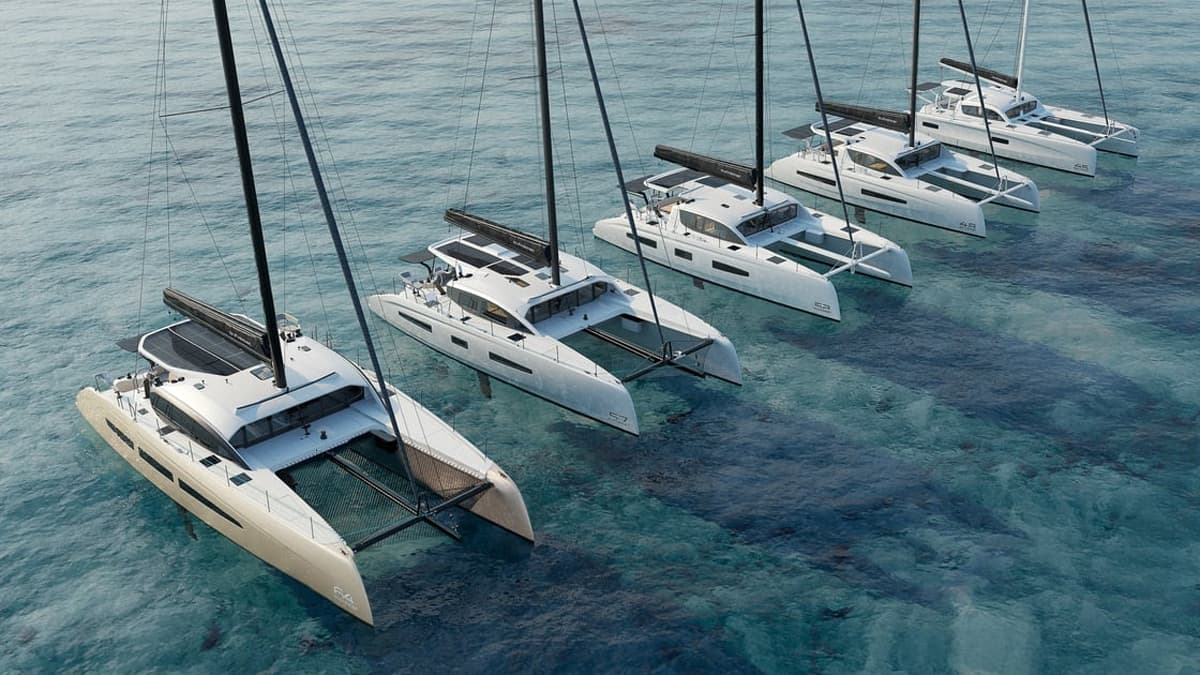
The present Outremer range runs through the 45, 48, 52, 55 and 57, and each model keeps the old priorities visible in a different way. The 45 is marketed as an easy-to-handle single-handed catamaran, with narrow hulls and light weight giving it the manners to be sailed without a large crew. That matters in real life, where the ability to reef, tack and manage the boat with fewer hands can shape the way a passage feels from the first watch to the last.
The 52 is the clearest expression of the modern Outremer pitch. The yard describes it as fast, light and responsive, with the ability to hold its averages without constant attention. That combination is exactly what long-distance sailors look for when they want a boat that keeps its pace without demanding constant correction at the helm. It also helps explain why the model has become one of the strongest ambassadors for the brand’s offshore identity.
The 57 pushes that same idea into a bigger platform, with Outremer presenting it as a new master of blue-water sailing based on the 55’s accumulated hundreds of thousands of miles of experience. The 48, unveiled at recent boat shows, extends the family’s reach further into the market while staying inside the same design language. Even as the sizes change, the message does not: these are still cats built to move, not to sit heavy at anchor as the default setting.
The best proof is still on the clock
Outremer leans hard on real-world results, and the numbers are useful because they show how the philosophy performs when the boat leaves the brochure. Roland Jourdain finished second in the 2022 Route du Rhum aboard Outremer 5X We Explore in 16 days, 5 hours and 51 minutes. Over 4,163 nautical miles, that passage averaged 10.68 knots, which is the kind of offshore pace that gives credibility to every claim about speed as safety margin.
The same idea showed up again in January 2024, when the Outremer 52 Awen completed an Atlantic crossing from the Canary Islands to Martinique in 16 days. That is a clean, understandable benchmark for cruising sailors, because it connects the boat’s offshore reputation to a passage type many owners actually dream about. It also reinforces why the brand’s story still resonates: the boats are not built to look fast, they are built to keep moving fast when the miles get long.
The awards have followed the sailing results. Outremer says the 52 won the British Yachting Award 2023 in the multihull category and European Yacht of the Year 2024 in the multihull category. Those titles matter because they validate the same balance the brand has been chasing since 1984, performance without giving up the liveability and support that blue-water buyers need. In a market crowded with bigger lounges and more hotel-style interiors, Outremer still stands apart by treating a catamaran like a serious sailing machine first, and that is exactly why its formula still has a market.
This article was produced by Prism’s automated news system from verified source data, official records, and press releases, then run through automated quality and moderation checks before publishing. The system is built and supervised by the people who set the standards it runs under. Read our full AI policy.
Know something we missed? Have a correction or additional information?
Submit a Tip