How to sail a catamaran, from crew position to spinnaker handling
Catamaran sailing rewards a different skill ladder, where crew placement, balance, and spinnaker control matter as much as wind angle. Start with the boat’s twin-hull behavior, then build toward confident multihull handling.
Most multihulls have two hulls, sometimes three, and their stability and light weight make them fast and exhilarating from the first shove off the dock. They also differ enough from monohulls to demand slightly different techniques. The smartest progression is not “learn to sail a boat,” but “learn what this boat rewards next.”
What changes the moment you step aboard
The first adjustment is mental as much as physical. A catamaran is built to stay flatter than a monohull, so the old habit of waiting for heel as a signal is less useful than watching speed, balance, and crew movement. Most multihulls are designed for two people, though some are sailed single-handed, so coordination is central to the platform from the start.
That two-person bias shapes the whole learning curve. One person cannot treat the cat like a simple big dinghy, because helm, sheets, and weight placement all interact quickly when the boat accelerates. On a cat, the crew’s job is to keep the platform settled, keep the flow clean, and move with purpose before the boat punishes delay.
Crew position comes first
On a catamaran, where you sit matters because the boat’s stability comes from beam and hull form, not from standing the boat on its ear. Early practice should focus on where the crew sits during acceleration, in lighter air, and when trimming through waves or gusts. The goal is to keep the boat squarely on its lines so the rudders and sails stay efficient instead of fighting each other.
That is also where catamaran handling starts to feel faster than monohull sailing. You are not constantly managing heel, but you are managing momentum, apparent wind, and how quickly the boat answers to movement. The RYA’s multihull training path runs “through everything you need to know,” starting with crew position.
Tacks and gybes: the first real multihull tests
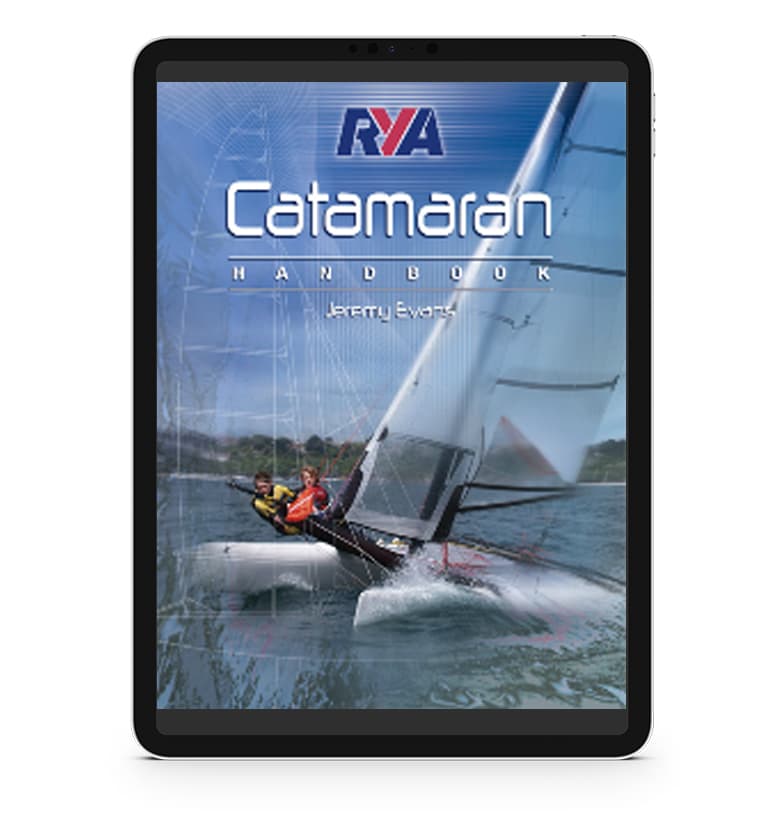
The RYA Catamaran Handbook centers safety, planning, tacking, and gybing, in that order. On a cat, a tack is not just a turn through the wind; it is a coordinated shift of weight, sheets, and attention so the bows do not lose pace and the boat does not stall awkwardly. Because multihulls have different stability characteristics from monohulls, the timing of that crew move is a real part of the maneuver, not decoration.
Gybing demands even more discipline. The boat’s wider footprint and speed mean the turn can carry more energy, so the crew has to be ready before the boom comes across and before the new leeward side loads up. The safest way to build confidence is to treat each tack and gybe as a repeatable sequence, not a single dramatic event.
Why speed management is part of seamanship
Performance on a catamaran is not only about going fast. The RYA’s Multihull Performance Sailing course covers boat handling and confidence on all points of sail, including hiking effectively, trapeze work, and spinnaker handling. The faster the boat, the more every handoff between helm and crew matters.
That also explains why sailors moving up from monohulls often find performance cats more demanding than they expected. The jump to a performance multihull can be a leap even for experienced cruisers because the platform rewards cleaner technique instead of brute familiarity.

Spinnaker work is its own discipline
The spinnaker module in the RYA pathway covers rigging, hoisting, gybing, and dropping a spinnaker on a multihull, making clear that the sail is a core handling skill. On a cat, that means the crew has to know where the sail loads, who owns each line, and how to keep the boat stable while the sail fills or comes down.
This is where catamaran teamwork becomes impossible to fake. The helm needs eyes on boat angle and pressure, while the crew needs to be ahead of the hoist, the gybe, and the drop. The best practice is deliberate repetition, because the multihull’s pace gives you less time to recover from a missed step than a slower boat would.
Cruising cats and performance cats are not the same school
The cruising side of multihull sailing has its own track. US Sailing’s Cruising Catamaran Endorsement uses a catamaran of at least 34 feet with wheel steering and twin-engine auxiliary power, and it requires Bareboat Cruising certification before you even get there. Close-quarters control, engine handling, and systems awareness are part of the modern cruising-cat skill set, not just sail trim.
US Sailing’s instructor evaluation for that endorsement also takes place aboard a catamaran of at least 34 feet and includes maneuvering with one or two engines. That emphasis differs from the RYA’s sport-oriented multihull progression.
Safety sits underneath every advanced move
Multihull safety is not an afterthought, because the platform behaves differently under load. A University of Southampton paper found that multihulls have very different stability characteristics from monohulls and that normal stability-assessment methods are not appropriate. US Sailing’s multihull safety rules also reflect that reality, including nets or trampolines between the hulls in coastal requirements.
For longer races, the consequences become sharper still. US Sailing defines ocean multihull races as long-distance events where rescue may be delayed.
A modern boat with old roots
The catamaran may feel like a high-tech modern machine, but its idea is old. The design traces to raft forms used in the Indonesian archipelago and throughout Polynesia and Micronesia. Early catamarans were used for visiting, war, and exploration, with sail-powered voyages of more than 2,000 miles. In the second half of the 20th century, the boat evolved into the sport and recreation craft sailors know today.
The platform was built for efficiency, range, and purpose long before it was built for weekend racing or owner-cruising. The Tornado class, created in 1967 to be the fastest racing catamaran for Olympic competition, pushed that performance identity even further.
This article was produced by Prism’s automated news system from verified source data, official records, and press releases, then run through automated quality and moderation checks before publishing. The system is built and supervised by the people who set the standards it runs under. Read our full AI policy.
Did this article answer your question?