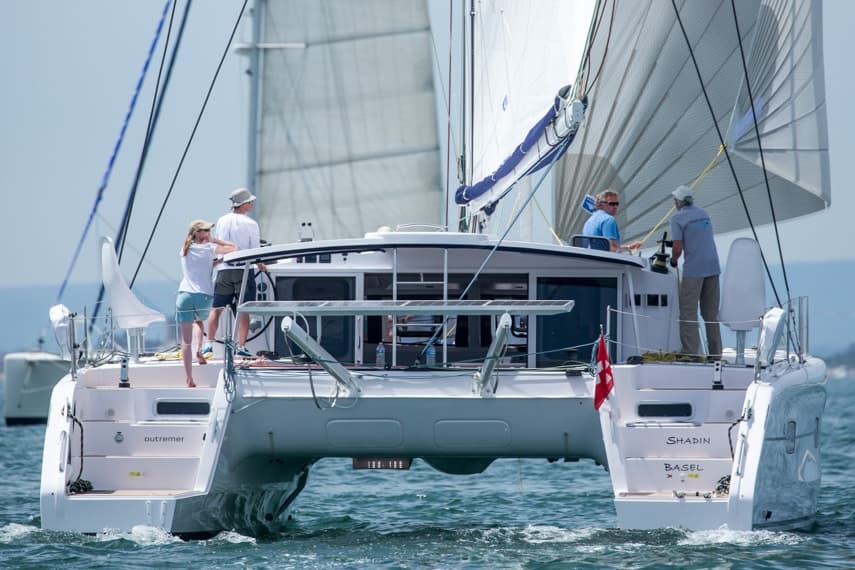
Outremer 45 crew battles wind and current off South Africa
South Africa makes the passage plan the star, with current, weather windows and boat speed deciding whether an Outremer 45 has a safe run.

The 800-mile run from Richards Bay to Cape Town is not a sightseeing leg, and the crew aboard Ilovent make that plain by the way they talk about it. Fabienne and Jean-Charles are dealing with a coast where the wrong departure window can turn a fast catamaran into a liability, not an advantage. On this stretch, routing, forecast discipline and speed management are not background details, they are the passage.
The coast decides whether speed helps or hurts
Ilovent, an Outremer 45, is averaging about 150 miles a day, or roughly 6.25 knots, which sounds comfortable until the South African coastline starts throwing current and wind against each other. Low-pressure systems can sweep through every two to five days, so the crew is never really planning for calm water so much as trying to stay ahead of the next change. The Agulhas Current is the hard reality underneath it all, commonly running around 4 to 5 knots and sometimes reaching 6 knots, which means a good boat speed alone does not guarantee an easy passage.
That is the first lesson for performance-cat sailors: speed is only useful when it is aligned with the ocean state. On a coast like this, a cat that can make miles quickly still needs to know when not to go, because the sea can get steep and confused very fast when wind and current oppose each other. This is where the Outremer 45 story becomes practical rather than dramatic, because it shows how a fast platform still depends on conservative route timing.
Wind-against-current changes everything
The most revealing detail from the passage is not the distance, but the kind of water the crew had to face. They describe one stretch with 4 knots of current and 20 knots of headwind, a combination that produced 10-foot waves and a real fear that something would break. That is the kind of setup that catches out even capable crews, because the problem is not just wave height, it is the shape of the sea, with short, near-vertical faces and the chance of rogue waves forming in ugly conditions.
Noonsite describes the Richards Bay to Cape Town coast as one of the most dangerous in the world for yachts, and that reputation makes sense when you look at the mechanics of the route. The south coast is not a long, relaxed coastal hop. It is a corridor where a few bad hours can matter more than a whole day of competent sailing, which is why passage planning has to be built around weather windows instead of fixed intentions.
For catamaran crews, that means a few hard rules apply:
- Treat current as a moving part of the forecast, not a constant.
- Leave only when wind direction, current and sea state line up in your favor.
- Assume that a fast average pace can hide dangerous individual hours.
- Plan for the worst water, not the best-looking headline number.
Use the South African port network deliberately
The coastal stops themselves matter because each port is part of the safety system. OSASA lists Richards Bay, Durban, East London, Gqeberha/Port Elizabeth, Mossel Bay, Cape Town, Saldanha Bay, Knysna, Hout Bay, Gordon’s Bay and Simon’s Town/False Bay, and that list is a reminder that this coast works best when it is broken into deliberate, well-supported stages. The goal is not to collect harbors, but to choose the next port with enough margin to avoid forcing a bad weather call.
That same network also explains why local knowledge is such an important part of the passage. Richards Bay has established yacht support, while yacht clubs and marinas farther south provide berth advice, paperwork and clearance help. On a demanding coast, the right stop is not always the prettiest one, it is the one that lets you reset safely, check the next weather window and leave with a clean plan.
Passage planning is part of the seamanship, not paperwork
OSASA, the Ocean Sailing Association of Southern Africa, was formed in 2020 during the COVID-19 restrictions after negotiations with the South African government. Its role matters because it turns the South African cruising chain into a managed system rather than an improvised one. The association’s guidance says most clubs and marinas require a passage plan for the next port before departure, and that is exactly the right mindset for this coast: the route is safer when the next decision is already on paper before lines come off.
OSASA’s guidance also says cruising yachts can move along the South African coast without repeated Immigration or Customs calls after clearance, but they still need the required paperwork and passage plans. That detail is easy to overlook, yet it changes how you think about the leg. The paperwork is not separate from the voyage, it is part of the voyage, because the authorities, yacht clubs and marinas are all working from the same assumption: offshore decisions and shore-side coordination have to match.
South African Weather Service support fits into that same picture. SAWS runs dedicated marine forecasts for deep sea and coastal ocean phenomena throughout METAREA VII, and its marine portal provides forecasts, observations and current data for the region. On a coast where low-pressure systems can arrive every few days and the Agulhas Current can punish a late departure, that data is not optional background reading. It is the backbone of the plan.
What an Outremer 45-style passage plan should prioritize
The Outremer 45’s South Africa leg shows how performance-cat cruising should be managed when the coastline stops forgiving mistakes. The lesson is not to sail slower for the sake of it, but to sail with enough discipline that speed remains an asset. A fast catamaran can expand options, shorten exposure and improve comfort, but only if the crew uses weather windows, current timing and port choice as one system.
The practical takeaway is simple: decide early, leave only when the pattern is right, and treat every leg between South African ports as a new routing problem. When the wind is fresh, the current is running hard and the sea has gone vertical, the smartest boat in the fleet is the one that waited for the right hour.
This article was produced by Prism’s automated news system from verified source data, official records, and press releases, then run through automated quality and moderation checks before publishing. The system is built and supervised by the people who set the standards it runs under. Read our full AI policy.
Know something we missed? Have a correction or additional information?
Submit a Tip