Performance catamarans reward hands-on sailors, but not every buyer
Performance cats make sense for sailors who want to work the boat, not just live on it. If you want easy volume, charter comfort, or low-attention cruising, look elsewhere.
Discover Boating puts catamarans at about 1.2 times the space of a monohull of the same length, and that comfort advantage is exactly why a performance catamaran is often the wrong buy for anyone who wants a floating home more than a sailing machine. These boats reward sailors who trim, tune, and stay engaged, and they ask for more attention than the broad-shouldered cruising cats that dominate charter docks and distance-cruising brochures.
Who should actively avoid one
The first filter is brutally simple: if you want the easiest possible learning curve, the most forgiving motion, or the largest interior volume for the length, a performance cat is not the cleanest match. Larger sailing cats have taken over distance cruising and bareboat chartering because they deliver more interior and deck space along with a motion that can reduce seasickness. Performance boats trade some of that comfort-first mindset for a more active sailing experience.
That trade-off matters most if you plan to cruise as a floating home, run a charter asset, or load the boat heavily for long-term liveaboard use. A performance cat will still cross oceans, but it will ask more of the owner in sail handling, setup, and attention to loading.
What makes a performance cat different
A catamaran has two hulls, and modern examples are usually built in fiberglass or carbon fiber. In the performance end of the market, those construction choices are paired with lighter composite builds, narrower hulls, and high-aspect sail plans designed to cut drag and improve responsiveness. Aeroyacht describes high-performance catamarans as boats built for speed, efficiency, and a more luxurious sailing experience.
That design logic changes the way the boat feels under sail. Cruising cats are displacement hulls that generally sail to hull speed with intermittent surfing, which is why the performance gap between many mainstream cruising models can be smaller than buyers expect unless the boat is intentionally drawn around speed. In a true performance cat, the boat answers crew input more directly, so good trim and smart course changes matter in a way that casual helm time on a heavy cruiser never really demands.
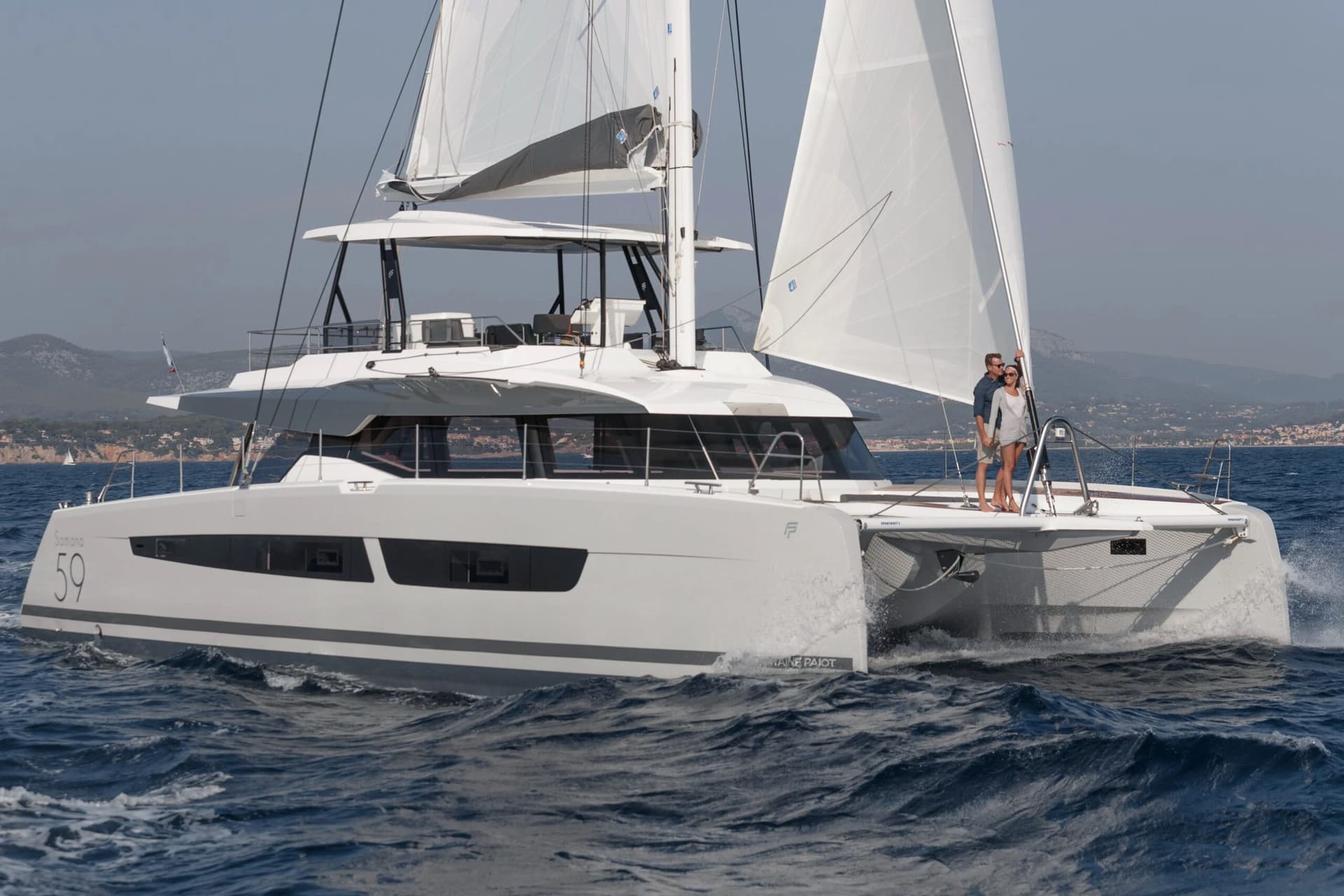
Performance cruising cats have become more popular and mainstream over the last 10 years. Buyers now compare comfort-first brands such as Lagoon and Fountaine Pajot against faster, more hands-on options like Nautitech, Outremer, HH Catamarans, Balance, Catana, Gunboat, and Panther 48.
Where the real ownership trade-offs show up
The biggest mistake buyers make is thinking the difference is only top speed. In practice, a performance cat changes the whole ownership equation: comfort, handling demands, payload tolerance, and cost all move together. More performance usually means more sensitivity to weight placement, more attention to rig and sail shape, and less patience for sloppy habits at the helm or on deck.
That is why these boats appeal so strongly to owner-operators who want quicker passage times without moving all the way into race-boat territory. You are not buying a stripped-out machine built only for podiums. You are buying a cruising platform that still expects you to understand what the wind is doing, how the boat is loaded, and when to change course or ease power out of the rig to keep the hulls working efficiently.
Voyage preparation looks different on a performance cat for the same reason. The usual offshore priorities still apply, but the pace of sailing and the need to manage energy, redundancy, and trim more actively mean the owner has to think harder about how the boat will be used. Balance Catamarans has leaned into that reality with owner Q&A, systems troubleshooting, and training content aimed at performance-cat ownership.
The use cases that make sense
For passagemaking, a performance cat makes sense when the goal is faster, more engaging miles and the crew is willing to stay involved. These boats suit sailors who enjoy trimming sails, reading wind shifts, and adjusting course and sail shape to keep the boat moving efficiently.
For family cruising or charter use, the logic changes fast. Larger sailing cats are already popular in bareboat chartering because they provide more space and easier motion, and that comfort-first formula is exactly why many buyers stay with mainstream cruising models. If your priority is a relaxed onboard life, easier motion in a seaway, and the broadest possible interior volume, a performance cat can feel like too much boat and not enough home.
For light-air sailing and fast coastal runs, the performance brief becomes especially attractive. The lighter composite construction and efficient sail plans are there to reduce drag and increase responsiveness, which is what buyers are paying for when they want a boat that can keep moving cleanly rather than just float along. One market report projects the global cruising catamaran market rising from USD 203 million in 2025 to USD 317 million by 2032, a 6.7% CAGR, while a separate 2025 brokerage report put the sailing multihull market at $337 million in total value sold in the second half of 2025.
Some buyers will still want the broad comfort of Lagoon or Fountaine Pajot, and others will step toward Catana, Outremer, HH Catamarans, Balance, Gunboat, or Panther 48 because they want more urgency at the helm.
This article was produced by Prism’s automated news system from verified source data, official records, and press releases, then run through automated quality and moderation checks before publishing. The system is built and supervised by the people who set the standards it runs under. Read our full AI policy.
Did this article answer your question?