Portland's Frog Ferry Offers Community Ownership Shares for Electric Catamaran Service
Frog Ferry's $2 million community share campaign for a 70-passenger electric catamaran on Portland's Willamette River launched the same week the FTA opened $657 million in electric ferry grants.
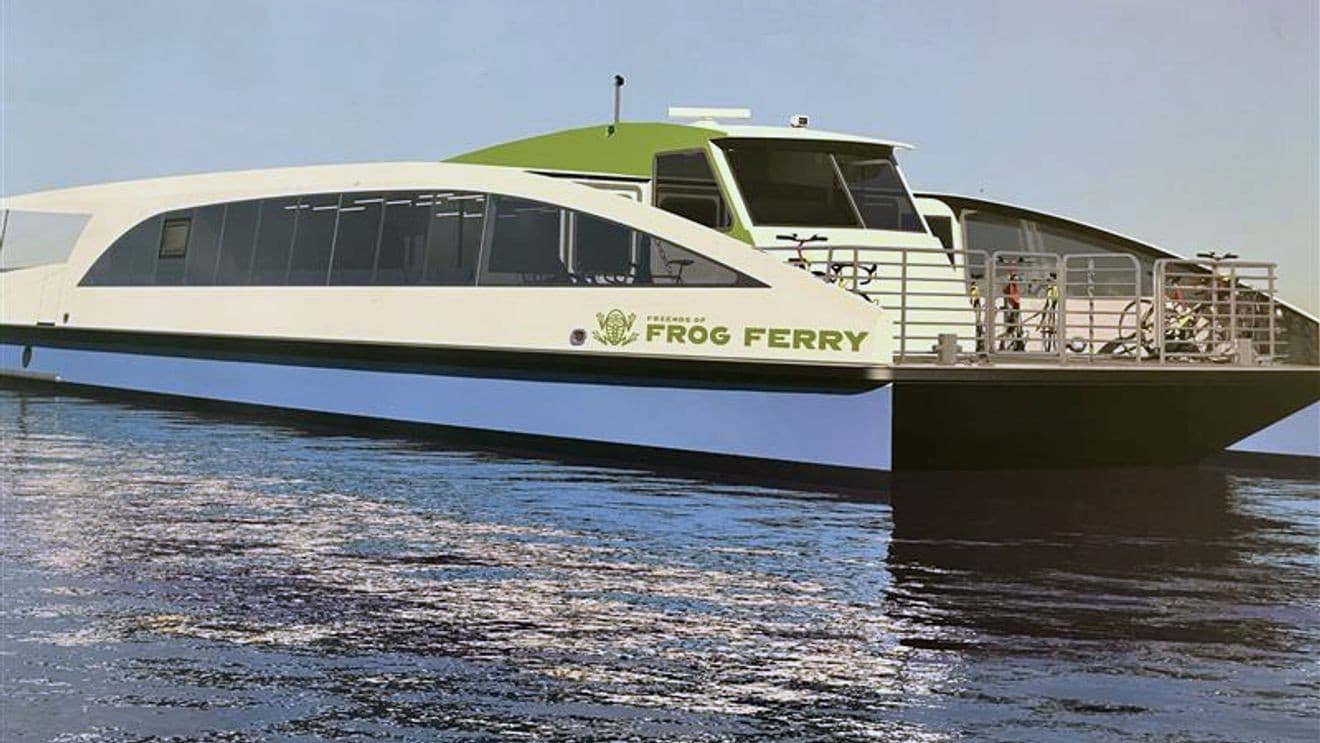
Before a single hull hits the Willamette, Frog Ferry's proposed electric catamaran needs to prove it can handle an urban commuter workload: 70 passengers per run, a low-wake profile through active river traffic, and a dock-to-dock charging window tight enough to sustain meaningful frequency on a route stretching from Cathedral Park in St. Johns to RiverPlace Marina in downtown Portland. Those are the baseline performance demands, and no builder has been selected yet. The project's RFP for the vessel won't go out until funding is secured, which makes what Susan Bladholm announced April 8 the most consequential decision the nonprofit has made in its eight-year push to get a boat in the water.
Bladholm, founder and president of Friends of Frog Ferry, unveiled a community-ownership funding model that puts shares on sale starting at $300, with a $15,000 contribution permanently naming a seat aboard and a $900,000 top tier that earns the right to name a vessel. The shares are donations, not equity, but the structure is unmistakably modeled on the Green Bay Packers, the NFL's only community-owned franchise. Former Packers CEO Mark Murphy appeared at the event alongside Oregon State Senator Bruce Starr and State Representative Daniel Nguyen, lending a notable private-sector imprimatur to the financing concept. Murphy's specific role within Frog Ferry's organization was not confirmed at the event, but his presence made the Packers parallel explicit and deliberate.
The $2 million community raise is not meant to build the boat on its own. Bladholm and her team are betting that demonstrable grassroots investment will unlock a cascading stack of state, federal, and philanthropic capital that would together push toward the roughly $20 million the pilot project requires. That sequencing matters enormously for anyone watching electric propulsion mature in the commercial ferry space. The community raise funds credibility, and credibility funds the RFP, and the RFP produces the vessel specs that catamaran owners and builders actually need to evaluate: charging architecture at both terminals, battery capacity against a Willamette winter, and cycle durability at commercial-grade utilization rates.
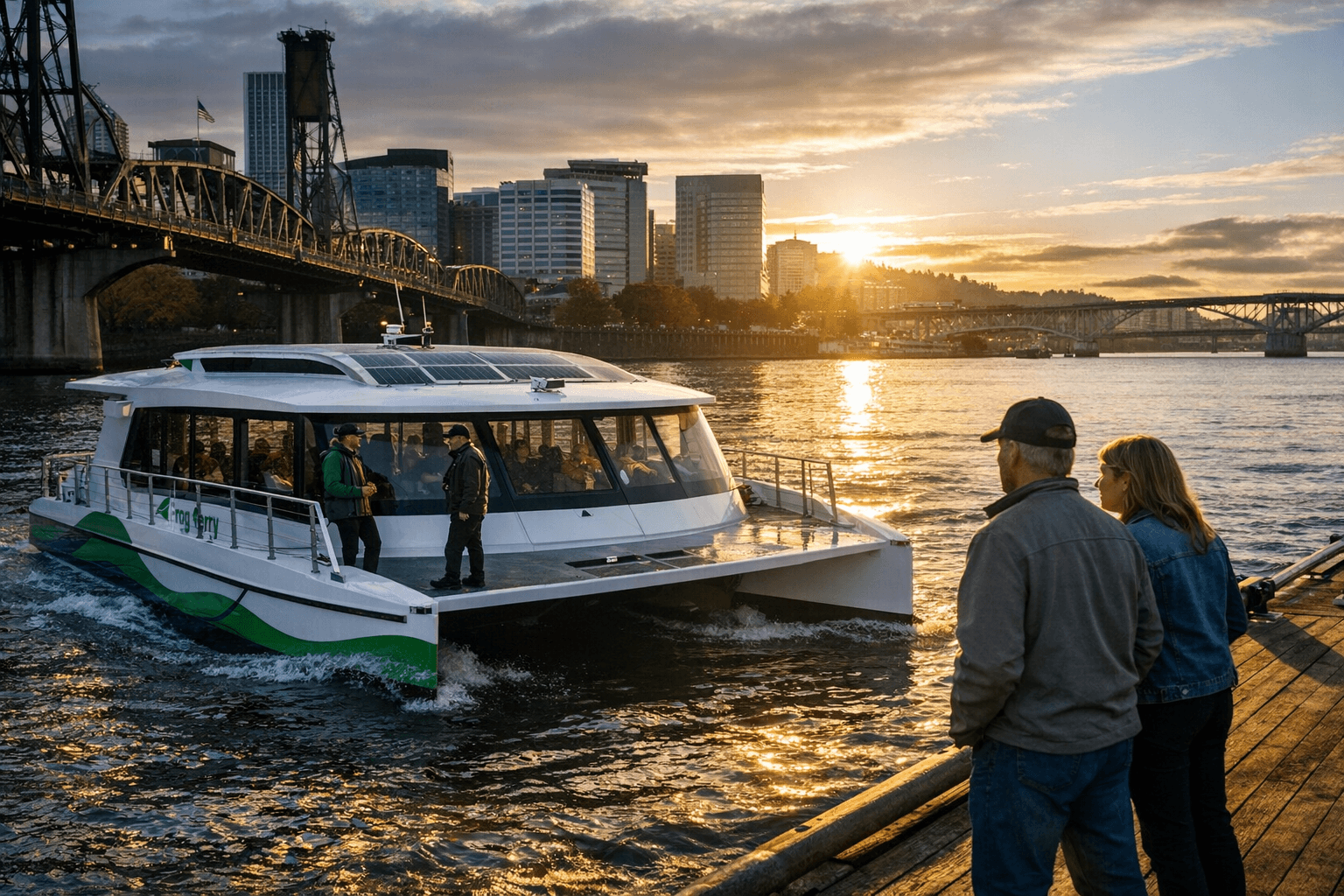
The dock infrastructure piece alone is a significant unlock. The City of Portland agreed in principle in 2025 to allow Frog Ferry use of its publicly owned docks at Cathedral Park and RiverPlace Marina, but conditioned that permission on Frog Ferry completing ADA-compliant upgrades at both landings. Capital from community shares and subsequent grants would fund exactly that kind of terminal investment, the sort of shore-side electrification work that determines whether a vessel's theoretical range holds up in daily operation.
The timing of the announcement is pointed. The Federal Transit Administration published its FY 2026 NOFO for the Passenger Ferry Program and Electric or Low-Emitting Ferry Pilot Program on April 7, making available roughly $657 million in competitive grants, with proposals due May 11, 2026. A demonstrated community ownership campaign positions Frog Ferry to argue community benefit and matching capital, two criteria that tend to move competitive grant scores. For the catamaran community watching this space, the questions worth pressing before calling the project viable are the ones the fundraising round is designed to answer: what builder, what battery supplier, what charging standard at each dock, and what off-season operating plan for a river that runs cold and fast through the winter months.
This article was produced by Prism’s automated news system from verified source data, official records, and press releases, then run through automated quality and moderation checks before publishing. The system is built and supervised by the people who set the standards it runs under. Read our full AI policy.
Did this article answer your question?