Éric Pilato plans solo Atlantic crossing on Excess 11 catamaran
Éric Pilato is turning an Excess 11 into a solo Atlantic tool, with no engines, no extra crew, and a Route du Rhum horizon in view.
A family cat turned offshore project
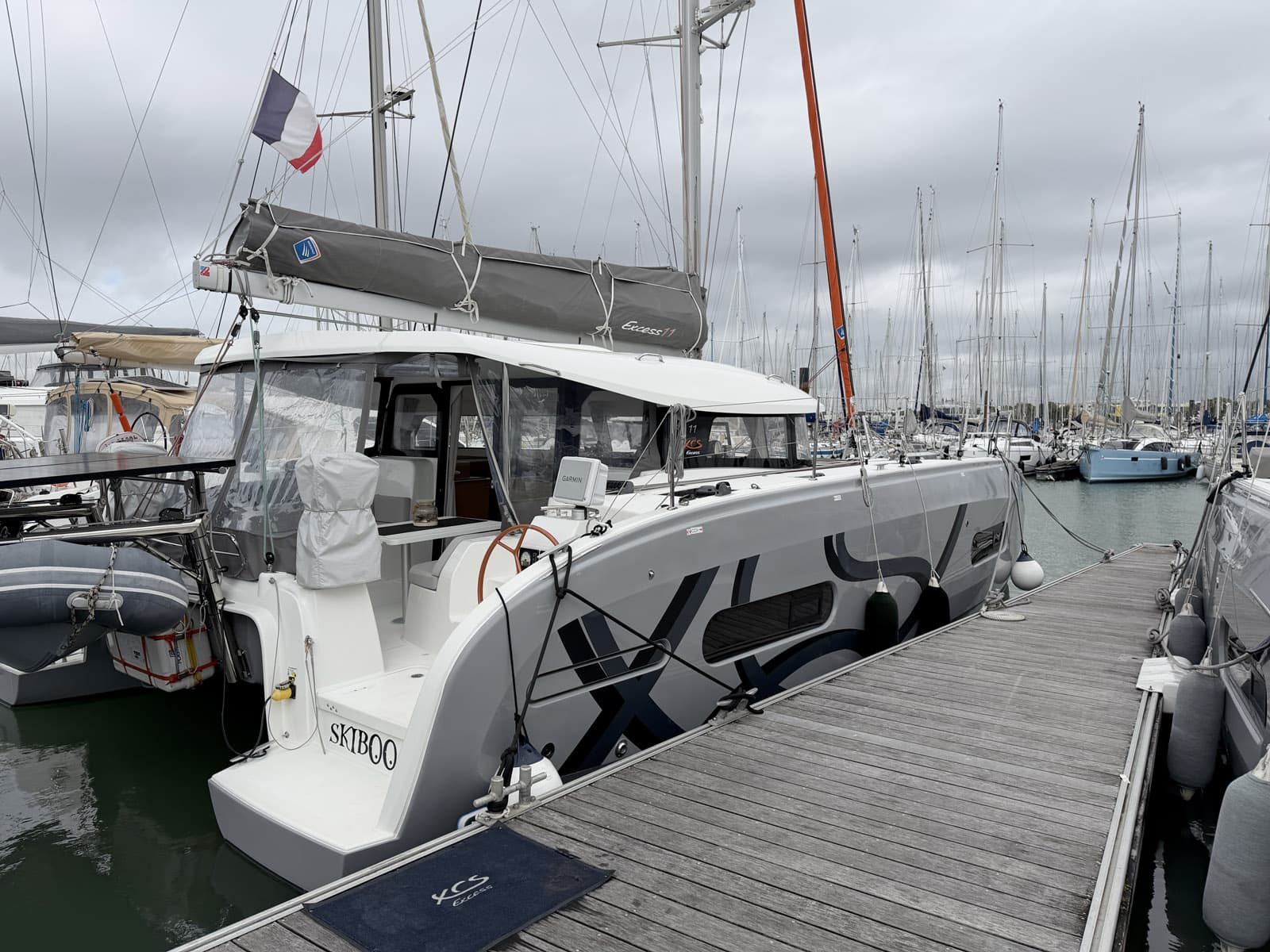
Éric Pilato is doing something that sits neatly between cruising culture and offshore ambition: he is preparing a compact Excess 11 for a solo Atlantic crossing. The boat is hull #151, one of the last examples fitted with a self-tacking jib, and the plan is stark in its simplicity, leave La Rochelle shortly after the 2026 Grand Pavois and sail straight to Pointe-à-Pitre without using the engines.
That makes the story more than a personal challenge. It is a test case for how far a production cruising cat can be pushed when the owner brings training, restraint, and a very clear idea of how to sail the boat efficiently. Pilato, 62, was born in La Rochelle, recently earned his 200 GT Master’s certificate in Belgium and Marseille, and has moved from owner to active ambassador for Excess after buying a catamaran that matched his family’s layout needs. His wife’s refusal to come cruising on a monohull set the original course, but the current project shows how ownership can evolve into something much more demanding.
Why the Excess 11 can be more than a marina cat
The Excess 11 is a 37-foot cruising catamaran, and that size is exactly what makes Pilato’s plan interesting. On paper, it is a liveaboard boat designed for long passages, with the proportions and volume expected of a modern production multihull. In technical listings, the boat sits at about 11.06 m to 11.42 m overall length, 6.59 m of beam, around 9.0 t displacement, a 55 m² mainsail, a 22 m² self-tacking jib, and twin 29 hp engines.
Those numbers tell the story better than any marketing line. The sail plan is compact enough to be handled by one person, especially with a self-tacking jib that removes a layer of complexity during tacks and short-handed maneuvers. The twin engines add maneuvering safety in harbor and a backup for everyday cruising, but Pilato’s Atlantic plan deliberately leaves them out of the equation. By insisting on a nonstop sailing passage, he is treating the boat as a true passage-maker rather than a delivery platform with a motor assist.
There is also a brand story inside the boat. Excess describes the Excess 11 as the model that really built the brand’s identity after its public debut at boot Düsseldorf 2020, and the builder says it is the only large-scale production boat on the market in this size class. More than 200 Excess 11s have already been built, which matters because Pilato is not sailing some one-off prototype into the Atlantic. He is taking a commercially significant production model, one many sailors know as a family cruiser, and showing how it can be sailed with a much more serious offshore intent.

The Route du Rhum is the shadow on the horizon
Pilato’s passage is not an official race entry, but it clearly borrows its emotional energy from the Route du Rhum-Destination Guadeloupe. The 13th edition is scheduled to start on Sunday, November 1, 2026, from Saint-Malo, and the organizer has announced 117 solo sailors for the start, with possible wild cards still to come. Since 1978, the race has been one of the defining solo transatlantic events, and its open format, with many boat types and sizes on the same starting line, gives the event a particular cultural weight.
That breadth is part of why Pilato’s voyage resonates. A solo crossing from La Rochelle to Pointe-à-Pitre, timed to arrive in the same broad moment as the Route du Rhum fleet, feels like a private echo of a public myth. He is not pretending his passage is the race, but he is using its atmosphere, its calendar, and its sense of transatlantic purpose as the frame for his own sail.
The detail that he intends to leave shortly after the 2026 Grand Pavois matters too. It places the project in the heart of the French multihull season, where boat shows, owner culture, and offshore ambition overlap. For an owner-ambassador like Pilato, that timing makes the crossing feel like a continuation of the boat-show circuit by other means, except the destination is Pointe-à-Pitre, not a dockside stand.
What has to work for one person to cross an ocean in a 37-footer
A solo Atlantic crossing on a cruising cat is not just about courage. It is about setup, systems, sail handling, and the discipline to keep the boat simple enough to manage alone. Pilato’s preparations already point in that direction, with solo training sessions and optimization work on the catamaran underway. On a boat like the Excess 11, those changes are likely to matter as much as any raw performance number.
The self-tacking jib is the clearest short-handed advantage in the rig. It cuts down on deck work during course changes and helps keep the boat moving without forcing the skipper into constant physical gymnastics. The 55 m² mainsail still gives the boat its driving power, but the real story is balance: a solo sailor needs a sail plan that can be reefed, trimmed, and watched without turning every adjustment into a full-deck event.
Power management will also be part of the crossing, even if the engines stay silent. A boat set up for a long passage has to handle navigation electronics, communications, lighting, and daily domestic loads without creating unnecessary strain on the sailor or the batteries. Storage matters too, because a sub-40-foot cat has enough volume to feel generous, but not enough to be careless. Every spare line, food box, safety item, and water system has to live somewhere that still allows fast movement and clear access when the boat is moving hard or the weather turns.
Watchkeeping is the other hidden layer. On a solo passage, the boat never fully goes off duty, so the skipper’s routine becomes part seamanship and part endurance sport. The Excess 11’s compact size and responsive sail plan help, but the limits of a 37-footer still show in the basic fact that there is only one person to reef, inspect, navigate, rest, and recover. That is the edge Pilato is approaching, not by pretending the boat is bigger than it is, but by proving that a well-set production cat can be sailed smartly enough to cross an ocean under one pair of hands.
A production cat with ambition still built in
What makes this story stand out in catamaran culture is the overlap of identities. Pilato is a La Rochelle owner, a newly qualified master, and an ambassador for a brand whose model built its reputation on accessible performance. The Excess 11 was designed for cruising comfort and sailing feel, yet it is being asked here to show another face: not just volume at anchor, but enough reach, balance, and seaworthiness to make a solo Atlantic passage believable.
That is the real significance of hull #151. It is not a race yacht in disguise, and it does not need to be. It is a production cat with the right sail plan, the right handling choices, and the right skipper to turn a family cruiser into a credible offshore machine. And when Pilato pushes off from La Rochelle after the Grand Pavois, the message will be clear from the first mile: a compact catamaran can still carry a very long way if the person aboard knows exactly how to ask it.
Know something we missed? Have a correction or additional information?
Submit a Tip