SailGP rebuilds F50 catamarans after New York collision
The New York pileup was only half the story. The real race began ashore, where SailGP’s tech crews had to rebuild an F50 fast enough to keep the fleet moving.
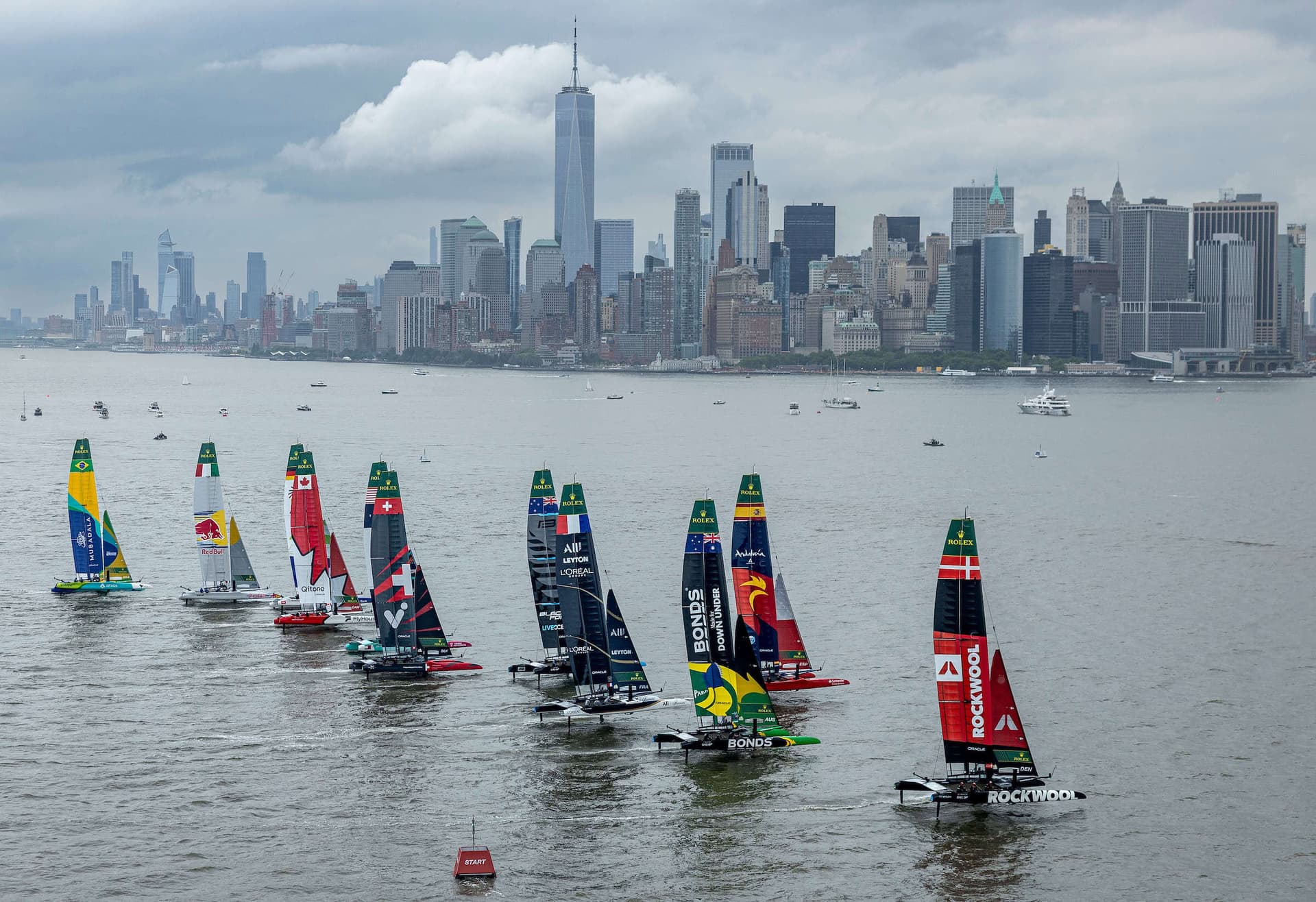
The loudest moment in New York was the three-boat collision at the start of race 3. The more revealing one came after the spray settled, when the Brazil, United States, and Red Bull Italy teams had to hand their damaged F50s over to the people who keep SailGP’s show on the road. That is where the championship’s hidden race begins: a sprint to salvage carbon, foils, and structure before the next stop on the calendar.
The crash everyone saw, and the safety check nobody should miss
SailGP said all athletes were safe and accounted for after the incident, and the event results later showed the United States SailGP Team received a points penalty tied to the collision. Taylor Canfield, speaking separately about the crash, put the blame on himself and said it was “really on me.” That accountability matters in a series where the margin between a headline finish and a repair crisis can be measured in a single tack, a single launch, or a single bad angle at the start line.
For catamaran readers, the important detail is that the visible wreck is only the first layer of the story. A three-way tangle does not just bend a foil or scuff a hull. It can force SailGP Technologies and the shore crews into a sequencing problem: identify what is damaged, isolate what can be saved, and decide what has to be swapped, rebuilt, or flown in before the fleet is expected to race again.
What an F50 really is when it arrives back at shore
The F50 is not a conventional racing catamaran, and that is exactly why the rebuild is so demanding. SailGP describes it as a 15-meter one-design foiling catamaran based on the AC50 platform from the 2017 America’s Cup, with performance that can exceed 100 km/h in ideal conditions. The fleet is built around interchangeable foils, daggerboards, rudders, and multiple wing sizes, which gives teams range across conditions but also turns every repair into a compatibility exercise.
That complexity helps explain the scale of the work. SailGP says building an F50 takes around 57,000 hours, which puts even a single collision into perspective. These boats are precision-built carbon machines with structural loads, hydraulics, electronics, and foiling hardware all packed into a racing package that has to remain light, stiff, and legal under one-design rules. When damage hits, the repair team is not merely patching a hull; it is protecting the integrity of an entire system.

How the rebuild workflow really starts
Once the boat is back ashore, the first job is assessment. Shore crews and SailGP Technologies have to read the damage across the hulls, foils, and structural components and decide what is still raceable, what needs urgent repair, and what must be replaced outright. That triage step is where the technical race begins, because the clock does not stop while composite specialists and engineers are sorting through the aftermath.
From there, the work becomes a tightly ordered rebuild. The team has to preserve the one-design specification, keep the foiling package compatible with the rest of the fleet, and get the boat back into a state where it can be rigged, tested, and trusted at speed. In practice, that means the same specialists who design and build these boats also have to think like emergency responders, moving from diagnosis to structural repair to reassembly with almost no slack in the schedule.
- Composite expertise matters because F50 damage often lives in the structure, not just the surface.
- Mechanical and systems knowledge matters because foils, rudders, hydraulics, and electronics all have to line up again.
- Time management matters because the next event does not wait for a perfect restoration, only a safe and raceable one.
Why the logistics are just as hard as the repair
SailGP has already shown what this kind of scramble looks like in earlier incidents in Sydney, Perth, and Auckland. In one case, SailGP Technologies built a new hull section and flew it to Auckland to meet a damaged boat before the next event. In another, a badly damaged F50 was judged too hurt to fix in time for the following day’s racing. Those cases show the real pressure point in a global championship: the repair plan is not measured in days of convenience, but in whether a boat can make the next venue at all.
That is where interchangeability becomes more than a design feature. The ability to move foils, daggerboards, rudders, and wings between boats gives the championship options, but it also demands disciplined inventory control and a repair shop that can turn parts around at racing speed. When a fleet is on a world tour, the support operation has to behave like a traveling high-performance factory.
The support system behind the spectacle
SailGP Technologies has grown to match that demand. In July 2025, the organization officially opened a Southampton, UK center of excellence with more than 100 designers, engineers, boatbuilders, and composites specialists, building on earlier launches in Warkworth, New Zealand. That footprint tells you how much industrial muscle now sits behind the series: this is not just a regatta operation, but a distributed engineering network built to keep the F50s in circulation.
For readers who follow catamaran development, that is the real lesson in New York. The race start produced the drama, but the fleet’s continuity depended on an invisible chain of skills that begins with damage assessment and ends with a boat that is ready to fly again. SailGP’s spectacle only works because, somewhere off camera, a very different race starts the moment the boats come ashore.
This article was produced by Prism’s automated news system from verified source data, official records, and press releases, then run through automated quality and moderation checks before publishing. The system is built and supervised by the people who set the standards it runs under. Read our full AI policy.
Did this article answer your question?