Sunreef ECO Catamarans Bring Solar Power and Luxury to Charter Market
Sunreef's ECO catamarans run AC and cruise on near-zero diesel, and Boatbookings says no builder has pushed solar-electric yacht tech further.
Solar panels laminated into the hulls, electric drives spinning quietly below the waterline, and battery banks that keep the air conditioning running without firing up a generator: this is what Sunreef Yachts has been building toward, and according to charter platform Boatbookings, nobody else in the industry has gone as far. In a feature published on 12 March 2026, Boatbookings put the shipyard's ECO series front and center, making the case that practical, low-emissions luxury chartering is no longer a future promise — it is already on the booking list.
What Sunreef's ECO Series Actually Does
The headline claim from Boatbookings is worth quoting directly: "No manufacturer has pushed the technology more than Sunreef Yachts, who offer their ECO range of catamarans designed to rethink how yachts generate and use energy." That is a strong statement in a market full of yards fitting token solar panels to conventional diesel cats and calling it eco. What separates the Sunreef ECO approach, according to Boatbookings, is integration at the system level: "Rather than relying primarily on diesel engines, the Sunreef Eco Series combines large solar arrays, electric propulsion, and high-capacity battery systems to dramatically reduce fuel consumption and emissions."
The practical consequence for a charter guest is stated plainly: "In practical terms, this means you can charter with very little fuel consumption, even while running air conditioning and cruising under power." If you have spent time on a conventional crewed cat anchored in a quiet bay and watched the crew run a diesel genset for hours to keep the cabins cool, you understand exactly why that sentence matters. The noise, the exhaust smell, the vibration through the hull — all of that is what a properly specified electric-solar system is designed to eliminate.
No kilowatt-peak figures or battery capacity numbers appear in Boatbookings' published feature, and Sunreef has not supplied independent technical specifications in the available material. The operational claims — very little fuel, AC running, underway — are the shipyard's and the charter platform's assertions, and they deserve third-party verification. That said, the direction of travel is credible: large-format catamarans have wide deck surfaces suited to high-density solar arrays, and the twin-hull layout provides volume for substantial battery banks that a monohull simply cannot match.
Beyond the Drive System: Sustainability Through the Interior
The ECO philosophy at Sunreef does not stop at the engine room. Boatbookings highlights a set of interior and material choices that extend the sustainability brief throughout the boat:
- Alternative decking materials that reduce reliance on traditional teak
- Recycled or responsibly sourced interior materials
- Energy-efficient lighting and onboard systems
Teak is worth singling out here because it is such a loaded topic in the sailing world. Responsibly sourced teak exists, but plantation teak quality varies, and demand has historically driven illegal logging in protected forests. Moving to alternative decking — composite, cork, or synthetic teak-look products — is a tangible step that guests can actually see and touch. Boatbookings frames the trade-off simply: "Sustainability, in this case, does not mean sacrificing comfort." In their words, the interiors on these builds "feel warmer and more contemporary than many traditional builds."
What Charter Guests Actually Gain
Even if you are chartering a Sunreef ECO primarily because the brief says 43 meters of catamaran and a custom interior rather than because you are counting carbon offsets, the technical configuration delivers real operational advantages. Boatbookings lists them directly:
- Quieter anchorages with fewer generator hours
- Lower emissions cruising in sensitive marine environments
- Greater energy independence when exploring remote areas
- A more modern onboard experience
The quieter anchorage point is the one that converts charter guests who weren't even thinking about sustainability. Drop the hook in a deserted bay in the Grenadines or the Cyclades, and the difference between a conventional genset running through the night and a silent battery bank is the difference between sleeping well and lying awake. Energy independence in remote areas is the other genuinely practical benefit: if you want to explore somewhere without a marina or a fuel dock for several days, a high-capacity solar-battery system changes the math entirely.
The Sunreef 43M Eco: Eco-Tech at Superyacht Scale
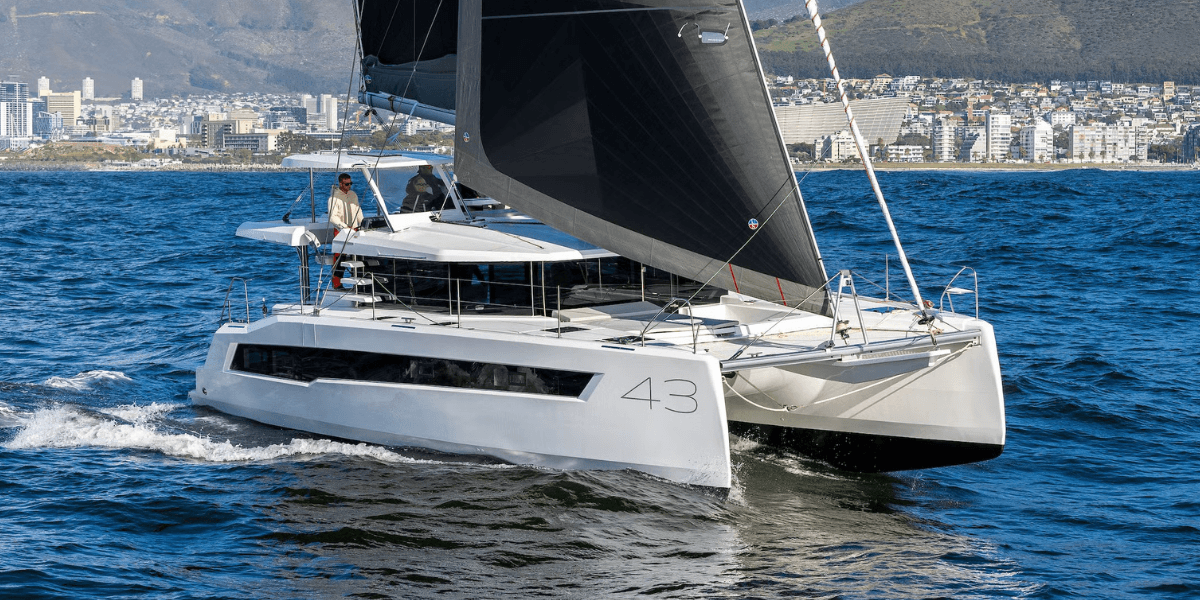
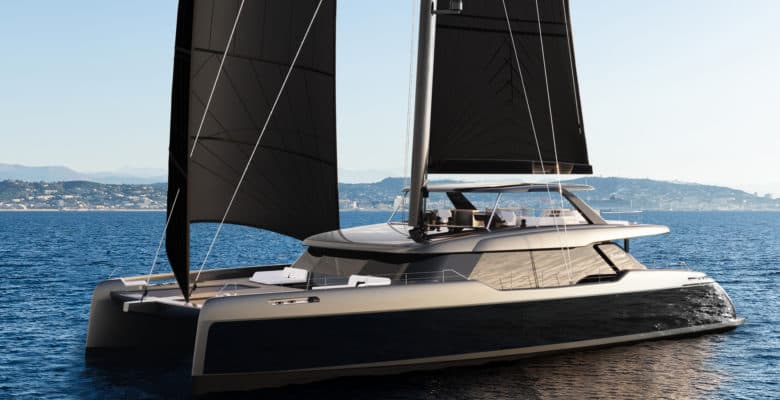
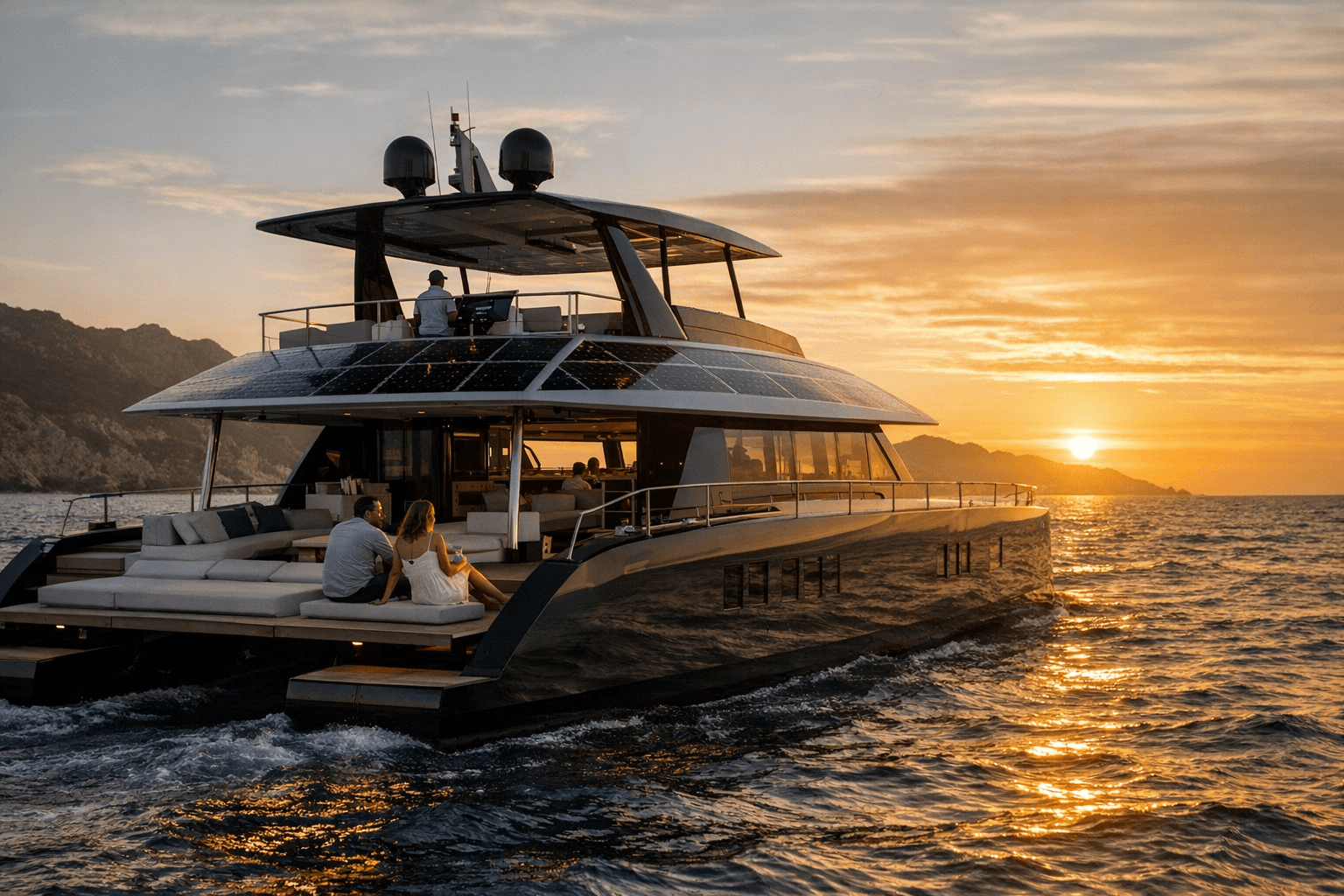
The flagship example in the Boatbookings feature is the Sunreef 43M Eco, and it is where the concept scales up to something that redefines expectations for large-format charter catamarans. Sunreef describes it directly: "The Sunreef 43M Eco brings the brand's eco-tech vision to the world of superyachts. This large-format catamaran offers exceptional volume, integrating next-generation solar panels, energy-efficient propulsion and a sustainable approach to materials throughout its interior structure."
The 43-meter footprint means the solar array can cover genuinely useful area — across the roof, the hardtop, potentially the hull sides — generating enough to make a meaningful dent in hotel loads and propulsion demand. Sunreef says that "despite its scale, it maintains a light environmental footprint, delivering long-range cruising with remarkable efficiency," and the on-paper case for that claim is stronger at this size than it would be on a smaller, less surface-rich hull.
Charter-side, the brief reads as pure superyacht: "Expansive decks, generous accommodation and a custom-designed interior make it a true luxury residence on the water, proving that sustainability and superyacht comfort can go hand in hand." The 43M Eco is not a stripped-down eco project that happens to have solar panels. It is a full superyacht specification with the eco-tech integrated from the keel up.
2025 Awards and What They Signal for the Market
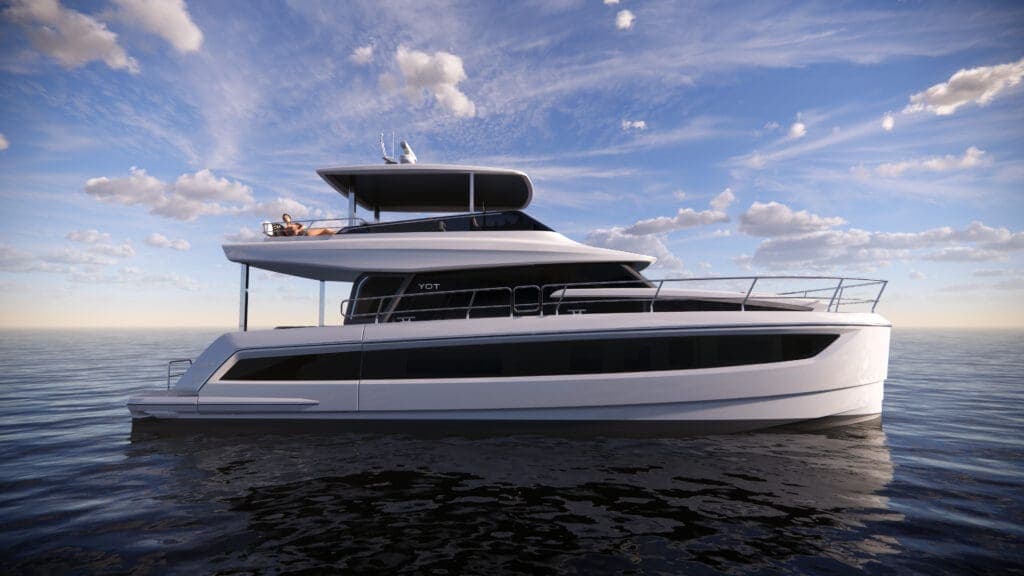
Sunreef points to 2025 industry recognition across three models as evidence that the broader market is validating this direction. The 60 Sunreef Power Eco received eco-focused accolades, with Sunreef noting that these "highlight the growing importance of clean propulsion and energy autonomy." The ULTIMA 55 gained design recognition reflecting, per Sunreef, "the rising demand for sculptural architecture and contemporary styling." And the Sunreef 43M Eco earned an innovation award, which Sunreef says "showcases a shift toward large-format superyachts that prioritise environmental responsibility without compromising luxury."
It is worth noting a gap in the available information: the sources do not identify the specific awards, the awarding bodies, or the precise award titles for any of these models. Sunreef refers to them as accolades and awards for 2025, but the details require follow-up directly with the yard before they can be reported with full precision. What the award claims do confirm is the direction Sunreef itself believes the market is moving: "Each honour highlights three defining strengths at the heart of Sunreef's identity: visionary innovation, design excellence and a commitment to sustainable yacht building."
Boatbookings' Position and What It Means for Charter Operators
Boatbookings has context that matters here: the platform states it "has been supporting sustainable chartering for more than twenty years," which puts it in a different position from a yard simply marketing its own product. Twenty years ago, sustainable chartering meant little more than recycling onboard and avoiding anchor damage to reef. The fact that a platform with that history is now featuring solar-electric propulsion systems and calling it "finally becoming a reality" signals a genuine shift in what is commercially available and bookable, not just conceptually possible.
For operators thinking about adding a Sunreef ECO model to a charter fleet, the practical questions that remain unanswered in the public material are the ones that will determine the business case: actual solar array output, battery storage capacity, achievable range under electric power at charter speeds, and real-world fuel consumption data from existing charter operations. Boatbookings makes the claims; the missing ingredient is independently verified numbers to back them up. Those specs are worth requesting directly from Sunreef before committing a fleet position.
The trajectory, though, is clear. The combination of solar integration, electric propulsion, and high-capacity batteries is no longer experimental technology on a catamaran platform. Sunreef has been refining it across multiple model sizes, the charter market is asking for it, and the operational benefits — quieter, cleaner, more independent passage-making — are the kind that guests remember long after the tan fades.
This article was produced by Prism’s automated news system from verified source data, official records, and press releases, then run through automated quality and moderation checks before publishing. The system is built and supervised by the people who set the standards it runs under. Read our full AI policy.
Did this article answer your question?