Vessev VS-9 Electric Hydrofoiling Catamarans Set for Swan River Tourism Operations
Vessev's VS-9 hydrofoiling catamarans cruise at 25 knots while conventional Swan River ferries are capped at 5-8 knots by wake restrictions the VS-9 simply doesn't create.
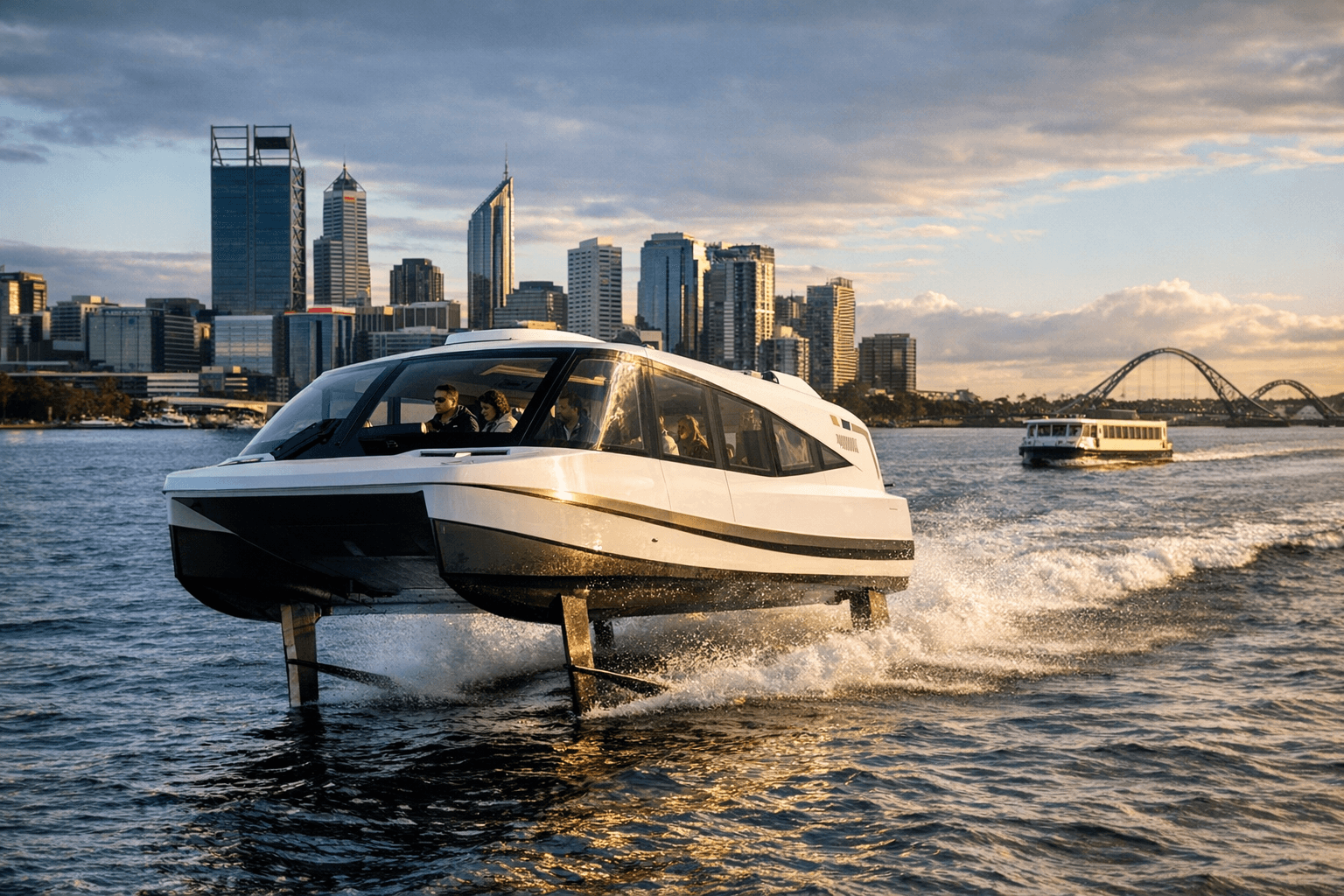
New Zealand marine-technology firm Vessev reserved several of its VS-9 electric hydrofoiling passenger catamarans for Perth's Swan River after announcing a partnership with local operator Enautic Group, with initial services to run under Enautic's AquaFlights brand covering Swan Valley cruises, twilight sailings and private charters.
The VS-9 is a nine-metre vessel that lifts its hull clear of the water on carbon fibre foils, cruising at around 25 knots with a stated range of up to 50 nautical miles. Vessev claims energy consumption up to 90% lower than a traditional vessel of comparable size, zero onboard emissions, and virtually no wake. That last point matters specifically on the Swan River, where conventional ferries are typically held to 5-8 knots by wake restrictions. A hydrofoiling hull that barely disturbs the surface can travel at higher speeds without damaging riverbanks or affecting other river users.
Globally, the VS-9 is operating in rare company. According to reporting by Maritimt Magasin, only three commercially-certified electric hydrofoiling vessels are in operation anywhere in the world, two of which are Vessev VS-9s that have together logged close to 10,000 nautical miles. That figure is worth treating as context rather than confirmed fact until verified against classification society records, but it underscores how early-stage this technology category remains.
Leading the day-to-day operation will be Kevyn Townley, founder of the Little Ferry Company, which ran solar-electric ferries on the Swan River for nearly a decade. His familiarity with the river's dynamics, regulatory environment and passenger base is presumably a significant part of why Enautic tapped him for the role. Josh Portlock, the aerospace engineer and Perth local who founded Enautic Group and serves as its Executive Chairman, is leading the project commercially. Portlock said the introduction of electric hydrofoiling vessels could transform how Perth uses its waterways, and that launching with tourism experiences would let passengers encounter the technology first-hand while laying the groundwork for a sustainable commuter network.
Vessev CEO and co-founder Eric Laakmann framed Australia's appeal in broader terms: "Cities around the world are beginning to rediscover the potential of their waterways as transport corridors. Electric hydrofoiling vessels offer greater efficiency, comfort and environmental performance compared with conventional boats. Australia's waterways, combined with its strong renewable energy adoption and innovation ecosystem, make it an exciting market for this next generation of marine transport."
Timing for the Perth deployment carries a discrepancy across sources. Two outlets reported the first VS-9s would arrive later in 2026, while Econews and Perthisok both cited an early 2027 delivery date. Vessels will need to clear certification with applicable classification societies and satisfy local regulatory requirements before entering passenger service; Econews noted Vessev is working with both classification societies and Western Australian regulatory bodies, though no approvals have been explicitly confirmed in published reports.
Longer-term, the route ambitions extend beyond tourism. Portlock and Laakmann have both pointed to potential commuter connections linking Applecross to the CBD, Perth to Fremantle, and Perth to Rottnest Island, known to the Whadjuk Noongar people as Wadjemup. Whether that timeline tracks closer to the initial tourism launch or represents a separate subsequent phase will depend heavily on how regulatory approvals, mooring allocations and passenger demand shape up once AquaFlights is running.
This article was produced by Prism’s automated news system from verified source data, official records, and press releases, then run through automated quality and moderation checks before publishing. The system is built and supervised by the people who set the standards it runs under. Read our full AI policy.
Did this article answer your question?