Warren and Erica solve Helia 44 mainsail handling problem in Fiji
Warren and Erica turned a stubborn Helia 44 mainsail problem into a cheap custom fix in Fiji, then tested a Cook Hook that should make every hoist and drop simpler.

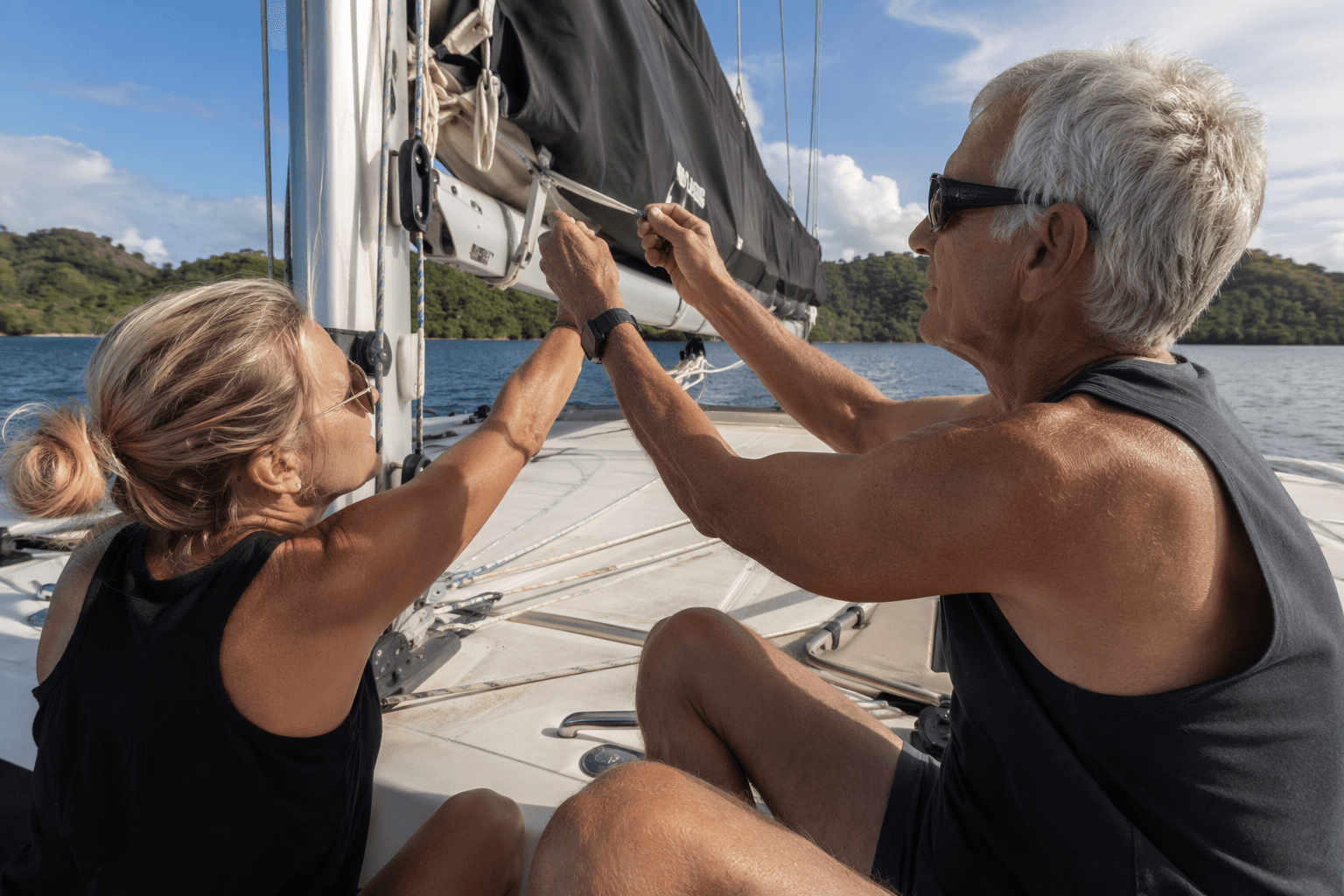
The problem started where cruising annoyances usually start: at the masthead. On VA, Warren and Erica’s Helia 44, the square-top mainsail worked well once set, but hoisting, lowering and stowing it in the lazy bag had become a daily nuisance because attaching and detaching the halyard at the sail head was a constant struggle. It was not a glamorous fault, but on a boat that has already covered more than 30,000 nautical miles, small friction points like this can shape how comfortable offshore life feels.
Why this matters on a Helia 44
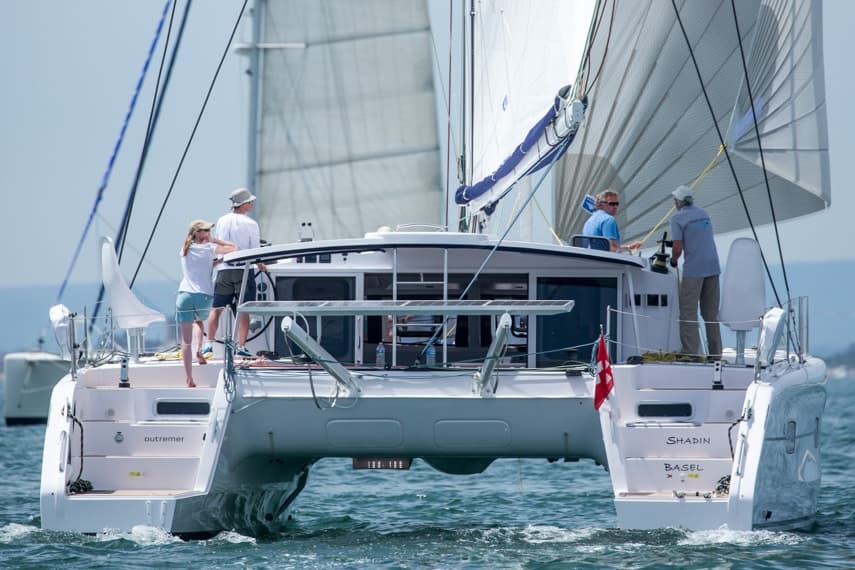
The Helia 44 is a 43.5-foot, 13.26-meter cruising catamaran with a 7.40-meter beam, designed by Berret-Racoupeau and introduced by Fountaine Pajot as a replacement for the Orana 44. In standard form, it commonly came with a fully battened mainsail, lazy jacks and a lazy bag, which makes the sail package efficient but also places a lot of attention on how the head of the sail is handled. Once a square-top main is part of the rig, the top-end geometry can add control and performance in gusty conditions, but it also demands cleaner handling at the hoist and drop.
That is the practical tension in this story. The sail plan does its job underway, but the human side of the system, clipping and unclipping the halyard at the head, became the weak link. For owners of similar passagemaking cats, that is the real lesson: the rig may be healthy on paper, but if one repetitive task becomes awkward, the boat starts to feel less sorted every time you leave the dock.
The commercial options were there, but the price was hard to justify
Warren did what good cruising owners do before reaching for the tools. He looked at commercially available solutions, including Karver’s hook and Facnor’s gaff-lock style hardware. Karver markets its hook and lock products for racing sailboats, superyachts and cruising multihulls, while Facnor’s gaff lock is aimed at full-batten square-top mainsails. Those products are built for exactly this sort of job, but the cost pushed the couple toward a different answer.
The sticking point was budget. Warren decided the ideal commercial solution would run into the thousands of dollars, which is a serious price for hardware meant to solve a handling issue rather than replace a failed spar or a damaged sail. That is where this story becomes especially useful for the cruising community: it shows the moment when premium equipment exists, but the owner chooses to balance performance, practicality and cost in a more hands-on way.
Why the square-top main makes sense, and why it can be fussy
The mainsail itself is part of the broader modern trend toward square-top or fat-head designs. In simple terms, the extended top batten and straighter leech help improve aerodynamic control, especially when the wind builds and gusts start to load the rig unevenly. That is why these sails are now a familiar sight on cruising cats and performance boats alike.
But better control does not always mean easier handling. A square-top main still has to be raised, dropped and stowed cleanly, and on a boat set up with a lazy bag and lazy jacks, any awkwardness at the head of the sail becomes magnified. On VA, the issue was not the sail shape itself so much as the process of dealing with it repeatedly, which is exactly the kind of operational detail that offshore crews end up noticing most.
The solution came from the cruising network, not a catalog
Instead of stopping at the price tag, Warren and Erica looked for a fabrication option they could trust. Their answer was to tap the boatbuilding world around Brisbane, where their friends Bryan, Karin and Sierra were working on Delos 2.0 at Stradbroke Yachts. That connection turned a Fiji maintenance headache into a community project, with the custom part being built from scratch in the Delos boatyard before the pair returned to Fiji.
The resulting piece became the informal “Cook Hook,” named for the custom hook Warren fabricated with help from Bryan and the Delos crew. It is a very cruising-world outcome: one boat’s problem becomes another boatyard’s weekend project, and the final fix is shaped by the people around it as much as by the metal itself. In a part of the South Pacific where support networks matter, that kind of practical improvisation is often more valuable than off-the-shelf perfection.
What Delos 2.0 adds to the picture
The Delos link is not just a friendly cameo. SV Delos describes Delos 2.0 as a 53-foot aluminum exploration catamaran designed by Villiers Marine Design and built at Stradbroke Yachts near Brisbane. The project emphasizes low-maintenance exterior systems, a large solar array, rainwater collection and hybrid-electric propulsion, which gives the boatyard setting a strong fit for custom, functional problem-solving.
That matters because it explains why Warren and Erica went there for help. A project like Delos 2.0 is built around practical systems thinking, and the same mindset applies to a custom halyard solution. When a boat is being designed around long-range use, low maintenance and self-sufficiency, a small hardware refinement on VA fits naturally into the same culture of making systems simpler to live with at sea.
What to inspect before a long offshore leg
If you sail a catamaran with a similar sail plan, this story points to a few checks worth making before you head out:
- Inspect how the halyard attaches and detaches at the sail head. If the process is awkward in calm weather, it will be worse when the boat is pitching.
- Check the lazy bag and lazy jacks together with the main’s head hardware. A well-cut sail can still be irritating to handle if those systems do not work in sequence.
- Look hard at the top of a square-top or fully battened main. The geometry that helps performance can also create extra handling friction.
- Compare the cost of premium hardware against a custom solution. If commercial gear solves the problem but blows the budget, a carefully built alternative may be the more realistic answer.
- Think about your support network. In this case, a Fiji layover, a Brisbane boatyard and a group of sailing friends turned into a working solution.
Warren and Erica’s fix works because it is specific to the problem in front of them. VA’s mainsail still does what a Helia 44 main is supposed to do under way, but the Cook Hook changes the part of the job that wears on a crew day after day. That is the kind of improvement cruising owners remember, because the best onboard upgrades are often the ones that make every hoist, drop and stow feel immediately less like work.
This article was produced by Prism’s automated news system from verified source data, official records, and press releases, then run through automated quality and moderation checks before publishing. The system is built and supervised by the people who set the standards it runs under. Read our full AI policy.
Know something we missed? Have a correction or additional information?
Submit a Tip