Climate Change Adds 30 Dangerous Heat Days to India’s Coffee Regions
India’s coffee belt is already living with about 30 extra scorching days a year, and growers say the heat is warping yields, quality and the price of every cup.
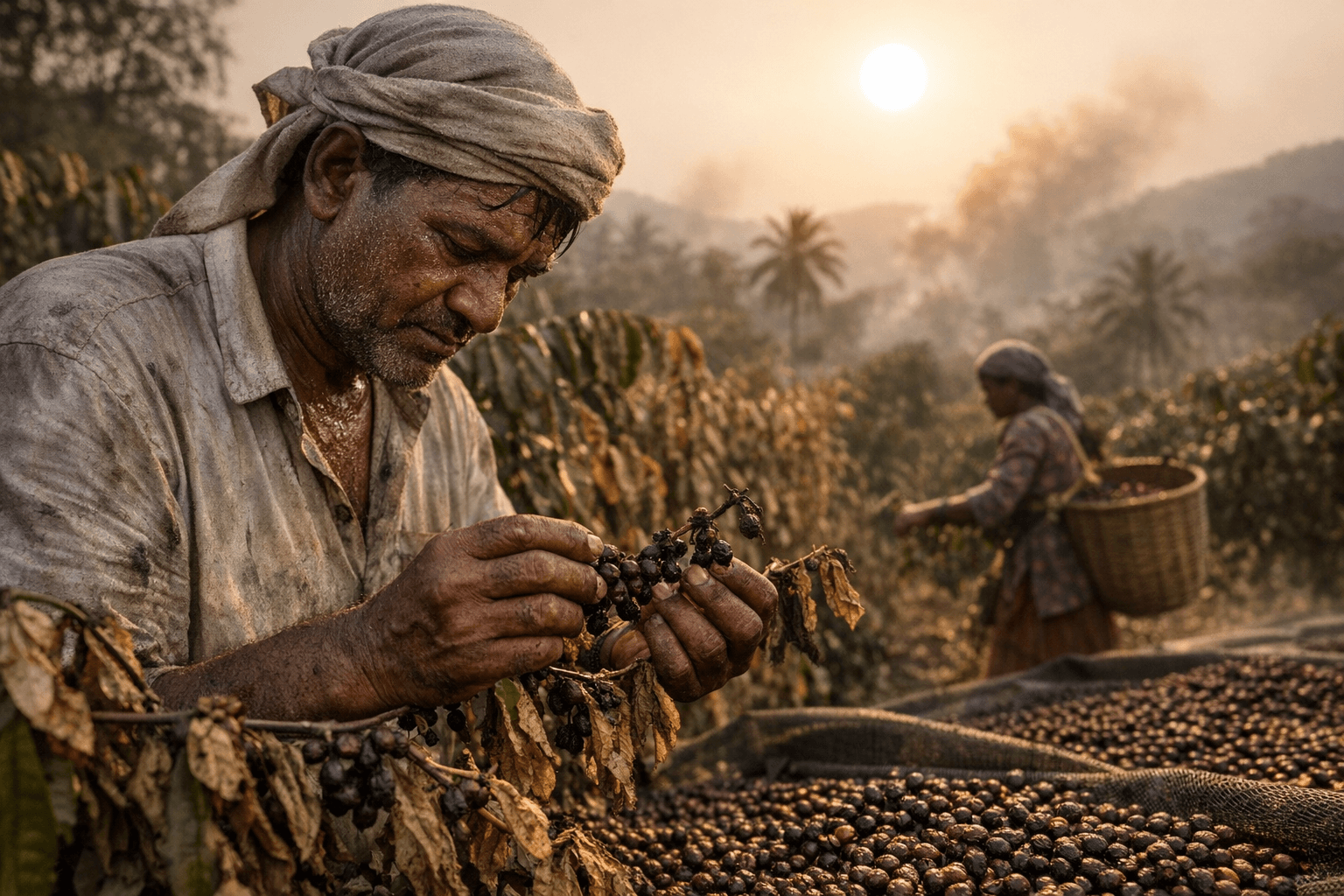
Thirty extra dangerously hot days a year is not a distant warning for India’s coffee belt. It is the new climate burden hanging over farms in the Western Ghats, where researchers found about 118 days a year above 30°C between 2021 and 2025, with roughly 30 of those days tied directly to climate change.
That matters far beyond the farm gate. India produces about 3.5% of the world’s coffee, and the country’s main growing regions are already feeling the strain. Climate Central’s analysis of 25 coffee-growing countries, which together account for about 97% of global coffee production, found that every one of them experienced more coffee-harming heat during that five-year period because of carbon pollution. In India, temperatures above 30°C are especially damaging for arabica and still suboptimal for robusta, the two beans that anchor the country’s crop.
The heat is not arriving alone. Growers across the Western Ghats have reported erratic rainfall, reduced soil moisture, faster drying of coffee fruit on the plant, warmer nights, and flowering cycles that no longer follow the old calendar. In Karnataka, which produces about 60% of India’s coffee, the pressure is most acute in Kodagu, the district that accounts for around 80% of the state’s output. A study cited in Indian reporting found that Kodagu’s total rainfall fell 7.5% between 1980-85 and 2009-14, from 2,599.6 mm to 2,402.5 mm, while month-to-month rainfall variability increased and humidity declined.
That combination is already hitting productivity and bean quality. Industry observers say disrupted flowering can cut yields, while uneven moisture and heat stress can spoil the crop before harvest. Planters in Kodagu, Chikkamagaluru and Hassan have said the farming calendar no longer matches memory, and some estates are now experimenting with Liberica, a more climate-tolerant coffee that can handle heat, drought and variable weather better than arabica.
State-level figures show how broad the pressure has become. Kerala saw an annual average of 65 additional extreme-heat days linked to climate change, Tamil Nadu 43, Karnataka 32, Tripura 47 and Telangana 44. For coffee farmers, those numbers translate into more stress on blossoms, more uncertainty at harvest, and more risk that suitable land for coffee will shrink in the decades ahead.
The warning lands in a market already on edge. Global coffee prices have been volatile, reaching record highs in December 2024 and again in February 2025. If India’s heat keeps climbing, the damage will not stay in the hills of Kodagu. It will show up in tighter supply, shakier farm incomes and pricier cups for drinkers everywhere.
This article was produced by Prism’s automated news system from verified source data, official records, and press releases, then run through automated quality and moderation checks before publishing. The system is built and supervised by the people who set the standards it runs under. Read our full AI policy.
Did this article answer your question?