El Salvador coffee output seen falling again amid climate strain
El Salvador’s crop is forecast to drop to 542,000 bags even as prices stay firm. Stable acreage, aging trees, and labor loss are keeping output on the slide.
El Salvador’s coffee industry is headed for another down year, and the problem is no longer just weather. Green coffee production is forecast to fall to 542,000 60-kilogram bags in market year 2026/27, down from 586,000 bags in 2025/26, even as the country keeps roughly 118,000 hectares in coffee. The numbers point to a structural squeeze: trees are aging, farms are undercapitalized, workers are leaving, and the money to renovate fields is still not getting through.
The latest hit came in December 2025, when torrential rains knocked ripe cherries off the trees at peak ripeness and damaged both yields and milling quality. That came on top of a longer climate pattern that has made Salvadoran coffee one of Central America’s more fragile origins. The sector is still dealing with a lack of long-term strategy, high input costs, and labor shortages tied to rural-to-urban migration, while many farmers have shifted into cocoa and white corn or sold land to real estate developers just to stay afloat.
Financing remains one of the biggest bottlenecks. Private banks continue to treat coffee as a high-risk business and are reluctant to lend, which leaves producers unable to pay for pruning, fertilizers, or replacement seedlings. Even government distribution of seedlings has run into the same wall: many small farmers cannot afford the planting and maintenance needed to keep young trees alive. USDA projections say El Salvador would need about 30 million rust-resistant plants a year for 10 years to fully renovate the coffee area, a scale of investment the sector has not yet been able to mount.

The result is a country that can still sell coffee, but cannot rebuild its farm base fast enough to stop the slide. Exports are expected to rise slightly because higher prices are encouraging sales, and the United States remains the key market, alongside Belgium, Canada, Italy, Germany, Japan, Saudi Arabia and the United Kingdom. But more beans moving out the door do not fix the underlying decline in production, especially when many farms are too old to respond well to another shock.
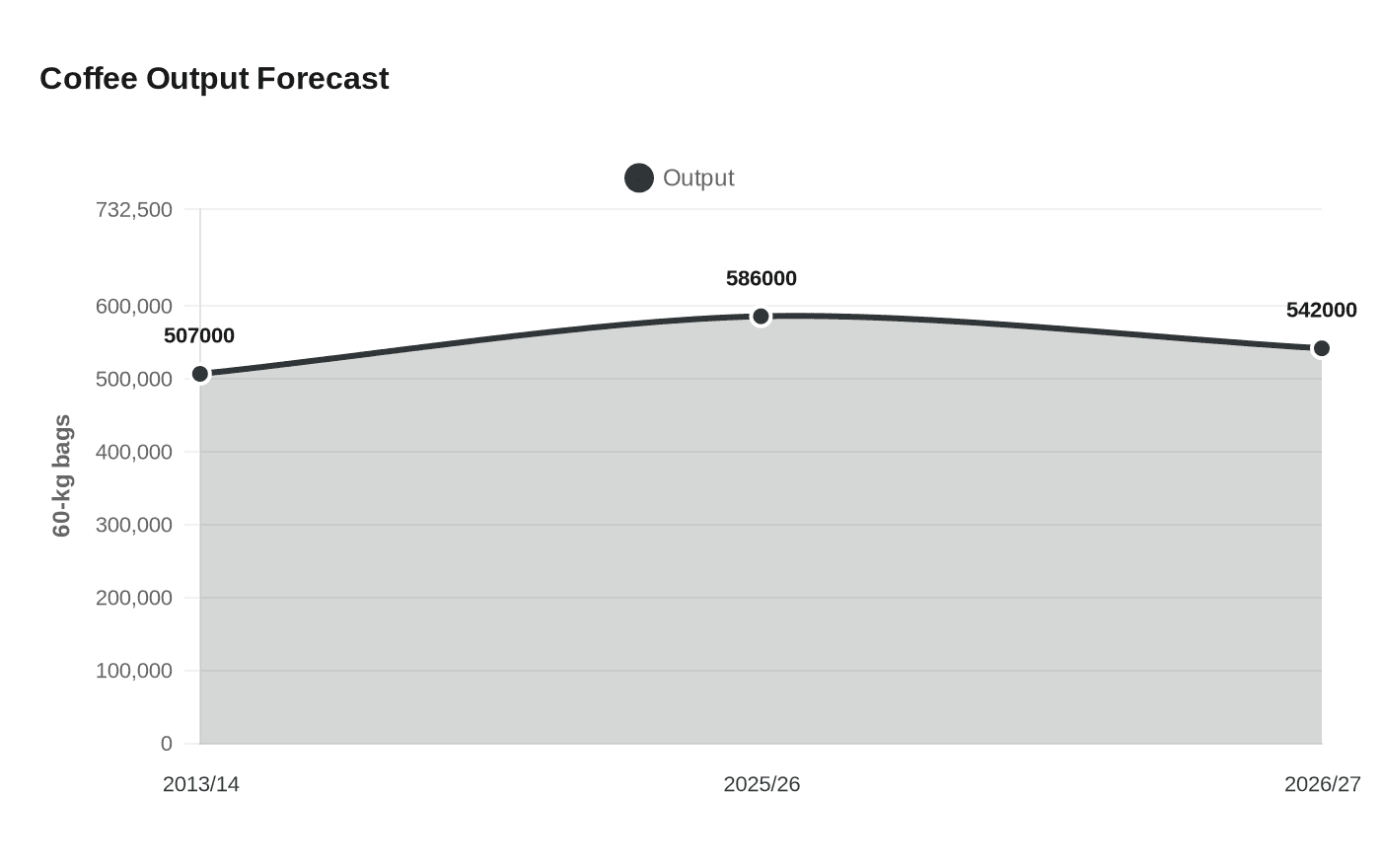
El Salvador has been here before. Coffee output collapsed to 507,000 bags in 2013/14 after a severe leaf rust outbreak, and FEWS NET said production fell 70% between the 2010/11 and 2013/14 seasons. The employment base shrank too, from more than 100,000 jobs to 37,005 in 2019/20, then only partly recovered to 42,513 in 2022/23. With Acafesal saying the 2025/26 harvest needed more than 150,000 pickers and younger workers drifting to construction and manufacturing, the country’s coffee future still looks constrained by the same pressure points that have already hollowed out its past.
This article was produced by Prism’s automated news system from verified source data, official records, and press releases, then run through automated quality and moderation checks before publishing. The system is built and supervised by the people who set the standards it runs under. Read our full AI policy.
Did this article answer your question?