Starbucks Transfers China Majority Stake to Boyu Capital in New Joint Venture
Starbucks handed 60% of its China retail business to Boyu Capital, setting a target of 20,000 stores from 8,000 in the world's most competitive coffee market.
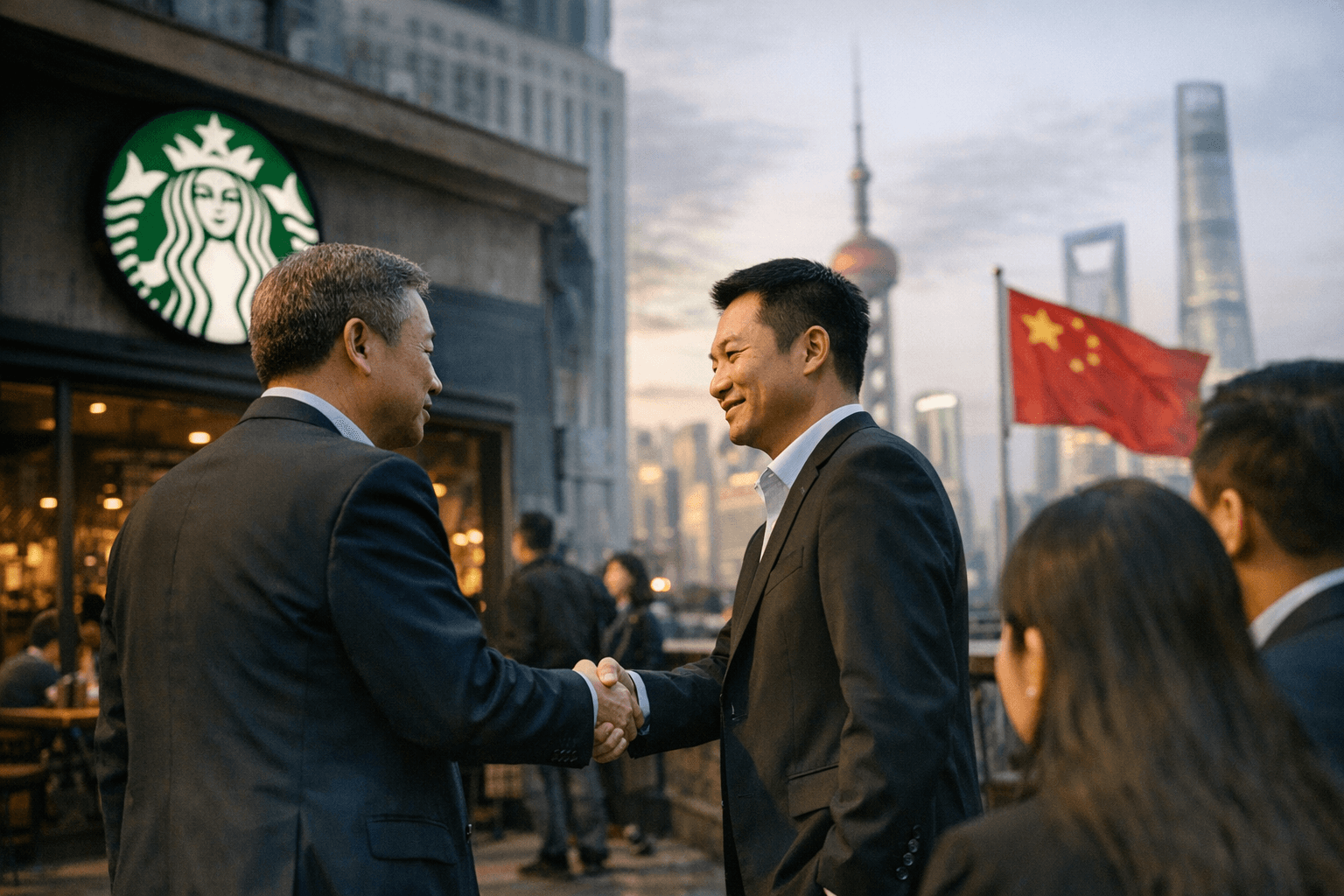
With roughly 8,000 stores already blanketing mainland China and a private-equity firm now calling the operational shots, Starbucks formalized what may be the most consequential restructuring in the company's international history. The coffee giant closed its joint venture with Boyu Capital on April 2, transferring 60 percent ownership and operational control of its China retail business to funds managed by the firm. Starbucks retains a 40 percent minority interest plus full ownership and licensing rights to its brand and intellectual property across the market.
The enterprise carried a cash-free, debt-free valuation of approximately $4 billion when the partnership was first announced in November 2025. That figure reflects the retail operational footprint alone; Starbucks' continuing equity stake and long-term licensing revenue stream extend the total economic exposure considerably further.
The explicit ambition behind the deal is scale. The joint venture is targeting a more-than-doubling of the current store count, with a long-term goal of 20,000 Starbucks locations across China. Reaching that number from 8,000 would require opening stores at a pace that outstrips anything Starbucks has previously attempted in the country, pressing deep into lower-tier cities where domestic rivals Luckin Coffee and Cotti have already built formidable positions at drastically lower price points.
That competitive pressure is precisely why the Boyu structure matters beyond the transaction itself. By ceding majority control to a firm with deep local capital networks and market expertise, Starbucks acknowledged that running a rapid-expansion playbook in China requires more than a multinational operating model. The company framed the arrangement as a move to "unlock sustainable, disciplined growth," language that signals as much caution about overextension as it does confidence in the growth runway. CEO Brian Niccol positioned the deal as a strategic acceleration play, arguing that the joint venture allows Starbucks to scale more quickly across its second-largest global market while preserving the brand integrity that underpins its premium pricing.
That premium is the central tension in the expansion plan. Starbucks China stores typically command prices well above what Luckin or Cotti charge, and any push into new cities will test whether that positioning holds outside the coastal markets where Starbucks built its China footprint.
For coffee watchers globally, the structural logic of the Boyu deal carries a second-order implication. China has become a laboratory for beverage innovation, from tea-infused lattes to regionally specific cold brew formats, often conceived and tested at speed by local operators. With Boyu's operational control and an expansion target of 20,000 stores, the joint venture has both the incentive and the resources to localize aggressively. Ideas that prove out in Chengdu or Wuhan have a history of migrating to Starbucks menus worldwide; the sheer scale of the new joint venture means the pipeline of China-born concepts heading to other markets could grow considerably wider.
The deal also repositions Starbucks as a capital-lighter operator in China. Rather than absorbing the full capital expenditure burden of opening thousands of new locations, Starbucks collects licensing fees, retains upside through its 40 percent equity, and preserves the option to adjust or monetize that stake as market conditions shift. It is a structure that trades day-to-day control for long-term financial flexibility, and in a market as complex and fast-moving as China, that may prove the smarter bet.
This article was produced by Prism’s automated news system from verified source data, official records, and press releases, then run through automated quality and moderation checks before publishing. The system is built and supervised by the people who set the standards it runs under. Read our full AI policy.
Did this article answer your question?