Columbia park system offers clues for Missouri cricket fields
Columbia turned American Legion Park into cricket’s first official home, showing Missouri cities how existing fields, approvals, and park calendars can make room.

If you are trying to get cricket onto a real municipal field in Missouri, Columbia shows the shortest route: work with the park system that already has lighted diamonds, a reservation calendar, and an office that can assign a space. The city’s first official cricket field at American Legion Park matters because it changes the question from where players can improvise to where they can actually show up and play.
Why Columbia works as a model
Columbia is a useful test case because it is not a city built around cricket. Columbia Parks & Recreation oversees more than 3,800 acres of parkland, maintains 75 parks, and manages more than 62 miles of trail, all inside a year-round sports program meant to create recreational opportunities for adults and youth. In other words, cricket did not arrive in a blank space. It had to fit into an established municipal system that already had its own rules, seasons, and field priorities.
That is exactly why Columbia matters to players in St. Louis, Kansas City, and Springfield. If your city already has baseball and softball fields, the Columbia example shows that cricket does not need a brand-new sports complex first. It needs a field assignment, a place to check the schedule, and enough consistency for a league to build around.
The park that made it possible
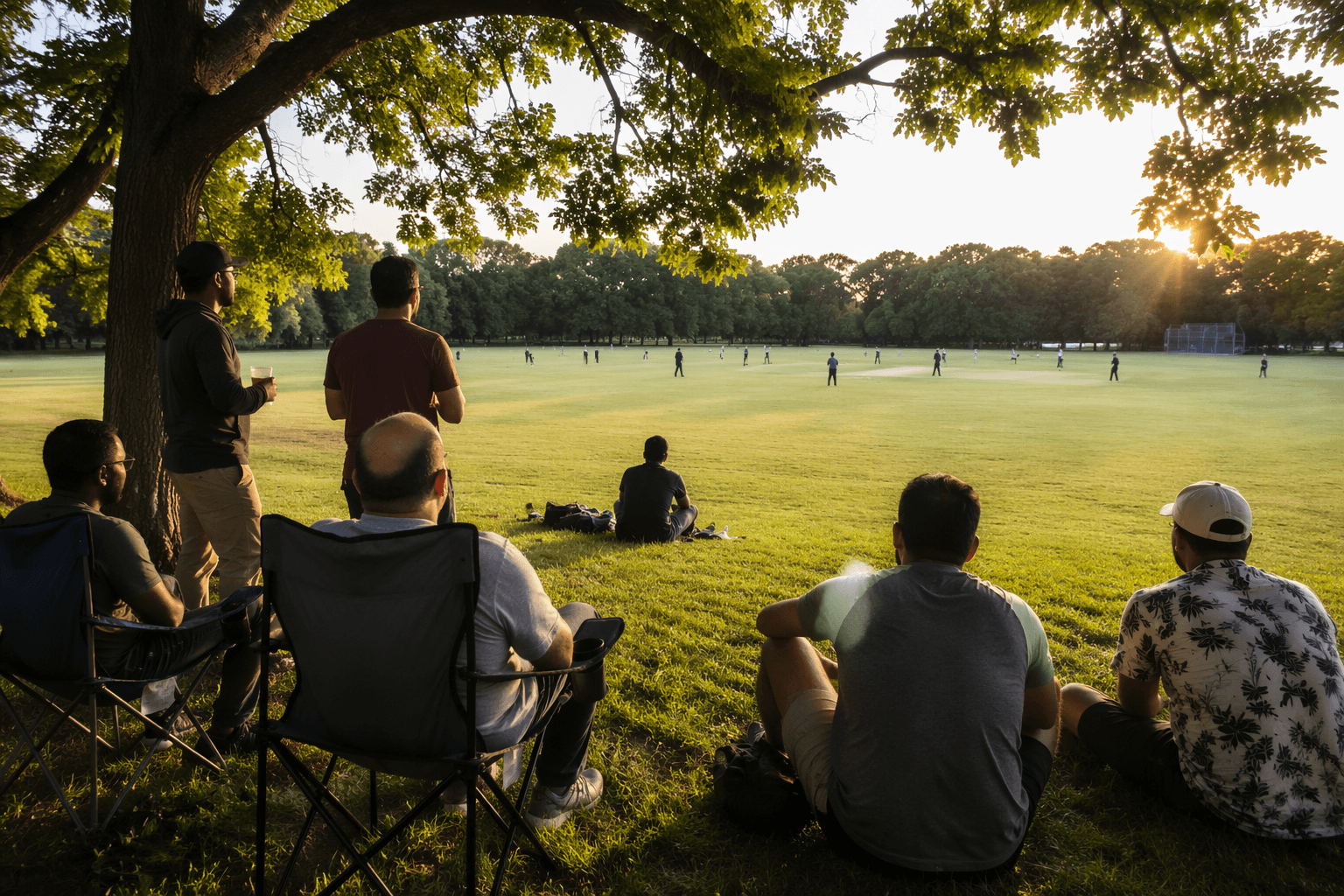
American Legion Park gives a clear picture of the kind of place that can absorb cricket. It is a 17-acre community park with two lighted baseball fields, a concession stand and restrooms, a fishing pond, two non-reservable picnic shelters, and a playground. The park also holds Columbia’s only archery range, which tells you something important about how the city thinks about shared public space: one park can serve several different user groups at once.
The field layout is also revealing. The city says the gold field on the east side can be used as a baseball or softball field, while the blue field on the west is reserved for baseball only. That kind of split use is the kind of compromise cricket groups can work with, because it shows the park system is already accustomed to balancing one field’s function against another’s.
For cricket players, the nearby amenities matter just as much as the grass. The presence of a concession building and restrooms makes the park easier to use for youth matches, league days, and long summer sessions. Batting cages at the park add another layer of familiarity for baseball users and give park staff a sense that this is already a bat-and-ball hub, not an alien request.
What Columbia’s reservation system teaches
The biggest lesson is that a cricket field is only useful if it can actually be scheduled. Columbia Parks & Recreation says it maintains approximately 22 baseball and softball fields that can be reserved for youth and adult games, tournaments, and practices. During March, weather permitting, Antimi Fields, Albert-Oakland Park, American Legion Park, and neighborhood parks can be opened for reservations. In April and May, as well as September and October, Antimi, American Legion, and Albert-Oakland fields are prioritized for Diamond Council leagues. From November through February, the baseball and softball fields are closed.
That calendar tells cricket organizers where the pressure points are. If you want municipal space, you need to understand when a park department is already committed to its busiest youth and adult seasons. Columbia’s model suggests that cricket grows faster when it does not ask a parks department to abandon baseball and softball, but instead finds a lane inside the existing schedule.
A practical blueprint for Missouri cities looks like this:
- Use one named park inside the city’s regular field network, not a special one-off site.
- Make sure the park has lights, restrooms, and access people already recognize.
- Ask for a consistent season or recurring reservation window, not random open dates.
- Expect to share space with baseball and softball rather than replace them.
- Put the request through the city’s sports division so the field sits inside the official system.
Columbia’s sports division is based at the Columbia Sports Fieldhouse, which is another clue for players trying to get organized. When a city has a central place that handles leagues, fields, and youth sports, cricket does better by learning that structure and using it. Columbia’s sports program is designed for adults and youth alike, so the path to a cricket field runs through the same civic machinery that already handles other local sports.
Why the official field changes the game
A 2025 Columbia video report says cricket players now have an official field at American Legion Park, and that the city has both a youth cricket league and an adult cricket league. The report names Sumit Gupta and Mayukh Ghosh, giving Columbia cricket a pair of local faces instead of leaving it as a vague growth story. A secondary write-up says the city dedicated the space earlier in 2025 so players could have a consistent location.
That consistency is the real breakthrough. Cricket depends on a repeatable strip, steady access, and enough certainty for players to learn rhythms, hold matches, and bring new people into the game. Once a city gives the sport a recognized home, the field stops being a favor and starts being infrastructure.
What Missouri players can take from it
Columbia also sits in a spot that makes the lesson easy to see. Mizzou describes the city as having about 120,000 people and sitting midway between St. Louis and Kansas City, which makes it feel like a practical center point for the state rather than a specialty outlier. The city’s recreation culture is broad, and cricket has found room by entering that broader system instead of standing outside it.
That is the Columbia lesson for Missouri cricket: start with the park map that already exists, learn the city’s reservation seasons, and ask for a field that can be used again and again. American Legion Park was already a busy public space before cricket arrived. The difference now is that one of its fields can finally be used for a game Missouri players have been building toward all along.
This article was produced by Prism’s automated news system from verified source data, official records, and press releases, then run through automated quality and moderation checks before publishing. The system is built and supervised by the people who set the standards it runs under. Read our full AI policy.
Did this article answer your question?