African Flower Crochet Pattern Turns Scrap Yarn Into Versatile Projects
A 6-petal African flower motif turns scrap yarn into blankets, pillows, plushies, and bags, with a 6-inch repeat that makes planning simple.
Why this motif keeps coming back
The African flower crochet pattern earns its place because it does one thing modern crochet needs more than ever: it scales. A single 6-petal flower can stand alone as a motif, but it can also become a repeatable building block for a blanket, a cushion, or a bag without forcing you into one fixed finish. That flexibility is the reason this design keeps resurfacing while trendier one-off motifs come and go.
Kimberly Arenas frames the pattern as a practical, beginner-friendly motif rather than a decorative dead end. If you know the basic foundational stitches, you can work the flower without getting trapped in complicated shaping, and that makes it a solid choice whether you are testing a new color idea or mapping out a larger project. In a craft where too many patterns are all concept and no utility, that matters.
What the African flower gives you on day one
The appeal starts with the structure. This is a 6-petal African flower crochet motif, and each flower hexagon is roughly 6 inches, which gives you a real measurement to plan around before you commit to a big project. That size is a practical sweet spot: large enough to feel like progress, small enough to stay manageable when you are building a stack of pieces.
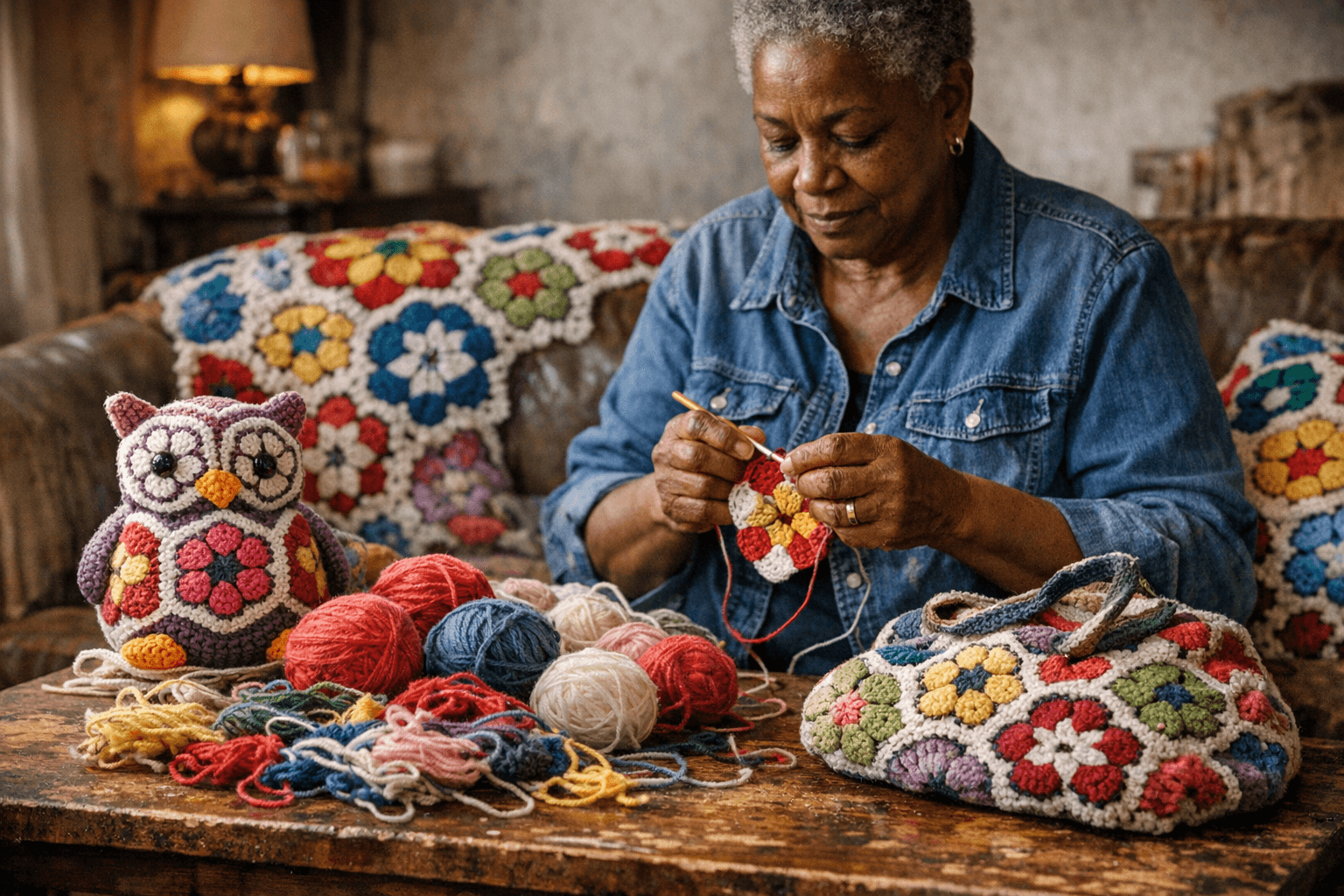
The pattern is explicitly positioned for blankets, pillows, and plushies, which tells you how adaptable it is in real use. You are not being nudged into a single finished object. Instead, you are getting a motif that can be stitched once for a small accent or repeated many times for a larger fabric with more visual punch.
That is also why African flower patterns photograph so well once they are assembled. The shape gives you clean geometry, and the flower centers and petals create instant color contrast without requiring fussy construction. For projects that need to look lively fast, that is a useful shortcut.
Why scrap yarn is exactly the right match
This is one of those patterns that makes stash busting feel intentional instead of improvised. The Caffeinated Snail points out that the motif works with random color combinations or a more coordinated palette, so you can use whatever is in your leftover yarn bin or plan a controlled color story from the start. Either way, the structure absorbs the color variation and makes it look like a design choice.
That is where the motif beats a lot of trendy, one-off patterns. A novelty square can be fun once, but if it does not repeat cleanly, it often stalls out after the first sample. The African flower motif is repeatable, modular, and easy to collect over time, so you can make a stack of pieces first and decide later whether they become a blanket, an accessory, or a decorative panel.
The portability helps too. Interweave notes that motif projects are especially portable because you often work on one motif at a time. That is a real advantage if you like taking crochet with you, because you do not need to drag a half-finished blanket everywhere just to make steady progress.
How the size changes your project planning
A motif that measures roughly 6 inches is easy to count in multiples, which is exactly what you want when you are laying out a bigger project. If you are building a throw, a pillow front, or a bag panel, that scale helps you estimate how many pieces you need before you start joining. It also keeps the project modular enough that you can stop after a few motifs if you only want a small accent.
The Caffeinated Snail’s related African flower bag pattern pushes that logic even further. That bag is made from 13 by 8 petal African flower crochet squares, which shows how naturally the motif can be adapted into structured accessories. Once you understand the size and repeat, the same design language can move from a square, to a panel, to an assembled bag without losing its identity.
That is the practical genius of motifs like this. They let you build in stages, which means you can experiment without gambling the whole project on one big commitment.
Beginner-friendly, but not boring
The instructions are framed as beginner-friendly as long as you already know the basic stitches, which makes the pattern accessible without being simplistic. You are not learning a whole new crochet language here. You are learning how to use a motif system, and that is a skill that pays off in every future project you make.
Because the motif is so clear in shape and repeat, it also gives newer crocheters a strong payoff. You finish one flower and immediately know whether your tension, color choices, and stitch placement are working. For more experienced crocheters, the interest comes from assembly and customization rather than technical difficulty.
That is the kind of pattern that keeps people engaged. It gives you a quick win, then leaves room for bigger decisions later, which is exactly what keeps motif work from feeling stale.
Where it fits in crochet right now
Crochet is relatively young, originating in the early nineteenth century, but motif-based work has become one of the craft’s most durable formats because it can be portable, colorful, and built one piece at a time. Flower motifs keep showing up in projects like afghans, skirts, scarves, and decorative home pieces because they offer visual impact without demanding complicated shaping.
The African flower sits comfortably inside that tradition. The Caffeinated Snail has also developed the idea into an African Flower Granny Square Pattern and an African Flower Bag Pattern, which reinforces that this is not a novelty design with one narrow use. It is an established motif family with enough flexibility to support multiple project types.
If you want a crochet pattern that makes scrap yarn look deliberate, gives you a clear 6-inch planning unit, and can move from small motif to finished object without friction, this is the kind of pattern worth returning to. The African flower endures because it does not just decorate a project, it gives the project its structure.
This article was produced by Prism’s automated news system from verified source data, official records, and press releases, then run through automated quality and moderation checks before publishing. The system is built and supervised by the people who set the standards it runs under. Read our full AI policy.
Did this article answer your question?