Choi+Shine turns crochet into community-made architectural installations
Crochet becomes architecture when Choi+Shine turns lace motifs, metal armatures, and volunteer labor into walk-in installations with real social gravity.

Crochet stops looking like a domestic handcraft the moment Choi+Shine stretches it across iron and metal armatures big enough to walk under. Founded in 2003 by Jin Choi and Thomas Shine, the studio has spent years pushing the same basic logic every crocheter knows, repeatable motifs joined by hand, into art, public art, design, and architecture.
How the stitch scales up
The useful thing to understand about Choi+Shine’s work is that it is not crochet pretending to be something else. It still depends on the same fundamentals of tension, repetition, and modular assembly, but the scale changes the reading completely. The studio says its crochet-based pieces often sit on iron or metal armatures, with Choi designing the motifs and Shine handling the structural components, so the soft material gets a hard skeleton before it ever becomes an installation.
That balance is what keeps the work from collapsing into gimmick. Choi says she researched lace archives and enlarged traditional lace motifs while keeping the original designs intact, including references to 16th-century patterns. In other words, the visual vocabulary comes from old lace, but the engineering is what lets it live outdoors, hang overhead, or fill a room without losing its crisp edges.
For anyone who crochets at home, that is the real takeaway: a motif can stay recognizable even when it is blown up many times, as long as the joins, support points, and shaping remain disciplined. Choi+Shine’s installations show that crochet’s strongest asset is not simply texture, it is modular structure.
Why the work became communal
The studio’s own history makes the social side of the process impossible to miss. Choi and Shine have said that making immense installations alone was too labor-intensive, and that bringing in volunteers gave the work a stronger sense of ownership and connection. Colossal group-making is not a side effect here, it is part of the method.
That shift is visible in project after project. The studio says local groups became a mainstay of the practice because the process turned into a shared build rather than a solitary fabrication job. The result is not only bigger work, but a different kind of authorship, one in which the finished piece carries the trace of many hands instead of a single maker’s rhythm.
The social payoff shows up most clearly when the work moves into public settings. Choi has said it is emotional to watch people from different backgrounds become friends through the workshops, and Shine has described the human connection as more powerful than simply viewing art in a museum. That is a familiar truth to anyone who has sat in a crochet circle, only here the circle is scaled up to architectural dimensions.
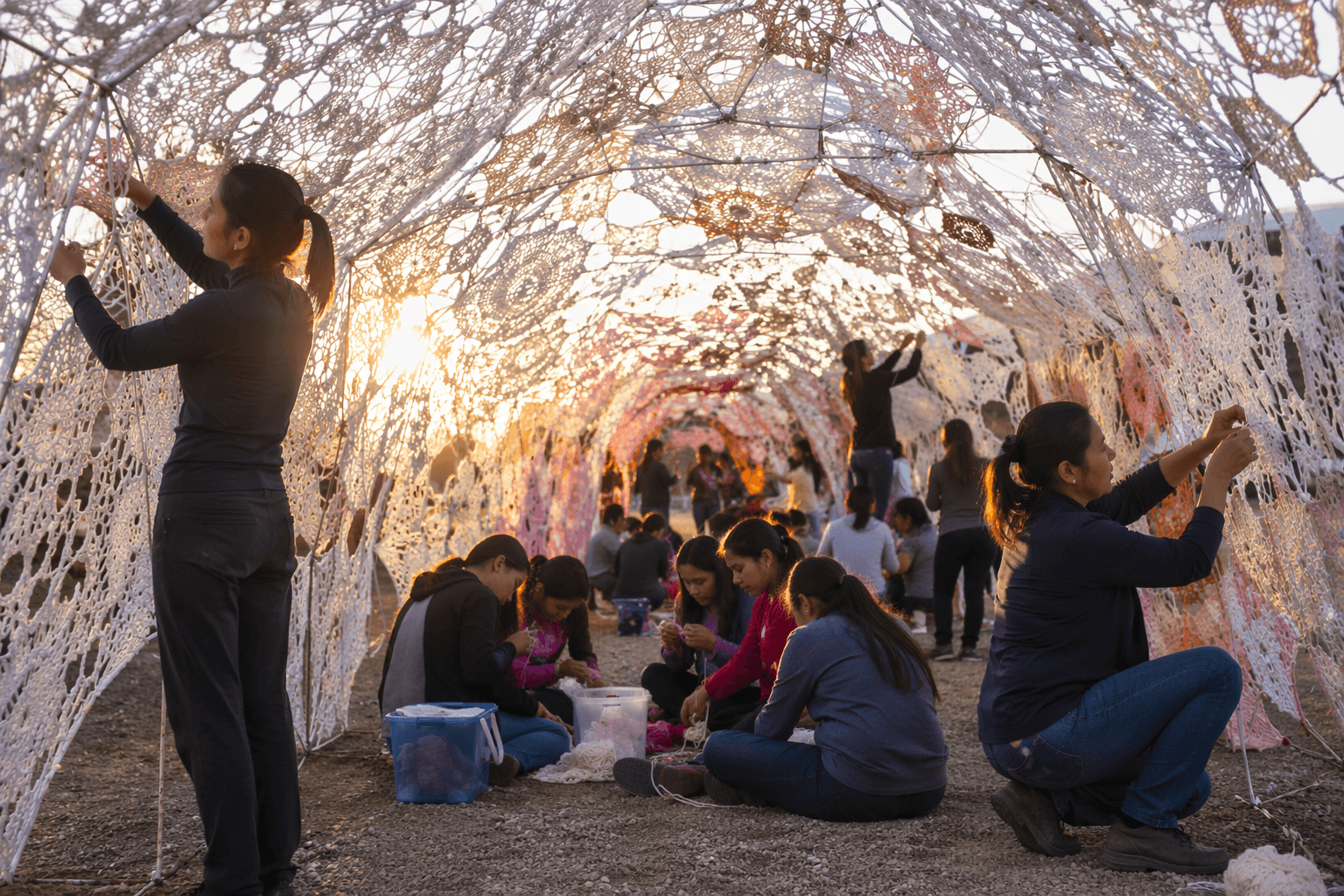
The Trees: crochet as a local build
The Trees, installed at Stockwood Discovery Centre in Luton, United Kingdom, is the clearest example of the studio’s communal method in action. The project ran from April to December 2022 and called for local volunteers to crochet the segments first, then sew the pieces together afterward. The process was slow, physical, and unmistakably collaborative.
Choi+Shine says the project created friendships, confidence, and a sense of ownership among the volunteers. One volunteer described the work as difficult at first but ultimately rewarding, with friendships forming through the making process. That is the kind of detail that matters in crochet, because the craft is often sold as relaxing solo time, when in practice the best projects are frequently social and repetitive in the best possible way.
For makers, The Trees is a useful reminder that assembly matters as much as stitch choice. Crocheting the components first and joining them later gives a large installation flexibility during fabrication, while still letting the final surface read as one continuous textile form.
Urchins, ARIZONA!, and the engineering of lace
The Urchins project, created for the 2017 iLight Marina Bay festival in Singapore, shows how Choi+Shine adapts crochet to a specific environmental brief. The festival theme was biomimicry and sustainability, and the studio answered with forms built from strong marine-grade cord held rigid in metal construction. The piece is not delicate in the usual sense of the word, even if it looks lace-like, because the cord and frame are doing the work of making the surface survive.
ARIZONA! takes the same idea and stretches it across a different landscape. Designed to float over the Arizona Canal, it was hand-crocheted in small pieces by volunteers from across the United States who followed patterns developed by Jin Choi. The studio says the lace ribbon was designed so it could be formed in many shapes while still retaining crisp lines and surfaces, which is exactly the kind of design problem that interests crocheters who like modular builds, drape control, and repeatable segments.
Both projects make the same point in different registers. Crochet can be ornamental, but it can also be spatial. Once the material is paired with a frame, a floating support, or a rigid substructure, the work stops behaving like a blanket or garment and starts behaving like a built environment.

Distance and the reach of the method
That logic continues in Distance, presented for the 2025 Hangzhou Triennial of Fiber Art at Zhejiang Art Museum. Choi+Shine says the piece was made with the joint weaving of 110 hands, while other coverage puts the volunteer count at 125 local participants. Either way, the number tells the same story: the work depended on a large collective effort, not a boutique fabrication shop.
The triennial theme, “Re-Constellations,” framed globalization and localization as a central concern, which fits the studio’s practice neatly. Choi+Shine’s work already lives in that space between place-based labor and international circulation, and Distance made that tension visible through the number of hands involved. For crocheters, the lesson is that scale is not only about size, it is also about coordination.
Barcelona, heritage, and public memory
The Barcelona version of The Urchins pushes the community model into cultural memory as well as fabrication. Manifesta 15’s network and educational department helped recruit more than 130 volunteers for the project, and Choi+Shine says the work was meant to honor Catalonia’s industrial, textile, and fishing histories, while also recognizing women’s labor and struggles for equality.
That breadth matters. Crochet here is not just a decorative surface, it becomes a way to hold regional memory in a public form. The same lace logic that starts in archives ends up tied to fishing heritage, textile production, and political struggle, which is a far more ambitious brief than most of us ever ask of a hook and yarn.
Choi+Shine’s broader portfolio, with installations shown at the Victoria & Albert Museum, the Busan Biennale, the European Union’s Global Gateway traveling exhibition, and the Hangzhou Triennial, makes the point plain. This is not a one-off stunt where craft gets enlarged for effect. It is a long-running practice built on the idea that crochet can carry structure, history, and community at the same time, and that a stitch pattern can still feel at home even when it has grown large enough to reshape a room.
This article was produced by Prism’s automated news system from verified source data, official records, and press releases, then run through automated quality and moderation checks before publishing. The system is built and supervised by the people who set the standards it runs under. Read our full AI policy.
Did this article answer your question?