Craftivism's Legacy: Can Knitting and Crochet Still Drive Social Change?
From pussyhats to Melt the ICE Hats, craftivism has never really gone quiet - but a new Vox feature asks whether fiber arts can still change minds in 2026.

The Word That Changed What a Hook Means
Betsy Greer started writing about the connections between craft and activism as early as 2002, when the two terms felt, in her own words, "very (at the time) out-of-touch." By 2003, she had launched craftivism.com and given the portmanteau its name. That name, "craftivism," blending craft and activism, would eventually attach itself to pink hats on the steps of the Washington Monument, guerrilla knitting on Confederate statues, and, in 2026, yarn circles protesting immigration enforcement. It started as a blog. It became a lens through which a generation of fiber artists understood their own needles.
Greer defines craftivism as "a way of looking at life where voicing opinions through creativity makes your voice stronger, your compassion deeper and your quest for justice more infinite." That framing matters because it positions craft not as a cute supplement to "real" activism, but as its own mode of political consciousness. Now, with Vox journalist Rachel Cohen Booth revisiting the movement's arc in 2026, the crochet community finds itself at the center of a genuine reckoning: what does it mean to wield a hook as a political instrument when the political landscape has shifted so dramatically beneath your feet?
Craft as Subversion Has a Long Memory
Sewing, knitting, and embroidery have historically been considered activities that fall under a woman's domain, rooted in domesticity and wifely duties. Perhaps this is why these have also become symbols of subversion, rebellion, and activism. There is a particular irony embedded in the logic of craftivism: the very qualities that kept fiber arts coded as "lesser" (feminized, domestic, quiet, slow) are precisely what make them disruptive when carried into the public square. A knitted kudzu vine draped over a Confederate monument hits differently than a spray-painted slogan, because it arrives in a language no one expects to be radical.
Yarn bombing, or graffiti knitting as it is sometimes called, uses knitting and crochet as a feminised response to the predominantly masculine street-art scene, making a statement about a woman's place in public space. This is craftivism at its most architectural: it claims territory without destruction, invites curiosity rather than confrontation, and leaves behind something soft in a world that defaults to hard edges.
The Pussyhat and the Moment Everything Scaled
No single object has done more to define craftivism in the popular imagination than the pink pussyhat. One of the most visible examples of craftivism in recent years is the Pussyhat Project, which gained global attention during the 2017 Women's March. The project invited participants to knit or crochet pink hats with cat ears, symbolizing solidarity and protest against misogyny and the erosion of women's rights.
What made the pussyhat remarkable wasn't just the scale, though the scale was staggering. That unity was extended through social media surrounding the creation and distribution of pussyhats, from individuals knitting for family members and friends, to knitting circles and clubs, to craft shops and suppliers. The hat became a supply chain of solidarity. Knitters who couldn't attend the march mailed hats to strangers who could. Yarn stores held knit-alongs in the weeks before. The act of making was inseparable from the act of showing up.
Since the 2016 election, the massive increase in public activism has given rise to more methods of art activism and craftivism as well. The pussyhat was both cause and effect of that surge. It demonstrated that fiber arts could operate at protest scale, and it drew hundreds of thousands of people who had never considered their hobby political into a conversation about what their hands could mean.
A Movement Bigger Than One Hat
The pussyhat was the most photographed, but it was far from the only project. There was also a movement called the Welcome Blanket project, which aims to show solidarity with immigrants and refugees with blankets. Where the pussyhat was confrontational and unified, the Welcome Blanket was quieter, more personal: a single crocheted or knitted rectangle sent ahead to a stranger arriving in an unfamiliar country.
There has also been the Kudzu Project, a guerrilla knitting art installation started in Charlottesville, Virginia, where flash installations of knitted kudzu vines were draped on Confederate monuments to "call attention to the role of these statues in perpetuating false narratives about the Civil War and white supremacy." That project is craftivism at its most site-specific: the choice of kudzu, an invasive vine associated with the American South, layered meaning onto every stitch.
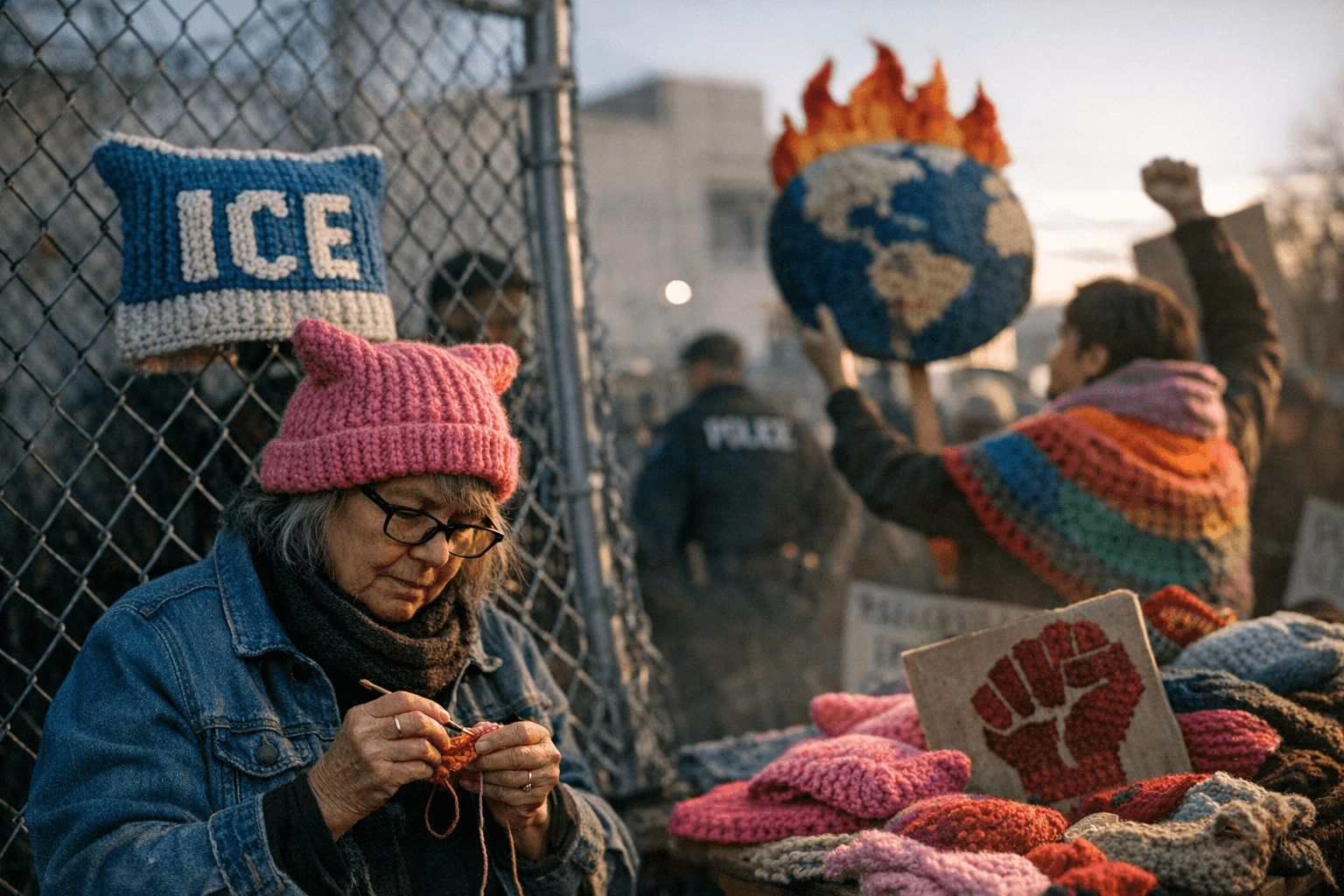
Yarn bombing more broadly continues to assert that public space is not neutral. Activists use yarn bombing to raise public awareness through non-violent protest using yarn and needlework. Attaching needlework, knitting, and crochet to public places subverts this traditional home art to communicate public messages.
The Honest Debate: Symbol or Substance?
This is where Rachel Cohen Booth's Vox feature stakes its most provocative ground. The question isn't whether craftivism has a history; it clearly does, and a rich one. The question is whether it still has teeth. Critics within the movement itself have raised this concern directly. One widely circulated essay questioned whether yarn activism makes participants feel better without actually combating systemic oppression, suggesting that after initial flashpoints like the Women's March, symbolic gestures can feel increasingly hollow when matched against entrenched political power.
Using domestic crafts signified as feminine as a medium of social and political expression and resistance, the lived experience of craftivists draws attention to oppressive and exploitative power relations and uses them to challenge that status. While craft foregrounds the material, embodied, and affective nature of making practices, it also has capacities as a political resource which recognizes the value of everyday materiality in creating change. A 2025 academic paper titled "The Affective Micropolitics of Craftivism" explored precisely this tension, examining how diffuse craftivist communities organize around shared political goals through "traditional techniques of handwork to answer or speak to current political situations."
The honest answer is that craftivism has never claimed to replace marching, organizing, or legislation. Its power is accumulative and relational. It builds community in living rooms and online comment threads, and it makes visible the political stakes of who is allowed to take up space in public.
2026: New Threats, New Stitches
In response to the January 2026 ICE operation in Minnesota, knitting a Melt the ICE Hat became a popular example of craftivism. The speed with which that project emerged, from a specific enforcement action to a named knitting pattern circulating in crafting communities, shows how dramatically online infrastructure has changed the movement's capacity to respond. What once took months of coordination (the pussyhat required weeks of pre-march knit-alongs) now takes days.
From even before the pandemic, the emergence of online crafting communities has facilitated new forms of participation and community. Platforms where crocheters share patterns and works-in-progress have become informal organizing infrastructure. A pattern tagged with a cause can reach tens of thousands of makers within hours. The hook and the hashtag have become genuinely intertwined.
What the Legacy Actually Is
Cohen Booth's Vox feature arrives at exactly the right moment to ask what craftivism's legacy looks like beyond nostalgia for the pink-hatted photograph. The answer, woven through more than two decades of practice, is that craftivism's power was never primarily photographic. It was always about what happens in the making: the conversation at the knit-along, the question a child asks when they see yarn wrapped around a statute, the refugee who unfolds a blanket that a stranger spent hours constructing.
Greer's book, "Craftivism: The Art and Craft of Activism," includes examples of prison craft programs and yarn bombing, demonstrating how broadly the practice extends beyond any single political moment. That breadth is the legacy. Craftivism is not the pussyhat, though the pussyhat is part of it. It is a persistent, low-barrier, highly portable form of political participation that has proven capable of scaling from a single knitter's living room to a global march and back again. Whether it can continue to drive social change in 2026 depends less on the craft itself than on the communities willing to keep showing up, hooks in hand, at the intersections where making and meaning meet.
This article was produced by Prism’s automated news system from verified source data, official records, and press releases, then run through automated quality and moderation checks before publishing. The system is built and supervised by the people who set the standards it runs under. Read our full AI policy.
Did this article answer your question?