Daniela Cerri’s free-form crochet room divider redefines contemporary interior art
Daniela Cerri’s free-form crochet screen turns yarn into a room-sized design object, giving crocheters a fresh reason to think bigger, bolder, and more functional.
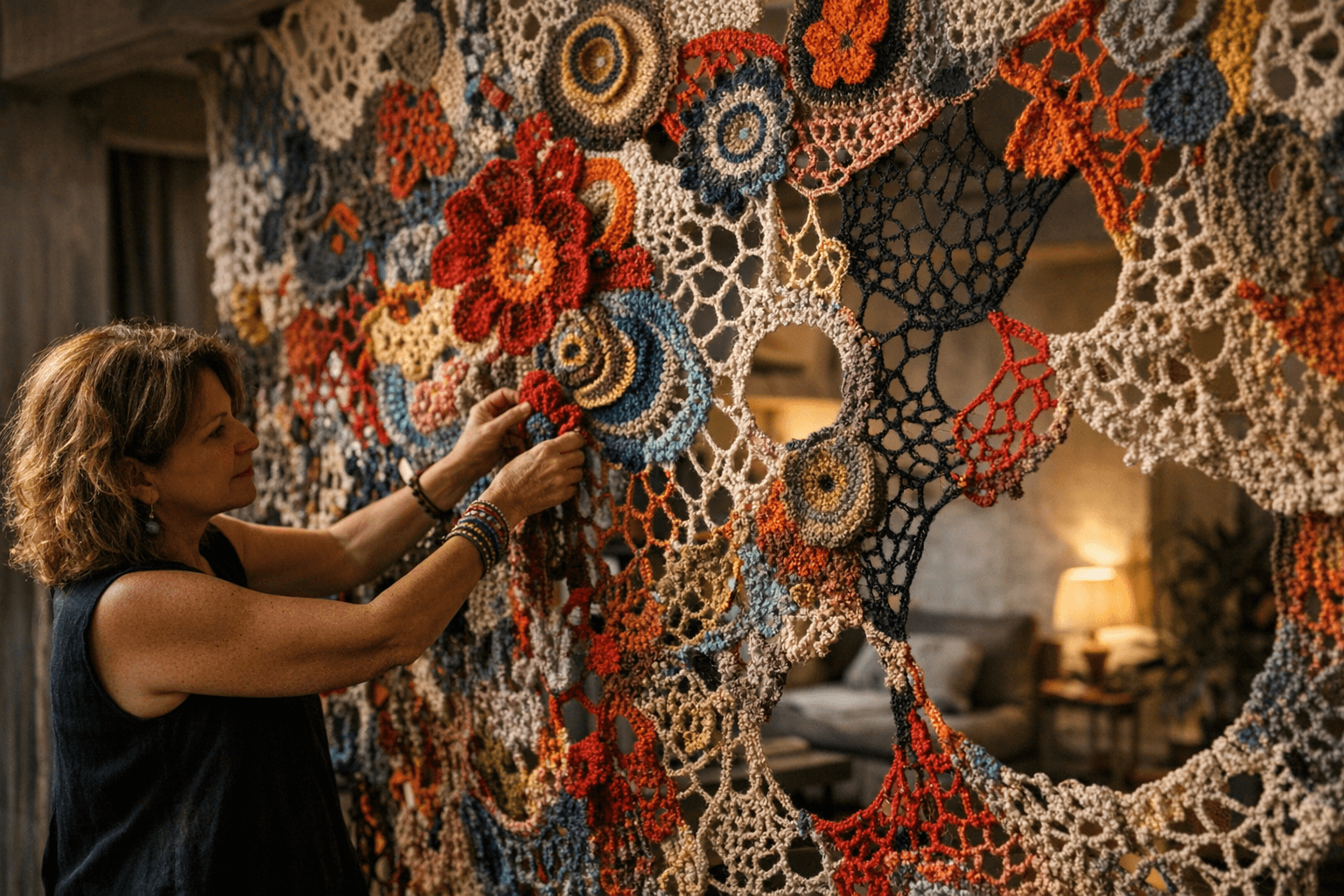
Daniela Cerri’s free-form crochet room divider does something every serious crocheter notices fast: it turns stitch work into architecture. Instead of stopping at a throw, motif, or garment, the piece claims a place in the room itself, making crochet feel less like decoration and more like a functional interior art form.
Crochet that works as a space-maker
What makes this divider so striking is not only its appearance, but its purpose. A room screen is practical by design, and that shifts the conversation from “pretty project” to “usable object.” In a home where flexible layouts matter, especially in small or multipurpose spaces, a divider can separate zones without the permanence of a wall.
That is why the piece resonates beyond art circles. It shows how crochet can participate in contemporary interiors, where screens and room dividers are increasingly used to shape space creatively. For crocheters, that opens a door to thinking in a new scale: how texture reads from across a room, how light moves through openwork, and how a soft material can still hold visual authority.
Why Daniela Cerri’s name matters here
Cerri is not coming at crochet as a one-off experimenter. She describes herself as an Italian designer focused on fashion and home, and as the author of crochet art-books plus digital and print pattern sheets. Her profile also says she has worked in graphic design, illustration, publishing, jewelry workshops, fashion studios, and design offices in Italy and abroad.
That background helps explain why her work feels so layered. Cerri says her practice is driven by research, imagination, experimentation, improvisation, invention, and attention to color and tactile qualities. Those are exactly the qualities that make a free-form room divider feel current rather than quaint. It is built from crochet language, but it speaks in the vocabulary of design, not just craft.
Her profile also notes recognition in Europe and Japan, including Osaka. That matters because it places her work in a wider international conversation about textile art, not just handmade home decor. She was born in Milan and has spent the last few years living in an old stone house in the Oltrepò hills, a setting that adds another layer of texture to the story of a maker who works where heritage, landscape, and contemporary design meet.
A project with real maker appeal
The room divider has the kind of response crocheters pay attention to because it is visibly labor-intensive and visually rewarding. Reposts of the piece described it as a “free form crochet room divider/screen” and noted that it involved “lots of work.” That reaction is telling. People are not just admiring the finished object, they are reading the time, patience, and construction skill inside it.
For crocheters, the appeal is practical as well as inspirational:
- It shows how free-form crochet can move beyond swatches and accessories into large-format design.
- It highlights texture as the main event, not just color or motif repetition.
- It suggests that crochet can solve interior problems, like dividing a room without building a wall.
- It offers a fresh target for advanced makers who want a project with presence, not just portability.
This is the kind of piece that changes what sits on the queue. It proves crochet can be scaled up without losing its handmade character, and that a soft material can still function as a strong design statement.
A maker with a long online trail
Cerri’s room divider also lands differently because her online history shows real continuity. She has been posting crochet projects online since at least 2012, which gives her work a long arc rather than a sudden viral moment. Her 2012 online posts already show an active pattern and project presence, including entries such as “Crochet 3D: Baroc Lamp.”
By 2018, her blog posts included pattern publications such as “Boho Chic Crochet” and “Happy Hippy Crochet,” further reinforcing that she has long treated crochet as a field for design development, not just hobby output. That background matters for readers because it suggests the room divider is part of a sustained body of work. It did not appear out of nowhere. It comes from years of refining a textile voice that moves comfortably between decorative object, pattern publishing, and art-led experimentation.
Connections across the crochet world
Cerri has also appeared publicly alongside Dutch crochet designer Adinda Zoutman in workshop and collaboration posts from 2016 through 2019. That link is important because it places her inside a recognizable international crochet network. For readers who follow the wider fiber world, Zoutman is a familiar name, and the association underscores how these designers push each other toward more ambitious forms.
The cross-border nature of that connection mirrors the broader reach of Cerri’s own profile, which references recognition in Europe and Japan. In other words, this is not a local novelty. It is part of a larger conversation about crochet as an expressive design medium with international momentum.
Why the room divider fits the moment
The reason this piece feels newsworthy now is that it lines up with how people want their homes to function. Flexible space has become a major interior priority, and screens are a smart answer because they divide without closing off. Crochet, with its openness, texture, and ability to filter light, fits that trend surprisingly well.
That gives hobby crocheters a concrete takeaway: you do not need to think of crochet only as wearable or seasonal. A project like Cerri’s points toward home-use pieces that are useful every day and visually distinctive enough to become conversation starters. It is proof that yarn work can enter the room as sculpture, utility, and atmosphere all at once.
Cerri’s divider does more than decorate a corner. It shows crochet operating at full design-object scale, where color, tactility, and structure matter as much as the stitch itself. For makers watching where the craft is headed, that is the real headline: crochet is no longer confined to the craft room.
This article was produced by Prism’s automated news system from verified source data, official records, and press releases, then run through automated quality and moderation checks before publishing. The system is built and supervised by the people who set the standards it runs under. Read our full AI policy.
Did this article answer your question?