Free Plush Whale Amigurumi Pattern Offers Beginner-Friendly Baby Gift Idea
Martha Miller's free plush whale from AmigurumiCorner is the beginner breakthrough project for anyone who's avoided bulky yarn, with a clever two-panel build that solves stuffed toy construction.
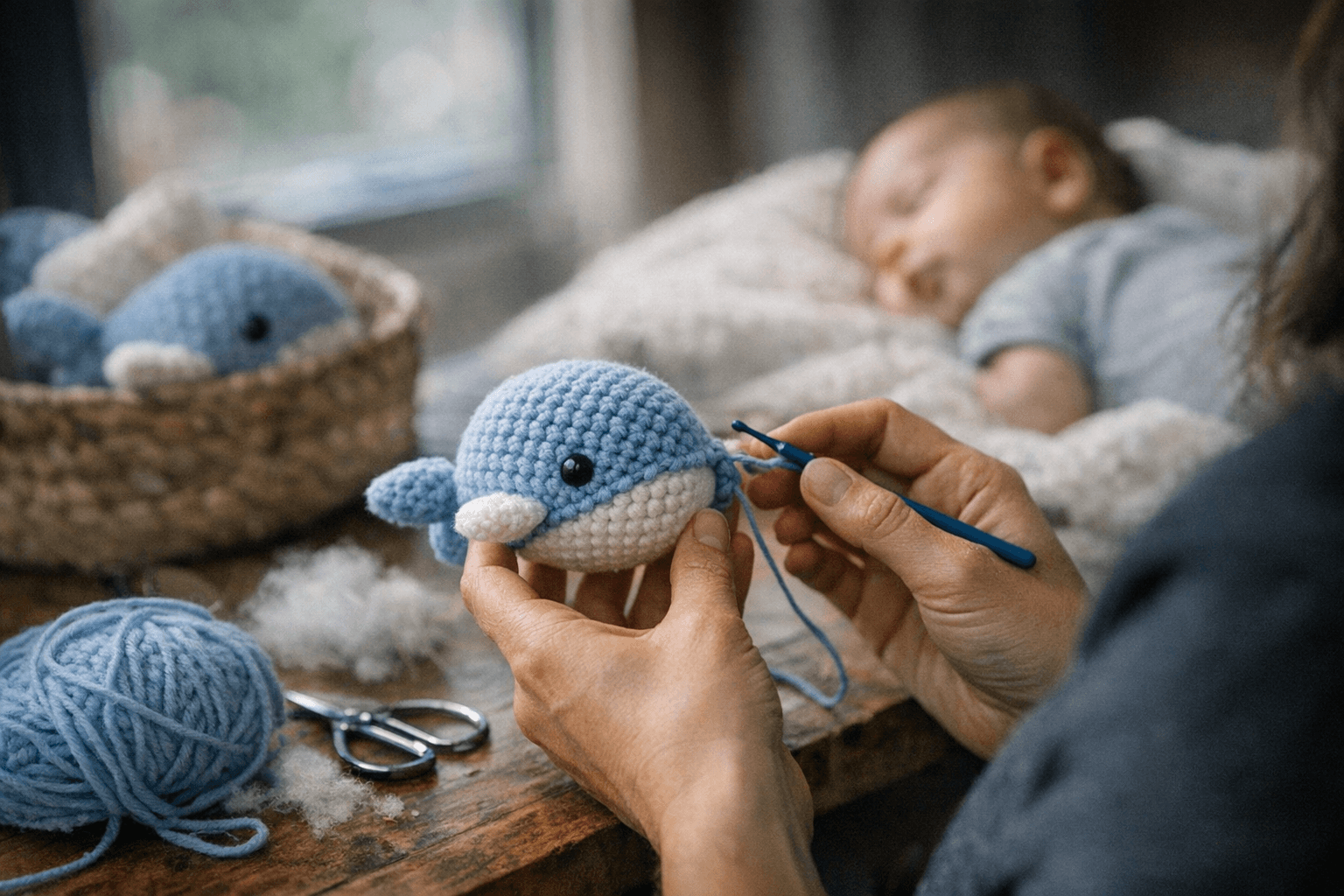
Martha Miller of AmigurumiCorner has built a reputation for patterns that meet beginners where they actually are, and her "Easy Plush Whale Amigurumi" delivers exactly that promise. The finished toy is a soft, rounded sea creature roughly 15 cm tall with a cheerful 19 cm fountain spout and a 15 cm diameter that reads instantly as "whale" from across a nursery shelf. If you've ever picked up a skein of bulky plush yarn, admired its squishiness, and then quietly set it back down because you weren't sure how to handle it, this pattern is the on-ramp you've been waiting for.
What You're Actually Making
The whale's dimensions strike the sweet spot for a handmade baby gift: compact enough to finish in a reasonable session, substantial enough to feel like a real present. The spout at 19 cm gives the silhouette that distinctive character, and the overall construction is designed to hold its shape through regular cuddling.
What sets this pattern apart structurally is the two-panel build. Rather than the fully-in-the-round cylinder-and-sphere approach common to entry-level amigurumi, Martha works a belly panel and a back panel outward from separate magic rings, then joins them to create a seamless, rounded body. The fins and tail are crocheted separately and attached or integrated during the final assembly stage. The payoff is a professional-looking finished toy with minimal seaming, and the seam line itself disappears into the plush fiber halo. For makers who dread sewing up amigurumi parts, this construction method is a genuine relief.
Honest Skill and Time Estimate
This pattern sits at the intermediate beginner level. You should be comfortable with magic rings, single crochets, basic increases, and decreases before starting. If you've finished one or two simple amigurumi in standard acrylic, you're ready. The panel construction adds a small assembly step that doesn't exist in fully-in-the-round designs, but it's more forgiving than tracking precise stitch counts through rounds you can barely see.
Realistically, budget 3 to 5 hours for a first make. Plush yarn works up quickly compared to fingering or DK weight, and the compact size keeps things moving. A confident beginner could finish in a single focused evening; someone newer to seaming and assembly might prefer a relaxed weekend project.
Where Plush Yarn Amigurumi Goes Wrong (And How This Pattern Addresses It)
Plush and chenille yarns handle completely differently from the smooth acrylics most amigurumi tutorials are written for. That gap trips up a lot of makers on their first plush project. Here's where things typically go sideways and how Martha's whale mitigates each problem.
Tight tension you don't notice until it's too late
Plush fibers grip the hook differently than smooth yarn. It's easy to unconsciously tighten your grip as you struggle to track stitches, and a too-tight fabric won't stuff evenly, creating visible puckers at seam lines. The pattern specifies a 4 mm hook paired with bulky plush yarn, which is deliberately on the generous side to encourage an open, squishy fabric. If your finished panels feel stiff rather than floppy before stuffing, size up half a millimeter without hesitation. Gauge is explicitly noted in the pattern as non-critical for overall shape, which removes the pressure to hit an exact number and lets you prioritize fabric hand instead.
You genuinely cannot see your stitches
The fluffy halo of plush yarn buries stitch definition almost completely. Miscounts in decrease rows will distort the whale's silhouette in ways that are hard to fix post-stuffing. Martha provides clear stitch abbreviations in US terms and explicit round-by-round notes, but the practical fix is a locking stitch marker in every single round without exception. A scrap of contrasting yarn works just as well. Move it up every row and don't rely on visual counting through the fiber pile.
Invisible decreases become nearly impossible
In smooth-yarn amigurumi, invisible decreases (invdec) are standard because they tighten the fabric neatly and hide well. In plush yarn, you can't reliably separate the front loops by sight, making invdec genuinely frustrating. Martha's pattern uses standard shaping appropriate for bulky yarn, keeping the decrease technique manageable for the material. And here's the practical truth: a standard sc2tog in plush yarn is completely invisible on the finished toy. The fiber halo conceals it entirely, so you're not sacrificing appearance by using the easier method.
Safety eyes vanish, shift, or become a hazard
Fourteen-millimeter safety eyes are specified in this pattern, and that size is not arbitrary. Smaller eyes simply disappear into the fiber pile and lose their expressive impact. Placement in plush is tricky because you're parting fluff rather than reading a clear stitch grid, so Martha recommends securing the eyes before closing the piece while you still have full access to the interior. Press the washer firmly against a hard surface to seat it fully. For infant-safe gifting, the pattern explicitly advises substituting embroidered eyes, and that substitution is non-negotiable for babies under 12 months.
Stuffing distribution collapses or distorts the form
Underfill a plush whale and it becomes a flat, sad lump; overfill and the seam gaps. The two-panel construction actually helps here in a way the standard approach doesn't: because the belly and back are joined along an edge rather than closed at a single opening, you have incremental control over stuffing placement as you work the seam. The pattern includes specific notes on stuffing distribution to maintain the whale's proportions. Pay particular attention to the spout, which needs enough fill to stand upright and hold its 19 cm height.
Materials and Substitutions at a Glance
- Main body yarn: Bulky plush yarn. Common alternatives include Bernat Blanket, Lion Brand Comfy Cotton Blend in bulky weight, or any bulky chenille with a similar halo.
- Detail yarn: White plush for contrast details. Any white bulky chenille reads well against a colored body.
- Hook: 4 mm as recommended; move to 4.5 mm if your tension runs tight, 3.5 mm if you crochet loosely.
- Eyes: 14 mm safety eyes for children old enough for them; embroidered satin stitch for infant-safe versions.
- Stuffing: Standard polyester fiberfill works fine. Premium fiberfill or a small amount of weighted pellets in the base can improve posture and heft.
Gauge is described in the pattern as non-critical for overall shape, which is accurate and standard for plush yarn amigurumi. Your finished whale may vary slightly from the 15 cm measurement and that's completely acceptable. The thing that matters is fabric density: no stuffing should be visible through the stitches when the piece is held up to light.
Gifting This as a Baby Shower or Nursery Present
The whale's dimensions make it easy to package and photograph, and plush yarn delivers the kind of satisfying squishiness that makes handmade gifts memorable. Martha's pattern includes explicit safety guidance specifically for giftmakers: secure safety eyes with a fully seated washer, ensure all seams are closed without gaps, and avoid any small removable embellishments if the toy is going to a very young child. The two-panel seam construction helps here too, since a well-joined edge is structurally more secure than a drawstring-closed opening.
Why the Two-Panel Method Is Worth Learning
Most beginner tutorials default entirely to in-the-round construction, and it's worth understanding why this pattern's approach is different and valuable. Working flat panels outward from a magic ring and seaming them produces a rounded, organic shape that sidesteps the precision shaping required to build the same silhouette through strategic in-the-round increases. It's a technique that translates directly to other flat-panel amigurumi projects and is substantially easier to execute in plush yarn, where tracking in-the-round stitch counts is already a challenge. The seam line is concealed by the fiber, the assembly is more controlled, and the structural result is a toy built to withstand actual use by a child.
Plush yarn amigurumi have surged back into the maker conversation as crocheters seek tactile, gift-ready projects that reward a beginner's skill set without demanding fine stitch definition. Martha Miller's whale lands exactly in that window: a fast, accessible, genuinely adorable project that builds real skills in plush yarn handling and panel construction while producing a finished object with staying power on any nursery shelf.
This article was produced by Prism’s automated news system from verified source data, official records, and press releases, then run through automated quality and moderation checks before publishing. The system is built and supervised by the people who set the standards it runs under. Read our full AI policy.
Did this article answer your question?