Free Sea Breeze Ripple Blanket Pattern Offers Endless Size and Color Options
Okie Girl Bling N Things' Sea Breeze Ripple is a free, scalable chevron blanket built around simple chain math and eight skeins of worsted, spring-ready and beginner-friendly.
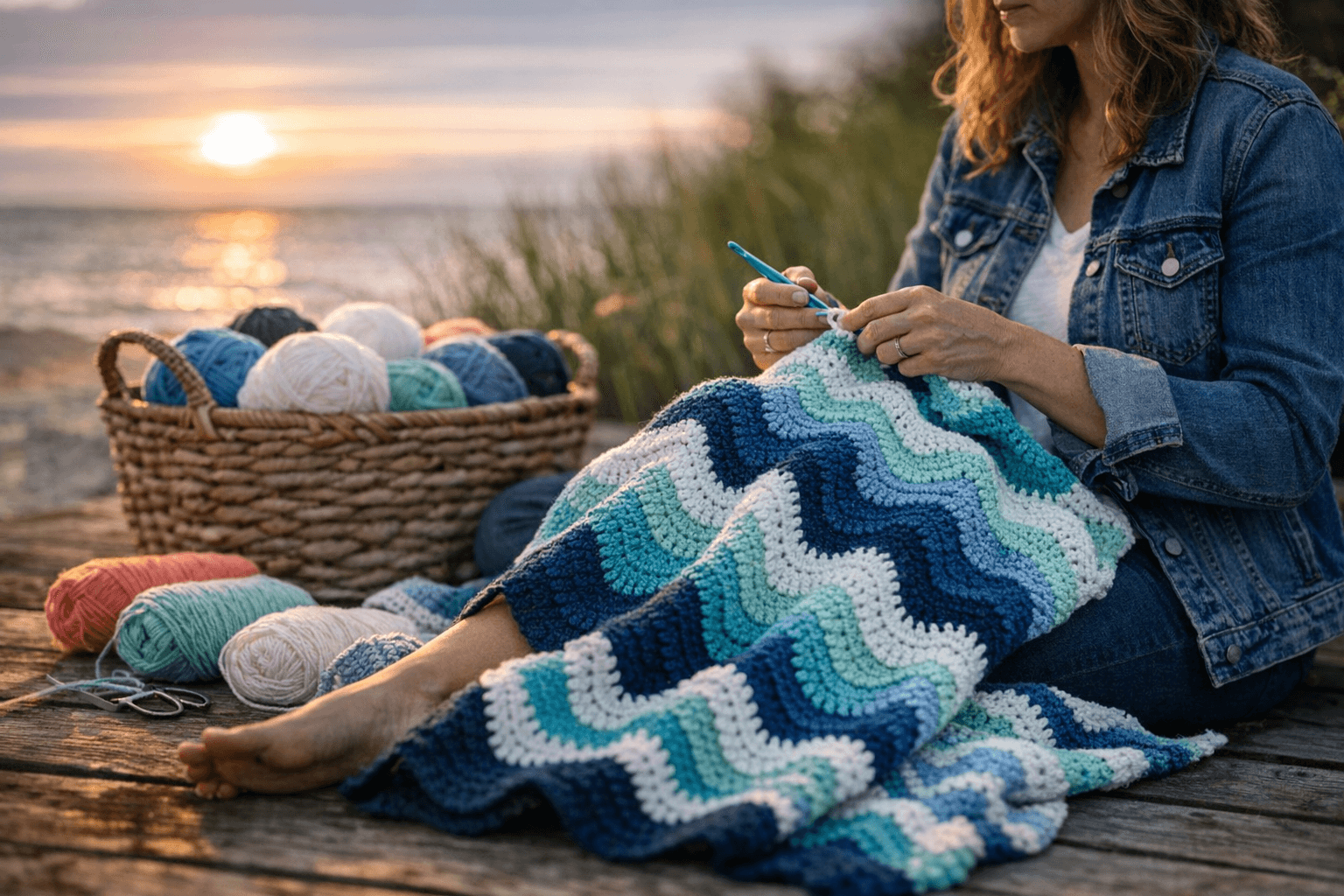
Okie Girl Bling N Things published the Sea Breeze Ripple Blanket as a free pattern, and what sets it apart from the wider library of ripple projects is one practical decision: the designer gives you the math, not just the measurements. The foundation uses a 12 + 3 chain multiple, which means every size adjustment is arithmetic rather than guesswork. The sample finishes at approximately 58" x 60" using eight skeins of worsted-weight yarn (about 2,800 yards total), and that same formula scales cleanly to a crib blanket, a standard throw, or a twin-bed cover. That kind of built-in scalability is rarer than it should be in free patterns, and it is the core reason this one is worth bookmarking before your queue gets any longer.
Why Ripple Is the Best Confidence-Builder in Crochet
The ripple (or chevron) stitch works by alternating increases and decreases across rows of double crochets, producing a wave pattern that looks impressively complex but becomes almost automatic after the first three or four repeats. That repetitive rhythm is exactly what makes the Sea Breeze a strong first large project for newer crocheters. Once you have locked in the sequence, your hands begin to anticipate the decrease before your eyes even reach it, and that muscle memory is what keeps a big project moving.
Visible progress is the other engine here. Each completed color stripe is a self-contained unit, which means you always have a clear finish line within reach rather than an undifferentiated field of identical stitches. The stitches themselves stay within comfortable territory: double crochets form the wave peaks, chain stitches open the peak points, and decrease stitches shape the valleys. If you have finished a granny square or a basic hat, you already have the technical vocabulary this blanket requires. Place stitch markers at each repeat boundary from the start; they remove the anxiety of losing your place mid-row, which is one of the most discouraging experiences for anyone tackling their first big project.
The Customization Calculator: Crib, Throw, and Twin
The 12 + 3 multiple is your resizing engine. Every size adjustment is a matter of changing how many 12-stitch repeats you chain, then adjusting your row count for the desired length. Three practical starting points:
Crib / Baby Blanket (approx. 36" x 45"): Use approximately 10 pattern repeats. Foundation chain: 10 × 12 + 3 = 123. Estimated yarn: 4 to 5 worsted skeins, roughly 1,400 to 1,750 yards. This size finishes quickly, makes a strong handmade gift, and is useful for testing a new colorway before committing to a full-size project.
Standard Throw (the sample size, approx. 58" x 60"): Use approximately 16 repeats. Foundation chain: 16 × 12 + 3 = 195. Estimated yarn: 8 skeins, approximately 2,800 yards. This is the size the pattern is written around, and it is the sweet spot for a couch blanket that photographs cleanly in marketplace listings.
Twin Bed (approx. 66" x 90"): Use approximately 18 repeats and extend your row count for length. Foundation chain: 18 × 12 + 3 = 219. Estimated yarn: 12 to 14 skeins, roughly 4,200 to 4,900 yards. Tension consistency becomes critical at this scale; any drift in gauge will show in the ripple edges. Always check your gauge against the pattern before purchasing a full yarn haul.
Spring Color Palettes: Five Ideas Worth Swatching
The Sea Breeze name signals a coastal, light-air aesthetic, and the ripple structure is a natural showcase for color. The chevron boundaries give you built-in transition points, which means gradient yarn cakes and coordinated leftover skeins from your stash both work beautifully without requiring perfectly matched dye lots. Five palettes to consider:
- Sea Breeze (Coastal Classic): Soft aqua, shell white, and sandy taupe. Clean, fresh, and reads immediately as spring in online market thumbnails.
- Coral Sunrise: Peach, warm coral, and cream. A warmer coastal read that sells well in late spring and transitions cleanly into summer.
- Lavender Garden: Pale lavender, soft butter yellow, and ivory. Slightly vintage in mood; gradient cakes blend particularly well here.
- Sage and Blush: Sage green, dusty rose, and warm white. Currently strong in home décor palettes and translates directly to ripple banding.
- High-Contrast Modern: True navy, bright white, and one accent color, mustard or terracotta. Abandons the soft coastal mood in favor of a graphic look that photographs with sharp visual impact.
The pattern's note on economy applies directly to palette planning: coordinated leftover skeins or gradient cakes create interesting color transitions without requiring large quantities of any single yarn. "I Love This Yarn" in worsted weight is the example cited in the pattern, a widely available and budget-friendly option that keeps the cost of entry low.
Your Progress Tracker (Screenshot This)
Sea Breeze Ripple — Progress Tracker ====================================================== [ ] Foundation chain done (123 / 159 / 195 / 219 ch) [ ] First full stripe complete — pattern rhythm locked [ ] 25% of rows finished [ ] 50% of rows finished — check tension at edges [ ] 75% of rows finished — final color sequence begun [ ] Last row complete [ ] Ends woven in [ ] Light blocking complete (if yarn benefits) [ ] Finished! ====================================================== My size: ________________ Hook: ________________ Yarn: ____________________ Colorway: ____________ Start date: ______________ End date: _____________
Photographed flat in natural light against a textured surface, a completed ripple blanket is one of the most visually readable finished objects in crochet. The wave geometry and color stripes both register clearly even in a small thumbnail, which matters for any marketplace listing where the first impression happens at scroll speed.
The Upgrade Option: Border and Texture Swap
The Sea Breeze works exactly as written, but one deliberate addition can move it from a solid blanket to a signature piece without requiring a design overhaul.
*Border:* A single crochet border in the darkest color of your palette tightens the ripple edges (which can be slightly wavy before blocking) and frames the piece cleanly. For a more polished finish, follow it with a round of reverse single crochet, the crab stitch, which adds a subtle rope-like edge that looks far more complex than it is to execute.
*Texture Swap:* Replace the double crochet peaks with half double crochets for a denser, tighter wave with more visible surface texture. This adjustment slightly narrows each repeat, so add one additional repeat to your foundation chain if you want to match the original width dimensions.
Making It Work for the Marketplace
Ripple blankets are perennial sellers in online handmade markets precisely because they photograph well at every scale. The Sea Breeze's three-size scalability means you can offer a crib size at a lower price point, the standard throw mid-range, and a twin for premium commissions, all from the same free pattern. Photograph finished pieces in natural light with textured backdrops; the interplay between ripple boundaries and color stripes reads as an immediate visual selling point that flat, solid-colored blankets simply cannot match.
Blocking lightly after completion, particularly in a yarn that responds to it, evens out the ripple edges and gives the piece an intentional, designed quality rather than a purely handmade one. Combined with consistent tension maintained across the full project, that final step is what separates a blanket someone made from a blanket someone crafted.
Know something we missed? Have a correction or additional information?
Submit a Tip