Irish crochet roundup expands beyond florals to motifs, garments and lace
Irish crochet is far more than antique doilies, and this roundup proves it with ties, cuffs, garments and whimsical gifts that keep the lace language alive.
Irish crochet is bigger than the doily
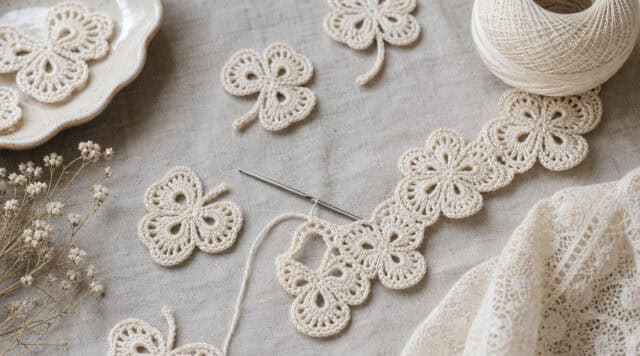
Irish crochet keeps getting flattened into one image, the fragile antique lace doily sitting under glass. This roundup pushes that idea aside and shows a craft with real range: raised motifs, corded outlines, layered floral work, and finished pieces that can land on a lapel, a wrist, or in a modern wardrobe. The appeal is not only beauty, but construction, because the best projects here tell you how they are built as clearly as they show what they become.
That construction focus is what makes the roundup useful. Some pieces are assembled from individual motifs joined into fabric, others use row-by-row shaping, diagrams, or vintage-style lace instructions. That means Irish crochet is not just a look, it is a method, and the method gives you options. A crocheter can choose a compact accessory, a decorative display piece, or a garment-shaped challenge depending on how much lace logic and patience they want on the hook.
A tradition built on motifs, not just flowers
The historical record helps explain why the style still feels so adaptable. Ireland’s National Inventory of Intangible Cultural Heritage describes Irish lace and Irish crochet lace as a distinctive handmade art that began developing in Ireland during the 18th century, with skills brought back by religious sisters from continental convents. By the mid-19th century, Irish crochet lace had developed as an imitation of Venetian lacework, and the craft spread especially during and after the Great Famine as a source of income for distressed families.
What emerged was not a single pattern language, but a construction system. The ASU FIDM Museum notes that Irish crochet is known for three-dimensional motifs that are separately crocheted and then joined to a ground, while the Lacis Museum of Lace and Textiles describes separate motifs linked by filigree mesh or crocheted bars. That modular structure is why the tradition has survived so many reinventions. Once you understand that Irish crochet is built from pieces, not just pretty edging, the category opens up fast.
There is also a paper trail that shows how quickly makers began codifying the look. The first book of Irish crochet patterns was published by Mademoiselle Riego de la Blanchardiere in 1846, a reminder that the style was already organized enough to be taught, collected, and shared. The National Inventory also notes that Irish crochet lace became a significant export item in the 19th century, which makes sense for a craft that could travel well through pattern, even when the making itself stayed labor intensive.
Why these projects feel workable now
The strongest thing about the roundup is that it does not treat Irish crochet as a museum category. It separates projects by how they function in real making life, which matters if you want the tactile payoff of lace without committing to a full traditional shawl or veil. In practice, that means the collection becomes a map of entry points: a small accessory for technique practice, a coordinated set for elegance, and a novelty piece for gift giving.
That approach also reflects how the craft has changed over time. Mechanization and disruption of trade routes during World War I helped reduce demand for handmade Irish crochet lace, and the National Inventory notes a brief revival in the 1960s linked to designer Sybil Connolly. Today, it survives largely as a hobby, though small creative hubs remain in Dublin, Cork, Limerick, and Monaghan. The modern patterns in this roundup feel like part of that survival story, because they keep the texture and relief of the tradition while making it easier to wear, give, or display.
The patterns that widen the category
The best overall pick, the Bohemian Lace Tie Pattern, is a smart gateway project because it condenses the decorative side of Irish crochet into a compact form. A tie lets the lace language stay formal and crisp without requiring the scale of a full garment. For someone who wants to understand how motifs and corded outlines can read as elegant rather than old-fashioned, it is a clean introduction.
The Irish Lace Crochet Black Tie and Cuffs Set pushes that idea further by showing how one visual vocabulary can carry across multiple pieces. A coordinated tie and cuffs set is useful in a way antique lace often is not, because it brings the same handcrafted detail into a dressed-up, wearable format. It also demonstrates one of the most appealing things about Irish crochet today: the ability to make something that feels complete without needing to be large.
The best gift pick, the Amigurumi Bumble Bee Crochet Pattern, sits outside traditional Irish crochet, and that is part of the point. The roundup uses it to remind readers that handmade character does not have to mean strict historic reproduction. If you are drawn to the mood of the craft, the care, the texture, the sense of something made by hand with personality, then a whimsical small project can still belong in the same conversation even when it is not technically Irish crochet.
What to look for when choosing a pattern
If you want a project that feels true to the tradition but still manageable, the construction notes matter as much as the finished photograph. The best Irish crochet patterns usually give you at least one of these clues:
- individual motifs that are joined afterward
- diagrams or vintage-style lace instructions
- visible corded outlines and raised relief
- a shape that can be worn, not just displayed
- enough structure to make the lace feel architectural
Those details help you sort out whether a pattern is merely decorative or actually approachable at your current level. That is especially important in Irish crochet, where the surface beauty can hide very different methods underneath. One project may be all about motif assembly, while another depends on shaping or spacing that only looks simple once it is complete.
Why the style still matters
The reason this roundup lands is that it restores Irish crochet to its full size. It is an old craft, yes, but also a living one, shaped by export history, famine-era teaching, revival moments, and the stubborn appeal of texture you can feel as well as see. The fact that the tradition once moved from convent instruction to cottage industry, then through revival and into hobby culture, helps explain why it can still support both formal lace and playful modern pieces.
That is the real correction the roundup makes: Irish crochet is not a dusty synonym for antique doilies. It is a flexible language of motifs, garments, accessories, and lace construction, and the best projects in the category let you see that language in motion. Once you stop expecting only florals under glass, the whole craft starts looking wearable again.
This article was produced by Prism’s automated news system from verified source data, official records, and press releases, then run through automated quality and moderation checks before publishing. The system is built and supervised by the people who set the standards it runs under. Read our full AI policy.
Did this article answer your question?