Kimberly Arenas Turns Oversized Daisy Squares Into a Sew-Free Tote
Kimberly Arenas’s daisy tote packs spring flair into just two oversized squares, cutting the usual crochet-bag sewing down to almost nothing.
A spring tote built for real use
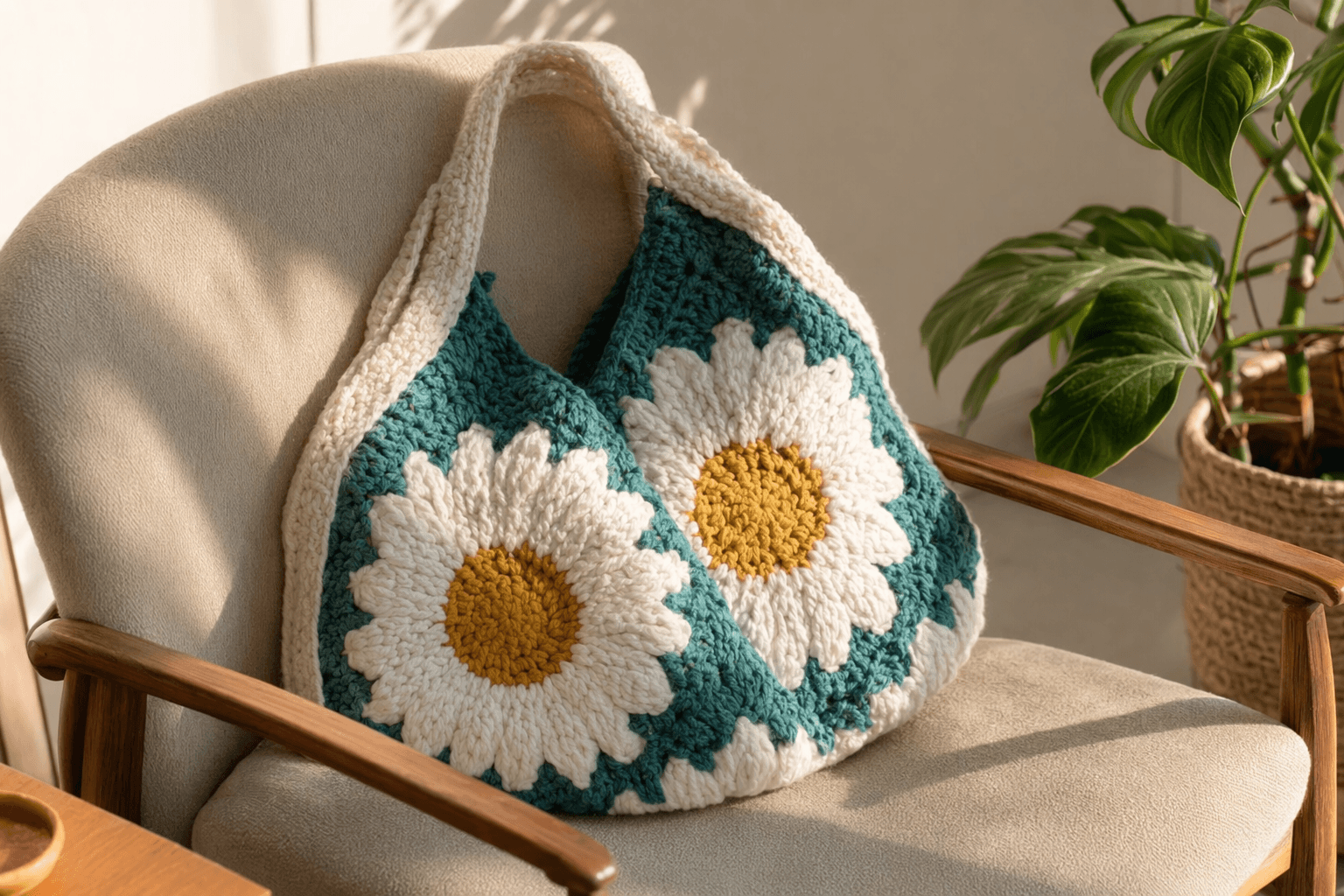
Kimberly Arenas takes the daisy granny square out of the “cute but complicated” category and turns it into a bag you would actually carry. Her daisy crochet bag leans on two oversized floral squares, so the finished tote looks bold and cheerful without asking you to join a mountain of tiny motifs.
That choice matters because crochet bags often lose people at the finish line. Arenas clearly knows the pain point, and she solves it the simplest way possible: fewer pieces, less sewing, and a cleaner build that still delivers the full daisy-square payoff. The result is a spring-ready tote that feels decorative first, but never forgets it has a job to do.
Why the oversized square approach works
Instead of building the bag from dozens of small segments, Arenas uses just two large daisy granny squares. Each one measures about 12 to 13 inches across, which gives the project a substantial footprint right from the start. That scale makes the bag feel like a real tote, not a delicate novelty that disappears under the weight of daily use.
The size also changes the making experience. According to the pattern notes, each square takes about an hour, so you get a meaningful result quickly without signing up for a months-long marathon. For crocheters who love the look of modular work but dread endless assembly, that is the sweet spot: enough structure to feel satisfying, not so much repetition that the project turns into a chore.
The no-sew spirit behind the design
Arenas has said she dislikes sewing, and that attitude is built right into the bag’s construction. The larger-square method is her way of reducing joining work while still keeping the daisy motif front and center. In practical terms, that means less time with a yarn needle and fewer places where a bag can start to feel bulky or fussy.
That matters for usability as much as for comfort at the craft table. Fewer joins usually mean a neater finish, and a neater finish helps a tote hold its shape visually when you are carrying it around town. The design is not advertised as a purely structural engineering feat, but its simplicity gives it the kind of clean, restrained build that everyday bags need.
A pattern that fits the current crochet mood
The bag also lands at a moment when crochet bags are leaning hard into faster assembly. Recent tutorials have been emphasizing no-sew and join-as-you-go approaches, which tells you a lot about what makers want right now: less finishing, more wearing. Arenas’s two-square version fits that appetite neatly, while still giving the maker a strong visual motif.
It also stands out inside an already popular daisy-bag lane. Annie Design Crochet’s daisy granny square bag uses 13 squares, while Pattern Princess’s daisy tote uses 8. Against those versions, Arenas’s two-square construction feels especially streamlined, and that low-friction approach is a big part of the appeal. It is still clearly a granny-square tote, but it trims the process down to something much more approachable.
Part of a bigger floral streak
This tote is not a one-off blossom. Arenas has said she has been inspired by flowers this year, naming tulips, roses, daisies, and lavender as part of that creative run. The bag fits that floral line naturally, especially since the same designer also published a Crochet Daisy Applique Pattern and has already built spring energy into earlier releases.
That pattern history gives the tote more personality. Arenas previously published a Crochet Tulip Bag Pattern with solid granny squares and tulip appliques, and before that a Crochet Tulip Pattern that was tied to a local spring festival and her own inspiration. Taken together, those projects show a designer who keeps returning to flowers not as a gimmick, but as a language she can translate into different kinds of makes.
What makes this bag beginner-friendly enough to try
Even though the bag is framed for intermediate crocheters, it does not rely on complicated construction. If you already understand granny-square basics and are comfortable with a bit of texture, the pattern stays straightforward. That makes it a good bridge project: ambitious enough to feel fresh, but not so technical that it shuts out makers who want a confident next step.
Arenas’s Crochet Daisy Applique Pattern also helps explain the tone of this whole floral set. The applique is described as a 12-petal, beginner-friendly daisy, which suggests that her floral designs are meant to be accessible rather than fussy. The tote carries that same spirit into a bigger format, pairing an easy-to-grasp motif with a finished object you can use every day.
Why this tote has share appeal
There is a built-in “wow” moment here that does not depend on an elaborate stitch count. A bag made from just two 12-to-13-inch squares is instantly memorable, and the fact that each square takes about an hour gives the project a satisfying, concrete scale. That is the kind of detail crocheters trade with each other because it makes the piece feel doable in real life.
The daisy squares also hit the spring sweet spot without drifting into something impractical. You get the bright, oversized floral look that reads clearly from across the room, plus a tote shape that belongs in an actual wardrobe. The teased daisy blanket pattern adds another layer of interest, because it hints that this bag is part of a wider motif family rather than a standalone experiment.
The appeal of a pretty bag that still earns its keep
What makes Arenas’s tote stand out is not just that it is floral. It is that the flowers are translated into a format that respects the realities of making and using a crochet bag: fewer joins, fewer pieces, a faster path to the finished object, and a size that feels substantial in hand. That combination turns a familiar motif into something with real staying power.
For crocheters who want spring color with everyday function, this is the kind of project that checks both boxes. It looks like a celebration of daisies, but it behaves like a bag designed by someone who has actually carried one.
This article was produced by Prism’s automated news system from verified source data, official records, and press releases, then run through automated quality and moderation checks before publishing. The system is built and supervised by the people who set the standards it runs under. Read our full AI policy.
Did this article answer your question?