Meladora’s Creations rounds up 10 playful crochet hacky sack patterns
A bean-filled ball can be a toy, a fidget, or a freestyle footbag, and this 10-pattern roundup shows why tiny makes keep pulling crocheters back.
The best hacky sacks have a simple promise: if the shape is round enough and the fill has the right weight, you get a finished object that can be kicked, squeezed, tossed, or gifted without much fuss. That is the charm Meladora’s Creations leans into with a 10-pattern roundup built around tiny, portable crochet balls, a category that keeps resurfacing because it is quick, affordable, and easy to make your own.
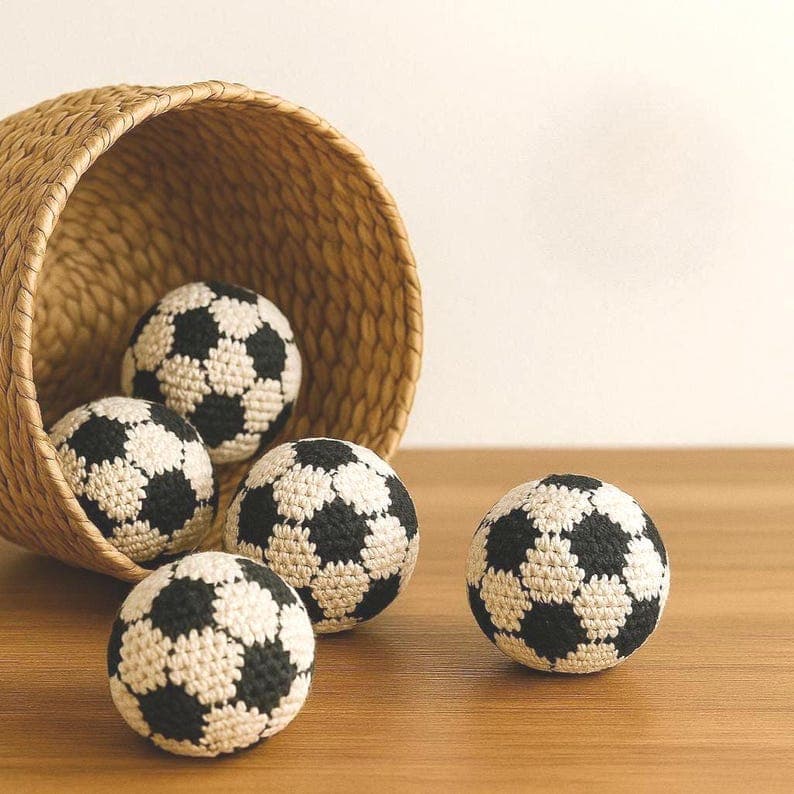
Soccer ball
The roundup opens with a soccer ball idea that makes immediate sense as a playable make, not just a display piece. A ball like this invites clean geometric colorwork and gives crocheters an excuse to turn leftover yarn into something that still wants to be used in the living room or the yard.
What makes it especially appealing is that it sits right at the intersection of toy and skill-builder. You are practicing shaping, seaming, and stuffing in a way that pays off in a finished object with real motion, not just a decorative object on a shelf.
Spiral hacky sack
The spiral hacky sack is one of those patterns that looks like a small experiment but behaves like a surprisingly satisfying hand toy. The spiral surface gives it personality before you even think about fill, and it is the kind of project that lets stitch texture do the talking.
Because the shape is still fundamentally a compact ball, it stays in the playable lane. It is also the sort of pattern that works well when you want something fast and tactile, the kind of make that can live in a project bag and disappear into an afternoon.
World Cup mini match ball
A World Cup mini match ball pushes the roundup toward sports nostalgia with just enough specificity to feel clever. It is the kind of tiny themed project that reads as a tribute as soon as you see it, especially for crocheters who like novelty with a recognizable reference point.
This one feels more like a playful keepsake than a pure utility object, but it still benefits from the hacky sack format. The familiar ball shape keeps it functional, while the themed styling turns it into a conversation piece that can also be tossed around.
Rainbow beach ball
The rainbow beach ball is all about bright colors and immediate charm. It is a strong example of how a hacky sack pattern can become a small burst of summer without needing a complicated stitch setup.
It also lands in that useful middle ground between cute and playable. The beach-ball look gives it novelty appeal, but the compact rounded form still makes it a practical little ball for juggling, fidgeting, or just making a scrap yarn pile feel more intentional.
Stress-ball style toys
Stress-ball style crochet makes are where the roundup starts showing its broader usefulness beyond the game itself. A bean-filled ball can become a desk fidget, a pocket toy, or a low-stakes gift, and that flexibility is part of why these patterns keep coming back.
These are not just cute because they are small, they are useful because the shape invites touch. When a pattern is built to be squeezed as much as it is admired, it earns its place in a busy maker’s queue.
Eye balls
Eye ball patterns lean hard into whimsy, and that is exactly why they work in a hacky sack roundup. The joke lands immediately, but the object still has to hold its shape, which keeps the project from being pure costume craft.
These are the kinds of makes that shine as Halloween-adjacent novelties or offbeat gifts, though they can still be perfectly playable if the stuffing is balanced. The fun is in seeing a familiar toy format turned slightly uncanny without losing the satisfaction of a quick finish.
Mother Earth globe
A Mother Earth globe brings a softer, more thematic kind of novelty to the mix. It is a tiny world that doubles as a playful object, which is a neat fit for crocheting because the craft is already so good at translating symbols into something you can hold.
This kind of ball is less about sports and more about visual storytelling. Still, the hacky sack base keeps it from becoming only decorative, and that balance is part of the roundup’s charm.
Rattle toy ball
The rattle toy ball is where the practical side of the list becomes especially clear. A small crocheted ball that can make noise or keep a baby occupied gives the category household value, not just nostalgia value.
It also fits the stash-busting appeal that makes these projects so queue-worthy. A rattle-style make is usually compact, fast, and easy to personalize, which means it works well for makers who want a finish without committing to a larger toy.
Pokéball-inspired make
The Pokéball-inspired pattern is pure fan-recognition crochet, and it benefits from being instantly legible. It is the sort of project that invites color blocking and crisp shaping, which means even a small ball can feel sharp and polished.
As a hacky sack, it lands closer to novelty than game gear, but that is part of the fun. The round form still gives it utility, and the theme does the rest, making it a strong choice for anyone who wants a playful object with a built-in reference point.
Easy footbag toy
The easy footbag toy is the roundup’s clearest statement about why this category keeps winning over crocheters. Recent tutorials have shown that a hacky sack can be stitched up in just a few rounds, and one pattern says it can take around 15 minutes and about 20 yards of yarn, which is hard to argue with when you want a fast finish.
It also points straight back to the original appeal of the form. Modern footbags are often filled with plastic pellets, though makers also use rice, lentils, sand, or other fillers depending on the feel they want, and one recent tutorial used about 46 grams of poly-pellets inside a nylon pouch for durability. That kind of flexibility is why the easy footbag lands as both a beginner-friendly make and a reminder that the simplest round object can still feel surprisingly complete once it hits the right weight.
The broader story behind the roundup is what gives all 10 patterns their staying power. Hacky sack and footbag have roots in 1972, when Mike Marshall and John Stalberger invented the modern Western version in Oregon City, Oregon, and the World Footbag Association officially opened on May 12, 1983 to support a sport that was still mostly confined to Oregon and Washington. That history adds a satisfying layer to the crochet versions now circulating through pattern roundups: a tiny bean-filled ball still feels fresh because it asks so little to make, and gives so much back once you start playing with it.
This article was produced by Prism’s automated news system from verified source data, official records, and press releases, then run through automated quality and moderation checks before publishing. The system is built and supervised by the people who set the standards it runs under. Read our full AI policy.
Did this article answer your question?