Mexican artist turns crochet into tiny dollhouse-scale fine art
Giovanna Guerrero’s crochet is so small it needs a magnifying glass, yet it sells out and earns recognition as fine art.
Tiny crochet, handled like fine art
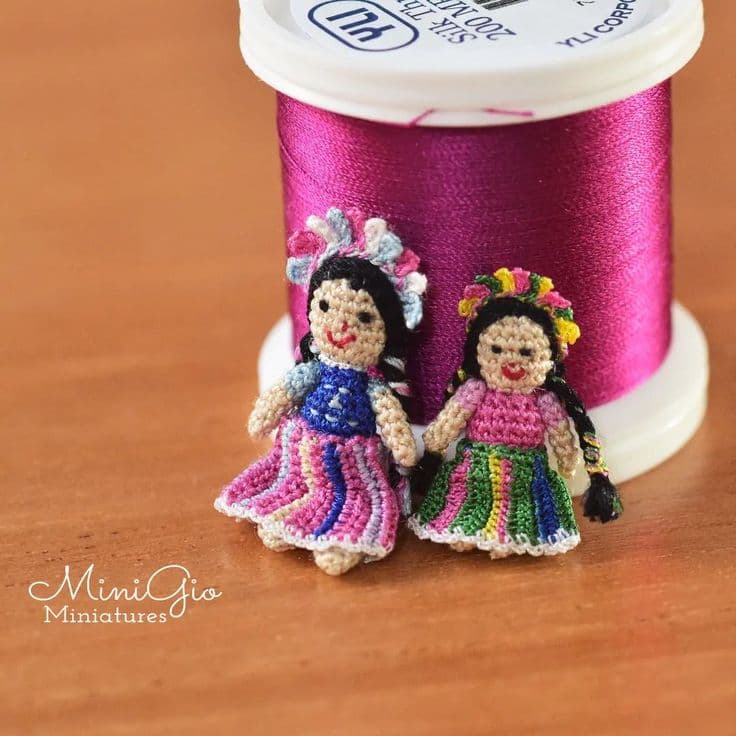
Giovanna Guerrero’s crochet is built on a scale that makes most handmade work look large by comparison. Her miniature pieces are often worked in 1:12 scale, the standard dollhouse ratio, and the effect is immediate: blankets, pillows, handbags, handkerchiefs, and silk reticules shrink into objects that belong in a room within a room. That level of reduction is not just visually striking, it is the whole point of the work, because every stitch has to carry texture, shape, and personality when there is almost no room to spare.
Guerrero, who works under MiniGio and minigio.miniatures, has been making miniature crochet for more than 10 years. Her online presence presents her as a Mexican miniature crochet artist and an IGMA Fellow, and the work has clearly moved beyond novelty. In the right setting, these pieces read less like tiny accessories and more like dollhouse-scale sculpture, with warmth, nostalgia, and little stories built into each object.
Why the smallest stitches demand the most patience
What makes Guerrero’s crochet so compelling is not only the size of the finished pieces, but the way they are made. She has described some of the work as requiring super tiny stitches and, for the smallest details, a magnifying glass. That changes the pace of the entire process. A single object can take a long time because precision matters at every turn, and a mistake that might be minor in full-size crochet can overwhelm a piece that is meant to live in a dollhouse.
That kind of making asks for a different mindset than most pattern work. Instead of speed or volume, the priority is control: keeping the tension even, preserving the shape, and making sure each tiny element still reads clearly at miniature scale. The result is crochet that asks to be studied up close, where the texture becomes part of the artwork rather than just a construction method.
- Work at a standard scale, such as 1:12, so the proportions stay consistent.
- Use a magnifying glass when the stitches become too small to read comfortably.
- Expect the process to take time, because precision replaces speed.
- Build details into the form itself, so even the tiniest piece has a clear visual identity.
For makers interested in miniature crochet, Guerrero’s practice offers a useful roadmap:
The silk reticule that shows the level of skill
One of the clearest examples of Guerrero’s range is her miniature crochet silk reticule in 1:12 scale. She identified it as the fifth piece of her submission for IGMA Fellow membership, and she said it was inspired by crocheted Victorian reticules. That single object captures what makes her work so distinctive: it is tiny, historically informed, and constructed with a jeweler’s eye for detail.
The reticule includes a central rosette, four bobbles, a white silk lining, and a drawn-string closure. Even in full size, those would be recognizable design choices; at dollhouse scale, they become a test of control and clarity. The piece also shows how Guerrero uses crochet to echo fashion history while translating it into a miniature format that feels collectible, delicate, and highly finished.
Why IGMA matters in this story
Guerrero’s work sits comfortably in the world of miniature arts because the International Guild of Miniature Artisans treats the field as something more than crafts. The guild’s mission is to promote fine miniatures as an art form, and its highest honor, Fellow membership, is reserved for Artisan members whose work develops to the very highest level of excellence.
That context helps explain why Guerrero’s tiny crochet carries such weight. A miniature handbag or reticule is not just a clever small object when it is made to this standard. It becomes part of a broader conversation about skill, discipline, and artistic intention inside the miniature world. Guerrero’s IGMA submission makes clear that crochet can stand alongside other fine miniature disciplines when the technique is pushed this far.
A collector response that matches the craftsmanship
The demand around Guerrero’s work has been just as striking as the work itself. A recent recap said she sold out her pieces on the first day of the Chicago International Dollhouse Show in Chicago, Illinois, United States. For a maker of ultra-small work, that kind of response makes perfect sense: the pieces are rare, painstaking to produce, and immediately legible to collectors who understand the labor involved.
Her social media numbers point in the same direction. Her TikTok profile listed about 14.5K followers and 142K likes, while a Pinterest profile that cited her Instagram listed 48K followers, 1,005 following, and 151 posts. Those figures show a strong audience for miniature crochet that bridges display, collecting, and inspiration. People are not just admiring the pieces; they are following the process and returning for more.
Patterns, instruction, and a wider maker reach
Guerrero’s practice does not stop at finished art pieces. Her online shop and pattern pages show that she also designs and sells miniature crochet patterns, including digital patterns on Ravelry under MiniGio. That adds another layer to her work, because it opens the door for other makers who want to try miniature crochet themselves.
She also has a presence across Etsy and Domestika, which helps position her practice as both artistic and instructional. In that sense, her work covers the full range of modern crochet culture: display pieces for collectors, patterns for makers, and social media content that shows how far the medium can go when scale becomes the main challenge.
Crochet that turns scale into spectacle
Guerrero’s work is astonishing because it makes the smallest possible objects feel fully formed. A magnifying glass, a standard 1:12 dollhouse scale, and a patient hand are enough to turn crochet into something that looks like fine art up close and draws a crowd when it goes on display. When a silk reticule can sell out a show and still read as exquisite at the size of a fingernail, the message is hard to miss: miniature crochet is not shrinking the craft. It is revealing how much craft can fit inside a tiny space.
This article was produced by Prism’s automated news system from verified source data, official records, and press releases, then run through automated quality and moderation checks before publishing. The system is built and supervised by the people who set the standards it runs under. Read our full AI policy.
Did this article answer your question?