Tunisian Mosaic Bee Potholder Blends Bold Style With Kitchen Function
A cheerful bee potholder turns Tunisian mosaic into a small, useful practice piece. It is quick to finish, kitchen-ready, and ideal for learning without tackling a blanket.
A small project that teaches real technique
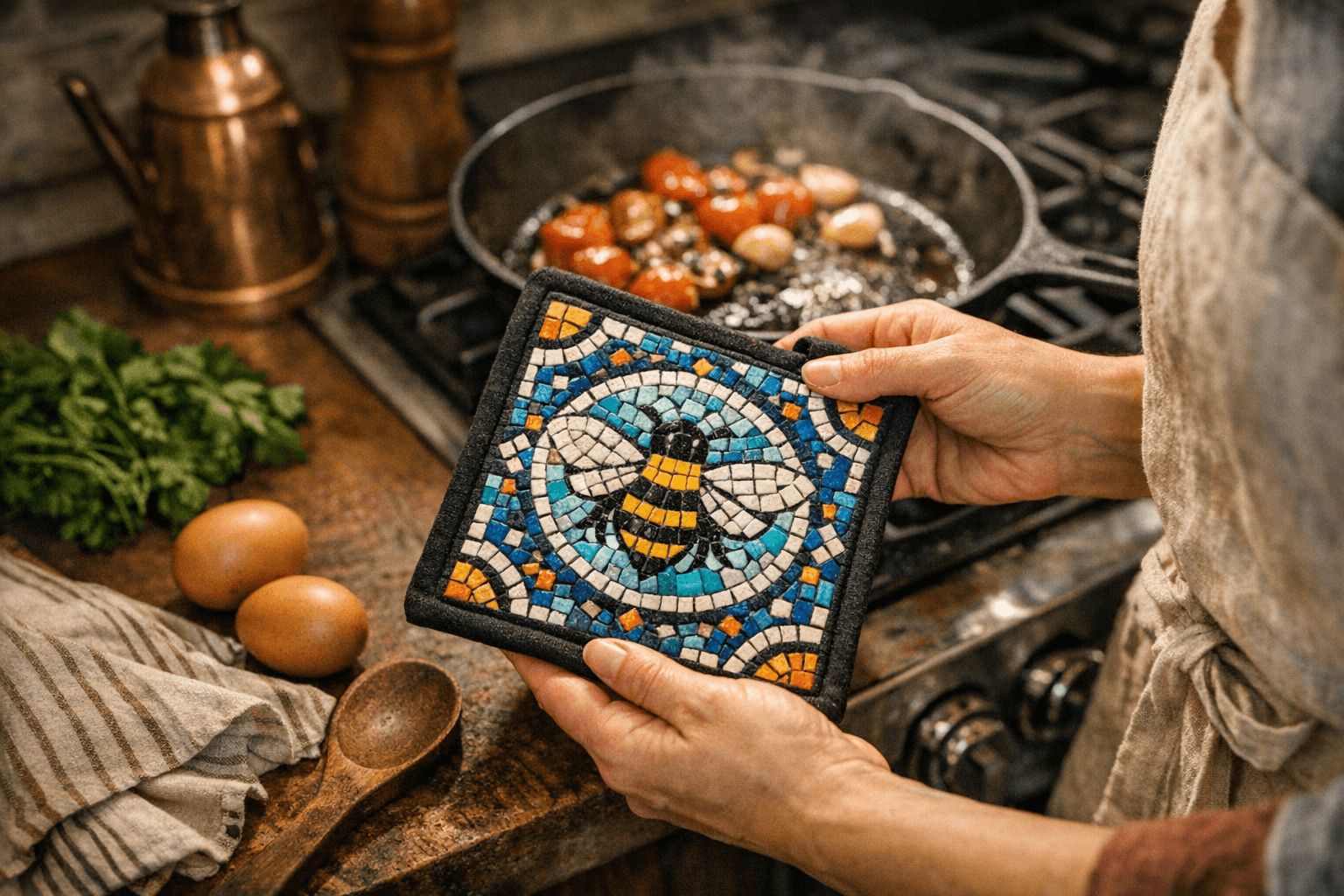
The Tunisian Mosaic Bee Potholder makes a strong case for starting small without settling for something flimsy. Cool Creativities released the pattern on April 16, 2026, and the appeal is immediate: a bright bee motif, a bold graphic finish, and a fabric that is thick enough to earn a place in the kitchen instead of living in a drawer. It is the kind of project that lets you try something technically interesting and still walk away with an item you can use every day.
That balance is what makes the pattern stand out. A potholder has to work hard, so the design is not just decorative; it is built around utility, with Tunisian mosaic crochet giving it structure and visual punch at the same time. For crocheters who want a manageable entry point into a more advanced-looking technique, this is the sweet spot.
Why Tunisian mosaic works so well here
Tunisian crochet uses an elongated hook and creates fabric that is substantially thicker than standard crochet, which is one reason it has such a natural home in sturdy projects like blankets and kitchen textiles. Mosaic crochet adds another layer of interest through two-color colorwork, typically using one color per row to create crisp, graphic motifs. Put those two methods together, and the result is a potholder that looks bold without requiring a huge time commitment.
That matters because the bee motif is doing more than decorating a square. The texture and density help make the piece practical for handling hot dishes, while the visual contrast gives it the kind of cheerful personality that reads well in a spring kitchen. It is an especially smart format for someone who wants to test Tunisian mosaic crochet before committing to a full throw, bag, or table accessory.
Materials and construction that keep it approachable
Andrea Cretu’s related tutorial for the same bee motif gives the project clear, usable numbers: about 35 g of the main color yarn and 30 g of the contrast color yarn. It also points to an 8 mm Tunisian hook and a 6 mm regular hook for finishing details, which keeps the tool list simple enough for a low-pressure tryout. Those details matter because they make the project feel concrete instead of abstract.
The construction options are just as practical. The tutorial explains that the potholder can be felted for kitchen use, or made in cotton and sewn double for added thickness and reversibility. That flexibility opens the door to different finishes depending on how you want to use it: one version leans into heat protection, while the other gives you a sturdier, more finished-looking everyday piece.
- 35 g main color yarn
- 30 g contrast color yarn
- 8 mm Tunisian hook
- 6 mm regular hook for finishing details
The pattern also benefits from its scale. Potholders are small enough to finish quickly, but they still teach valuable skills that carry into larger Tunisian and mosaic projects. If you have been eyeing colorwork but want a controlled setting, this is a low-risk way to build confidence while making something useful.
A bee motif with more than decorative value
The bee design gives this potholder a friendlier, more seasonal identity than a plain geometric sampler. It feels giftable, especially for a bee lover, but it also fits neatly into a spring kitchen as a practical accent that does not need to be hidden away. That blend of charm and function is exactly why the pattern has broader appeal than a novelty motif.
There is also a real-world resonance behind the theme. The U.S. Forest Service says the United States has more than 4,000 native bee species, and USDA and U.S. Fish and Wildlife Service materials emphasize that pollinators are vital to food systems. Those same materials also note that many bee and other pollinator species have experienced major declines for more than 25 years, which gives a bee-themed project a relevance that goes beyond cute imagery.
The research around honey bees reinforces that context. A 2018 study in Proceedings of the Royal Society B found that the western honey bee averaged 13% of floral visits across 80 plant-pollinator networks in natural habitats worldwide, making it the most frequent floral visitor in that analysis. Add in the Honey Bee Health Coalition’s report that commercial honey bee colonies saw average losses of 62% between June 2024 and February 2025, and the motif starts to feel especially timely. A potholder cannot solve pollinator decline, of course, but it can turn that awareness into a small, visible daily object.
Why this pattern belongs in your queue
This is the kind of release that earns attention because it is both learnable and useful. The video tutorial lowers the barrier for crocheters who find mosaic techniques intimidating, and the project size keeps the stakes low while the skills remain real. You get the satisfaction of trying Tunisian mosaic crochet, the visual payoff of a bold bee motif, and the everyday value of a finished kitchen tool.
That combination is what makes the pattern memorable. It is not trying to be a blanket in disguise, and it is not just a decorative sampler either. It is a compact practice piece with enough personality to feel special, enough technique to teach something new, and enough practical value to stay within reach long after the first kitchen test.
This article was produced by Prism’s automated news system from verified source data, official records, and press releases, then run through automated quality and moderation checks before publishing. The system is built and supervised by the people who set the standards it runs under. Read our full AI policy.
Did this article answer your question?