Thorisdottir, Davidsdottir Launch Postpartum Training Program With Brianna Battles
Annie Thorisdottir and Katrin Davidsdottir partnered with Brianna Battles on an 8-week postpartum program that puts pelvic floor and load tolerance ahead of bounce-back timelines.

The generic six-week clearance has governed postpartum return-to-fitness for years: get the doctor's sign-off, ease back in, hope the body cooperates. The 8-week postpartum program that Annie Thorisdottir, Katrin Davidsdottir, and Brianna Battles launched through Empower by Dottir operates on a fundamentally different premise: readiness is measured, not assumed.
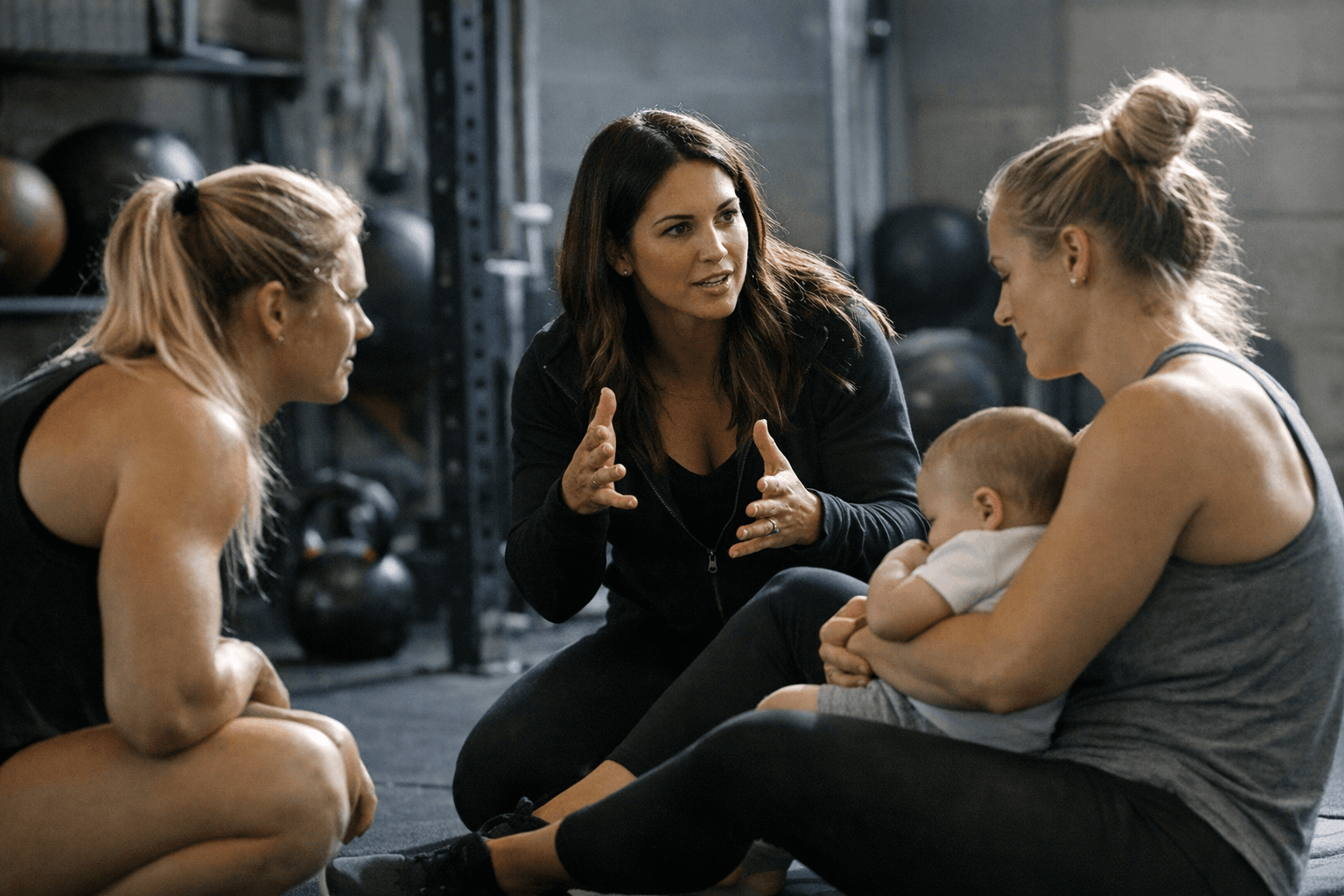
The collaboration brings together three credentialed perspectives that CrossFit has never before seen in a single product. Thorisdottir, a two-time CrossFit Games champion, and Davidsdottir, also a Games champion, both returned to elite competition after childbirth. Battles is the founder of Pregnancy & Postpartum Athleticism and has spent over a decade developing performance-based postpartum protocols for athletes ranging from CrossFit competitors to UFC fighters.
The program, available through Empower by Dottir in both gym-based and at-home versions, builds from foundational core reconnection into progressive loading and sport-relevant conditioning. The curriculum addresses four interconnected systems that generic return-to-fitness content routinely skips.
Breathing and intra-abdominal pressure come first. The early weeks focus specifically on reestablishing pressure management before any load is added, a necessary precondition that matters enormously for athletes accustomed to barbell cycling, double-unders, and high-intensity conditioning. Pelvic floor progressions are integrated throughout, not bolted on as an afterthought, because pelvic floor function directly dictates when impact work, running, and high-load squatting can be safely reintroduced.
Load tolerance is rebuilt through objective benchmarks, not arbitrary timelines. Where most programs hand new mothers a schedule and call it progress, this one uses strength benchmarks and symptom tracking to gate advancement. That shift from calendar-based to performance-based progression is one of the more substantive differences between this program and what a well-meaning but underprepared box coach might improvise.
Return to impact is handled explicitly. Jumping, running, and barbell cycling are not treated as a monolithic category but as skills requiring progressive reintroduction after pelvic floor and load tolerance foundations are established. The program includes cues designed to identify red flags, including leaking, pelvic heaviness, and sharp core pain, as objective signals to de-load rather than push through.
The Empower by Dottir platform already carries programming informed by Dr. Stacy Sims' research framework, which emphasizes training with female physiology rather than against it. This postpartum product extends that philosophy into the fourth trimester, a stage of athletic life that has historically been treated as a pause rather than a phase requiring its own periodization.
For affiliate owners, the launch provides a concrete reference point for class programming starting this week. Postpartum athletes in group settings are regularly handed programming built around kipping pull-ups, double-unders, and heavy squats that assume an abdominal integrity that may not yet exist. Coaches can use the Empower postpartum framework to establish a simple three-phase check before scaling a postpartum member into standard programming: confirm pelvic floor baseline, confirm pressure management under load, and confirm symptom-free impact tolerance. None of that requires a separate certification, but it does require asking different questions than "how are you feeling today?"
Both Thorisdottir and Davidsdottir competed at the CrossFit Games after becoming mothers. That they channeled that experience into a structured, evidence-informed product rather than simply sharing personal return-to-training timelines on social media is the signal the community has needed. Postpartum athleticism has never been a niche. It has always been a gap in how gyms are programmed.
Know something we missed? Have a correction or additional information?
Submit a Tip