Cuba's Diaspora Investment Policy Lacks Basic Legal Protections, Analysts Warn
Cuba's March 2026 diaspora investment opening fails eight key legal benchmarks that markets require, analysts warn, with double taxation and OFAC rules compounding the risk.

Cuba's government presented its March 2026 announcement that Cubans abroad could invest in private island businesses as a historic turning point. Analysts reviewing the policy through the lens of international capital markets reached a colder verdict: the gesture clears none of the eight legal thresholds that investment funds, development banks, and political-risk insurers treat as baseline requirements before committing capital.
The critique, published April 2 by CiberCuba, opens with a deliberate deflation of the regime's usual framing. The standard international investors apply does not require democracy; it requires predictability. Vietnam, a one-party state, unlocked diaspora remittances and investment by building clear statutory frameworks and stable rules. Cuba's current offering is ministerial statements, which are not substitutes for treaty-level protections recognizable to arbitration panels or multilateral insurers.
The eight pillars Cuba fails to satisfy span the full architecture of investable environments: written laws that cannot be changed retroactively; fair and equitable treatment with enforcement teeth; impartial dispute resolution outside the Cuban judicial system; guaranteed capital and profit repatriation; transparent and non-discriminatory licensing; consistent tax rules; independent regulatory bodies; and access to political-risk insurance or international guarantees.
Each gap carries a concrete mechanism of failure. Cuba's December 2022 property law contains procedural improvements but leaves "public utility or social interest" undefined, allows state-determined valuations in expropriation cases, and routes judicial appeals through courts that are constitutionally subordinate to the Communist Party. El Toque documented as recently as March 2026 that expropriation remains an active policy tool. For diaspora investors whose own families lost property after 1959 without real compensation, that track record does not read as ancient history.
The currency problem is equally structural. Cuba's monetary fragmentation is not a technical inefficiency but a control mechanism, the analysis argues. Profits generated in pesos or restricted currencies cannot be freely converted or repatriated; the exit terms remain at state discretion. Capital may enter; whether it can leave intact is a different question.
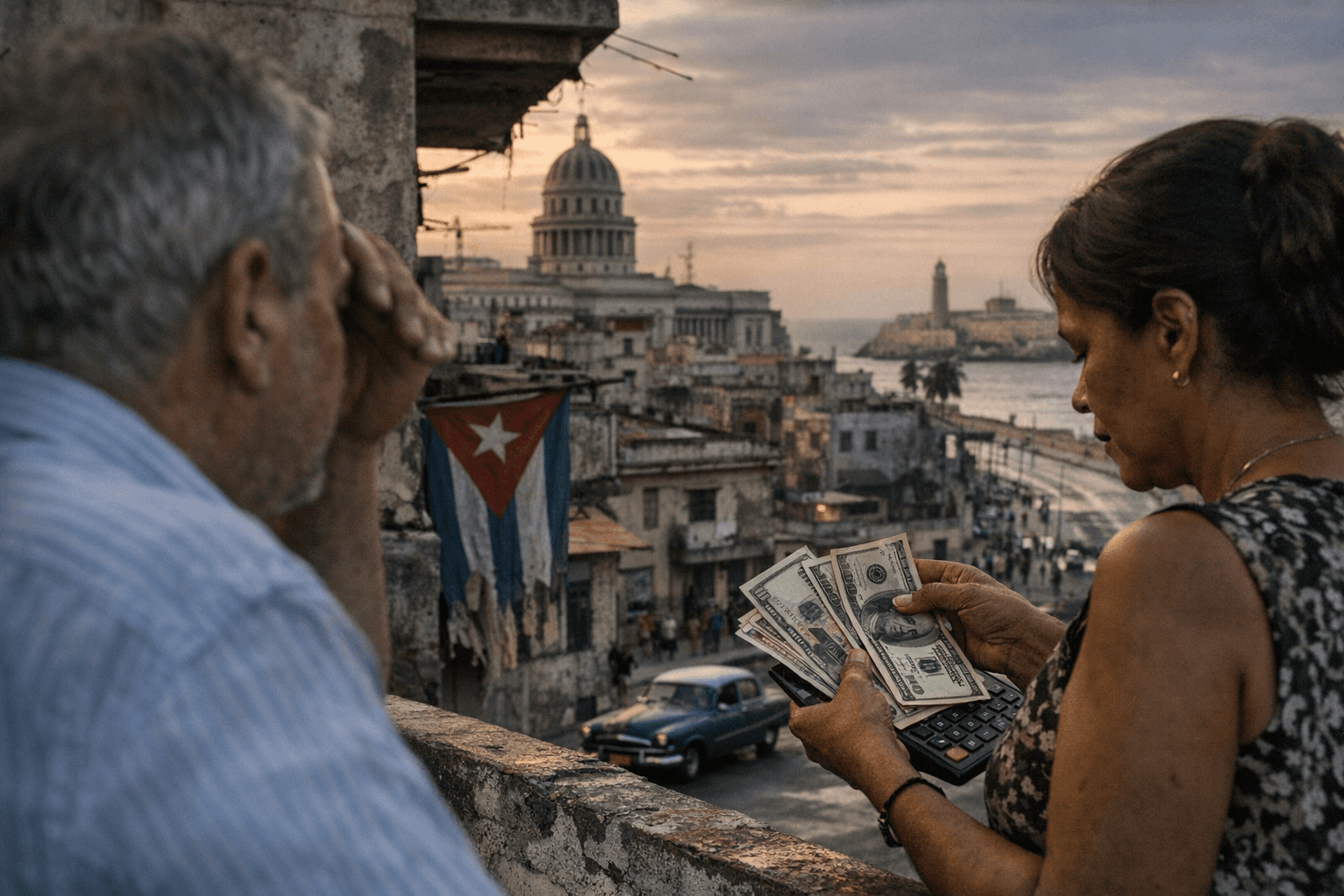
Cuban-Americans face a compounding layer of risk that no Havana announcement can dissolve unilaterally. Without a bilateral tax treaty between Cuba and the United States, dividends earned on the island face double taxation in both jurisdictions, eroding returns to non-competitive levels. Beyond taxation, Cuban-Americans residing in the U.S. still require a license from the Office of Foreign Assets Control to invest legally, and the Helms-Burton Act of 1996 ties full embargo relief to political conditions the Cuban government has no intention of meeting.
Deputy Prime Minister Oscar Pérez-Oliva Fraga, who presented the policy shift to NBC News as an openness to "fluid commercial relationships," did not address any of those structural gaps. The analysis identifies four supplementary measures that would signal seriousness to markets: a publicly binding written investment code, dispute-resolution clauses enforceable in neutral fora, explicit currency and repatriation rules, and credible anti-retroactivity guarantees.
The practical test will arrive in the pilot sectors most likely to attract first-mover diaspora capital: small-scale agriculture under the announced usufruct land model and independent tourism operations. If implementing regulations for those sectors contain the protections currently absent, the policy shift could develop real weight. Without them, it remains what the analysis calls it: a symbolic olive branch extended by a government in acute economic crisis, dressed in the language of historic opening.
This article was produced by Prism’s automated news system from verified source data, official records, and press releases, then run through automated quality and moderation checks before publishing. The system is built and supervised by the people who set the standards it runs under. Read our full AI policy.
Did this article answer your question?