Bands Can Play Live Without a Drummer Using Modern Backing Tracks
Modern backing tracks and multitrack systems make drummerless live performance entirely feasible, and the community has practical tricks to keep everyone locked in tight.

Losing your drummer before a gig used to feel like a full stop. Cancellation, apologies, maybe a hastily rescheduled date. That assumption is now genuinely outdated. Jamzone's how-to published on March 12, 2026 makes the case plainly: modern backing tracks and multitrack systems make it entirely feasible to perform live without a human drummer. With careful planning, the argument goes, performances can proceed without a full band, and the show goes on.
The claim isn't just theoretical optimism from a company with an app to sell. Community musicians on Music Stackexchange have been working through the same problem from the ground up, and their practical advice maps neatly onto what technology now makes possible. Put together, the two perspectives form a genuinely useful playbook.
What backing tracks and multitrack systems actually do for you
A backing track drops a pre-recorded audio bed beneath your live performance. A multitrack system goes further, giving you individual control over separate audio channels so you can raise or lower specific elements in the mix, isolate a click signal to one output, and manage what the audience hears versus what the band hears in monitors. In a drummer-free setup, this means the kick, snare, hi-hat, and percussion parts can play back through the PA exactly as they were recorded, while the rest of the band performs live over the top.
Jamzone positions its app squarely in this space, describing itself as "the ultimate app for musicians on the go" built to let players "play, rehearse, and perform with unmatched control and flexibility." The platform also frames backing tracks as a rehearsal tool, not just a live crutch: their content covers how backing tracks can "enhance your practice, improve your skills, and prepare you for live performances." That rehearsal dimension matters a great deal, because a band that has lived with a backing track for weeks before a gig will lock into it far more naturally than one that bolts it on at soundcheck.
The logistics problem is real and deserves honest attention
Music Stackexchange user nicorellius offers a grounding note before anyone gets too comfortable: "Logistics: This is an entirely separate question. It may require click tracks, or engineering your songs to a click or just starting it once you're playing..." That sentence trails off, but the implication is clear. Deciding to use a backing track is the easy part. Deciding exactly how every band member stays synchronized with it on a loud stage is where the real work lives.
There are three main technical routes worth understanding. First, you can give every player an in-ear click and have each person individually locked to the track. Second, you can designate one person to wear the click and have the rest of the band follow that person. Third, you can rely on a rhythmically strong live instrument to do the guiding, essentially acting as a human substitute for the drummer's timekeeping function.
Each option has distinct tradeoffs. Music Stackexchange user slim addressed the multi-player click scenario directly: "Choose one person and give it a try; then everyone else can follow that person. This is better than the alternative of each player having the click. This can have it's own complications as well." The logic is sound from a drumming perspective: when multiple people are each privately tracking a click, small differences in how they interpret and react to it can cause subtle phase drift between instruments. Having one locked player who the others follow aurally is closer to how a live drummer actually functions in a band.
Appointing a beat leader when the drummer's chair is empty
Whether you use a click or not, slim's core recommendation transfers directly from the drummer-present world to the drummerless one: "Make someone the leader. Pick an instrument that's constantly playing a reasonably rhythmic part. It may vary song-by-song. Make sure everyone knows this is who's responsible for the beat. Follow them."
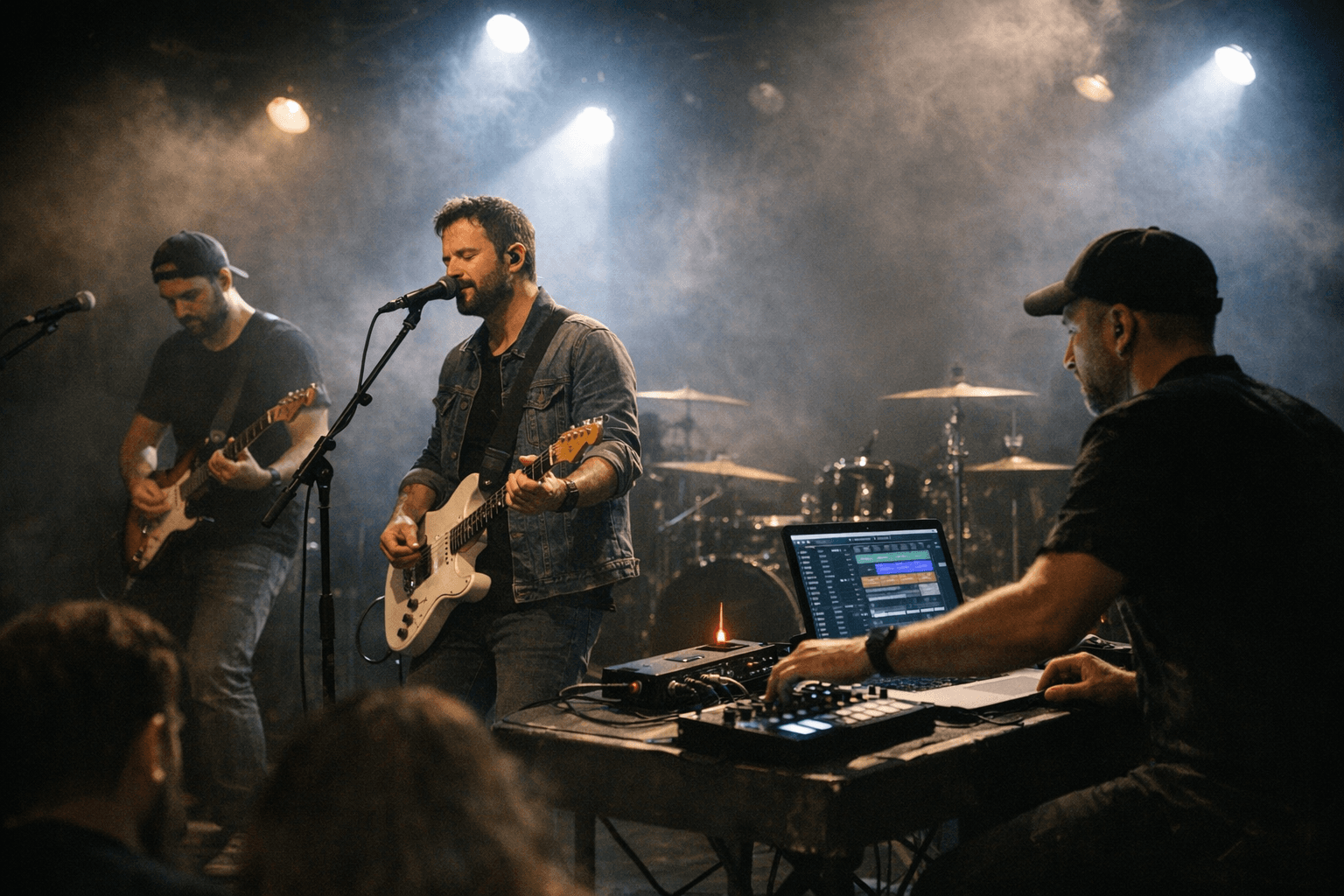
This is essentially reassigning the drummer's social and musical role to an instrument that is already present. The person wearing the click, or the player locked most tightly to the backing track, becomes the de facto timekeeper. Everyone else plays off them, not off their own internal count.
User dddppp elaborates on which instruments are best suited to that role: "In pop music bands, your rhythm section is your bass, rhythm guitar and sometimes your keys; one of those guys is generally doing something rhythmic enough to follow. Have everyone else listen to that instrument as a source of rhythm." In practice, this often means the bassist becomes the anchor. A locked-in bass line running over a programmed drum track gives every other player something concrete and continuous to track, much as the kick-and-bass relationship anchors a band with a live drummer.
Visual metronomes: useful tool or optical hazard
Visual metronomes, including apps available cheaply on iPhone and iPad, show up in this conversation as an accessible low-cost alternative for players who find in-ear monitoring impractical. Nicorellius notes: "i'd recommend a visual metronome. they take getting used to but can be helpful. there are some cheap ones on the market, especially if you have an iphone or ipad."
The caveat, though, is significant. Slim warns: "Visual metronomes are OK, but I've found they can actually be tricky to play to. Sometimes your eyes play tricks on you and it can get confusing." On a dimly lit stage with gear everywhere and an audience watching, splitting your attention between an instrument and a flashing light is genuinely harder than it sounds in a rehearsal room. Visual metronomes work best as a supplementary aid during practice rather than the primary sync mechanism at a live show, unless the band has specifically rehearsed with them over many sessions.
Building this into your rehearsal process
The common thread running through both Jamzone's framing and the community advice is that none of this works without rehearsal time built around the backing track itself. A band that treats the track as a live-performance-only tool will fight it. A band that rehearses every song with the track running, that decides song-by-song who the beat leader is, that tests and settles on a click-routing approach before soundcheck day, will find the transition far less disruptive than expected.
Jamzone's rehearsal-focused content specifically addresses this angle: their "How to Rehearse Smarter with Backing Tracks" guidance frames the backing track as something that can deepen practice and skill development, not merely paper over an absent band member. That framing is worth internalizing. The bands that make drummerless sets sound natural are the ones who have spent enough time with the technology that it stops feeling like a workaround and starts feeling like part of their sound.
The practical reality for working bands is that a missing drummer no longer has to mean a cancelled gig. It means a different workflow, some decisions about click routing and beat leadership, and enough rehearsal that the backing track becomes as familiar as any band member. Get those elements right, and the audience rarely needs to know the difference.
This article was produced by Prism’s automated news system from verified source data, official records, and press releases, then run through automated quality and moderation checks before publishing. The system is built and supervised by the people who set the standards it runs under. Read our full AI policy.
Did this article answer your question?