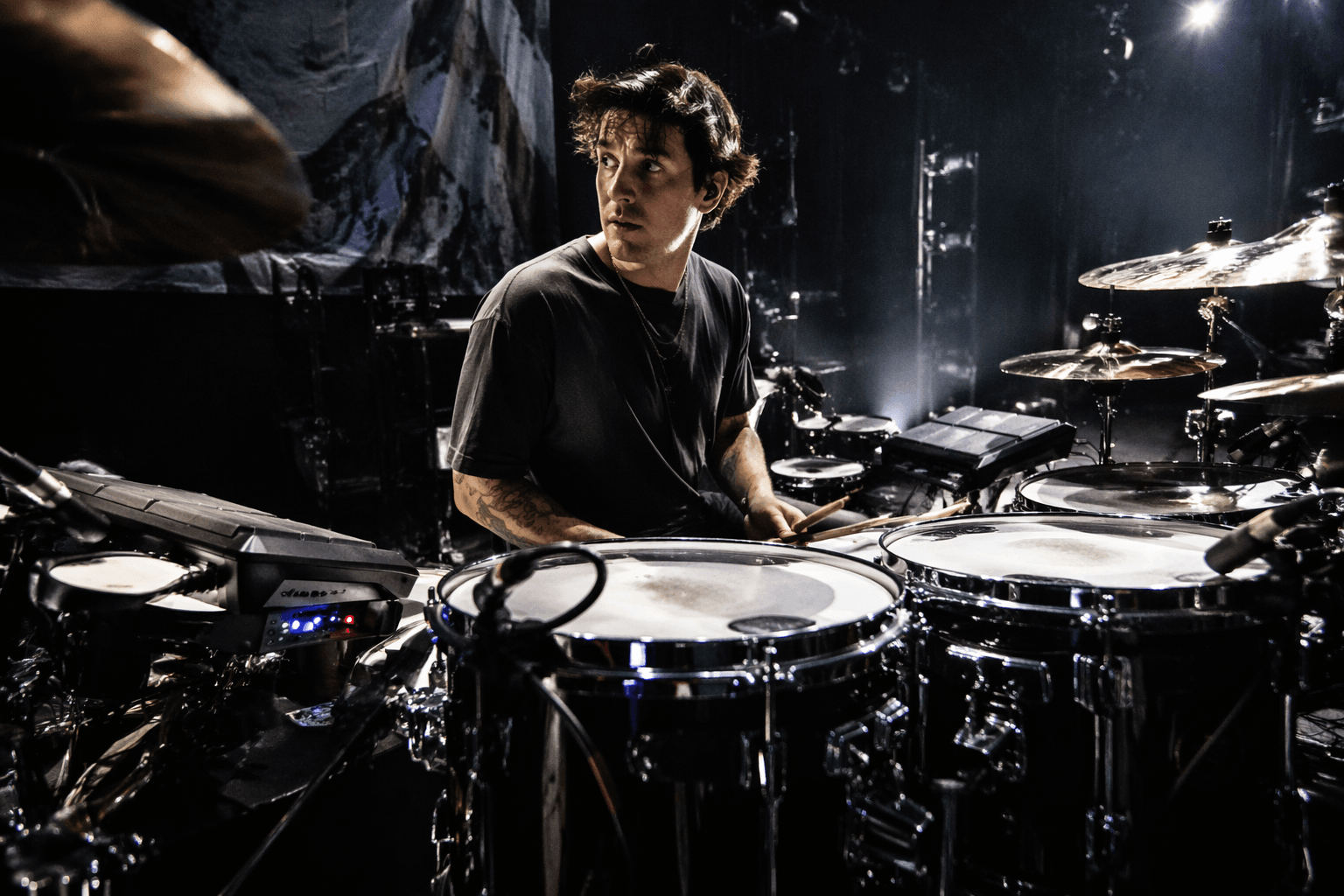
Chad Smith Breaks Down John Bonham's Iconic Good Times Bad Times Drum Part
Chad Smith's free Drumeo lesson on "Good Times Bad Times" reveals the one Bonham bass-drum trick so demanding that Zeppelin never played it live.
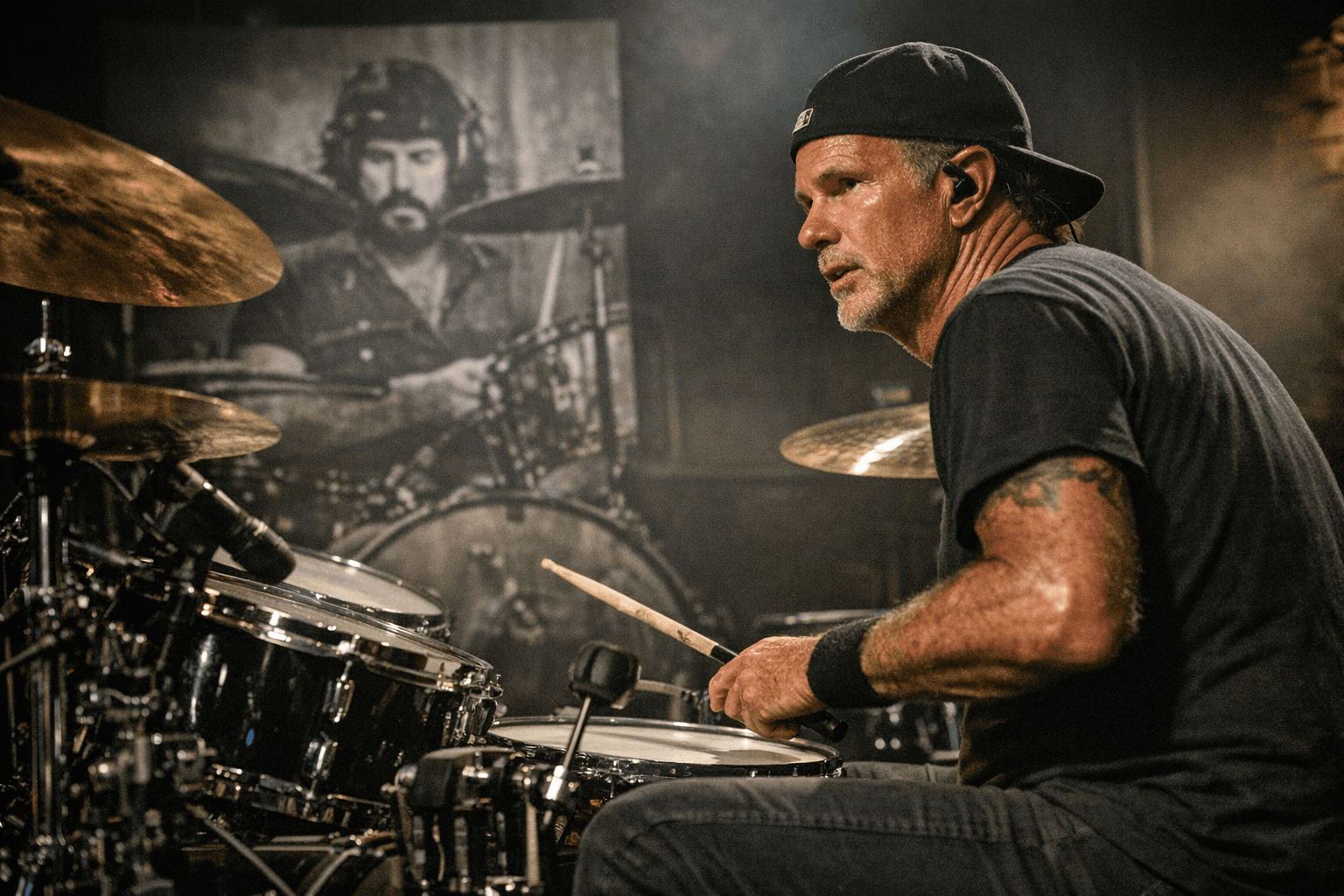
John Bonham never performed "Good Times Bad Times" live with Led Zeppelin. The bass drum part he put on tape in 1969 was so physically extreme that it couldn't be reliably reproduced in a concert setting, and even his own son Jason reportedly needed double bass drums to replicate it. That single fact tells you everything about why Chad Smith sitting down to break the track apart in a full Drumeo lesson is the most instructive hour you can spend with a pair of sticks right now.
The video dropped on Drumeo's YouTube channel on March 24, 2026, as part of Smith's ongoing educational collaboration with the platform. It functions as both a performance and a structured breakdown, with Smith performing the iconic opening track from Led Zeppelin's 1969 debut and then dissecting the decisions Bonham made. The full lesson is available free on Drumeo's YouTube channel (the recorded live stream is publicly linked), with shorter clips distributed across TikTok and Instagram in the days that followed.
The 12-Second Entry Point
Before any other part of "Good Times Bad Times" demands your attention, the opening fill does. It is approximately twelve seconds long, and it is the moment Bonham announced himself to rock drumming permanently. Smith addresses this passage as the lens through which everything else in the track should be understood: the fill is not a flex placed before a simpler groove, it is a preview of the level of foot-hand coordination and deliberate swing that runs through the entire track. Watch this section of the video first to calibrate your ears before attempting to isolate any individual element.
The Five Bonham Moves Chad Breaks Down
1. Bass drum triplets on a single pedal. This is the one. Bonham generated the rapid bass drum pattern that most listeners assumed required a double pedal using only his right foot. The technique involves a toe-flick rebound rather than a straightforward heel-down or heel-up stroke, allowing the beater to bounce back and generate successive hits with minimal reset time. Smith demonstrates the mechanics of this approach in the lesson, and watching his right foot is exactly where viewer comments have zeroed in: "watch his foot on the triplets, so sick," noted one commenter after the clip circulated. The practical takeaway for practice is that the technique is less about raw speed and more about pedal tension, beater rebound, and trusting the bounce rather than muscling every individual stroke.
2. The cowbell groove as the rhythmic anchor. Bonham's right hand drives steady eighth notes on a cowbell throughout most of the track, but close listening reveals that he throws in 16th-note licks, played as triple and even quintuple strokes, woven into what initially sounds like a uniform pulse. Smith, who plays his own Latin Percussion signature cowbell in live performance, leans into this texture and highlights how the cowbell is not decorative but structural: it holds the swing together while the bass drum does something counterintuitive underneath it. If you are practicing at home without a cowbell mounted, the bell of the ride cymbal works as a substitute and keeps the hand pattern intact.
3. Left-foot hi-hat throughout the verses. One detail that gets dropped from most cover attempts: Bonham's left foot is playing the hi-hat pedal consistently through the verses, not just in the intro. It drops out only during the one-measure breaks after each chorus. Smith points to this as a critical piece of the track's rhythmic density: the left-foot ostinato adds a quiet layer of pulse that thickens the bottom without being overtly audible in the mix. Drilling this before adding the bass drum triplets is the correct order of operations.
4. The swing feel embedded in the pocket. "Good Times Bad Times" is written in 4/4 but Bonham plays it with a swing-influenced feel that pulls certain 16th notes slightly back, creating the sense that the groove is breathing rather than clamping down mechanically on the beat. Smith's instruction draws attention to this as a stylistic identity marker: it is what separates the track from a technically accurate but soulless execution. The goal in practice is not to rush toward the triplets but to find the settling point in the groove before layering complexity on top.
5. Ghost notes on the snare between the backbeats. Bonham placed quiet ghost notes in the spaces between his backbeats, and these are easy to miss on a first listen because the bass drum pattern draws all the attention. Smith highlights their function: they add motion to what would otherwise be a static snare pattern and give the groove its conversational quality. In practice, focus on keeping these notes genuinely soft, well below the volume of the main backbeats, so the dynamic contrast does the rhythmic work.
What Chad Changes, and Why It Matters
Here is the detail worth sharing: Smith does not attempt to replicate Bonham's exact bass drum velocity and attack. He pulls back slightly on the sheer pounding and leans harder into the feel and momentum of the triplets, prioritizing rhythmic shape over brute force. This is a deliberate pedagogical call, and it reflects an honest acknowledgment of the track's difficulty. Bonham's recorded performance is, by most accounts, something even Bonham himself could not sustain in a live setting. Smith's version makes the language of the part legible and learnable rather than presenting it as an unreachable artifact. Fans watching the clip recognized this distinction immediately: "As a huge Led Zep fan I can say you absolutely crushed this," wrote one viewer. Another added, "Dude, that was absolute perfection. John Bonham would be very happy with that, no doubt."
A Practice Plan You Can Start Today
Work through these steps in order, each at a slow tempo before moving on:
1. Set a metronome around 80 BPM and practice the left-foot hi-hat pedal as a constant eighth-note ostinato. Do this for five minutes with no other limbs involved until it becomes involuntary.
2. Add the right hand on cowbell (or ride bell) playing straight eighth notes. Keep the left foot going. Spend ten minutes locking these two together before touching the kick.
3. Introduce the snare backbeats on 2 and 4 with a light ghost note on the "and" of each beat. Check that the swing feel is present: if it sounds mechanical, slow down further.
4. Add the bass drum in its simplest form first: one note per beat, then two per beat, building toward the triplet figure only after the limb independence for steps 1 through 3 is solid.
5. Once you have the triplet motion in isolation, bring all four limbs together at 70 BPM before gradually climbing toward the track's actual tempo of approximately 96 BPM.
The goal is not to arrive at Bonham's recording in one session. The goal is to develop the coordination map so that each practice run builds on the last.
The Broader Course Context
The "Good Times Bad Times" breakdown is a standalone entry point into Smith's larger "Legends of the '70s" course with Drumeo, which launched in early March 2026. The course spans 24 lessons and covers four foundational drummers Smith cites as direct personal influences: Bonham, Bill Ward of Black Sabbath, Keith Moon of The Who, and Ian Paice of Deep Purple. Smith has described the material as representing the drumming he grew up absorbing and the playing that shaped everything he brought to the Red Hot Chili Peppers, which he joined in 1988. The free YouTube performance ties directly into that curriculum, offering an accessible preview that functions as its own complete lesson for players who want to understand the Bonham pillar without committing to the full course.
The release also illustrates a broader pattern in high-engagement drum education: pair a living rock drummer whose name carries instant recognition with canonical repertoire that players already love, package it as accessible free content, and the result reaches students worldwide who might never have picked up a formal method book. For the Bonham catalog specifically, hearing that a single-pedal recording technique is the gold standard, 57 years after it was cut, is a reminder that the most enduring technical problems in drumming are still waiting for more players to solve them.
This article was produced by Prism’s automated news system from verified source data, official records, and press releases, then run through automated quality and moderation checks before publishing. The system is built and supervised by the people who set the standards it runs under. Read our full AI policy.
Did this article answer your question?