Chicago Drum Show 2026 builds education into the lineup
Chicago Drum Show 2026 leans hard into clinics and masterclasses, with Zach Miller, Dave King, and Mark Guiliana making the education track the trip’s real draw.
The Chicago Drum Show is leaning into clinics and masterclasses hard enough to change how drummers should plan the trip. Instead of treating education as a side room off the vendor floor, the 2026 lineup makes it part of the main attraction, with sessions running from 8:30 a.m. and a clinician list that stretches from groove-heavy names to more exploratory players.
What kind of show this is now
The 35th annual Chicago Drum Show is set for May 16 and 17, 2026, at the Prairie Events Center at the Kane County Fairgrounds in St. Charles, Illinois. Online ticket orders have ended, and entry will be handled at the front entrance, where VIP, 2-day, Saturday, and Sunday passes are available for cash or credit.
That setup matters because it tells you what kind of day this is meant to be. The show still has the classic drum-show backbone, with exhibitors spread across East Hall and West Hall, but the education piece is no longer an add-on for people who happen to wander by. It is built into the schedule, and that makes the event feel less like a shopping trip and more like a working drummer’s weekend.
Why the education track changes the value of the trip
Drum shows can be easy to misunderstand if you only picture rows of snares and vintage shells. The stronger version of the event is part market, part clinic circuit, part hang, and that is where the 2026 Chicago Drum Show is pointed. Educational sessions give the day a spine, especially for players who want more than a chance to tap on a few kits and talk hardware.
That is especially useful for younger drummers, hobbyists, and players who are still figuring out how to translate what they hear into what they can play. A clinic room can flatten the intimidation factor of a big convention floor, and it gives attendees a place to ask questions about technique, setup, practice habits, sound, and performance thinking. In a community that often learns by watching other drummers solve problems in real time, that is a bigger draw than a product table full of shiny gear.
Who the clinicians signal this year
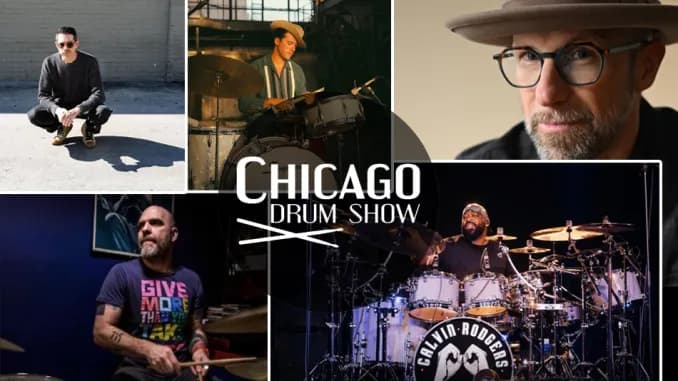
The 2026 clinician lineup includes Zach Miller, Calvin Rodgers, Teddy Campbell, Dave King, Nicholas Baker, and Mark Guiliana. Taken together, that is a strong share-hook on its own: six named players, six different lanes, and a schedule that suggests the show is aiming at a wider slice of the drumming world than a pure gear buyer crowd.
The posted schedule puts Zach Miller at Saturday 11 a.m., Dave King at Saturday 1 p.m., and Calvin Rodgers at Saturday 3 p.m. Sunday continues with Nicholas Baker at 11 a.m., Mark Guiliana at 1 p.m., and Teddy Campbell at 3 p.m. If you are trying to decide whether to spend the weekend in St. Charles, that spread is the clearest clue that the event is trying to serve both working players and curious fans who want to hear how different drummers think.
For players drawn to pocket, church, and the kind of feel-first playing that translates quickly to the kit, Zach Miller and Calvin Rodgers are the sessions that stand out on paper. Dave King and Mark Guiliana are the names that make the schedule feel especially adventurous, the kind of bookings that can pull in drummers who like the more experimental end of the spectrum. Teddy Campbell and Nicholas Baker round out the list with the kind of broad, performance-minded credibility that makes a clinic useful even if you are not looking for a niche style lesson.
How to plan the weekend around the clinics
The 8:30 a.m. clinic and masterclass start means this is not a show to drift into late. If you want the education program to justify the trip, the smart move is to treat the morning as the anchor and leave time around it for walking the floor, comparing gear, and stopping by the East Hall and West Hall exhibitor areas.
A practical approach looks like this:
- Use the morning clinics to lock in your schedule before the floor gets crowded.
- Save your booth time for the gaps between sessions, not the other way around.
- If you are buying, compare what you see on the floor with what you just heard in a clinic about touch, setup, and sound.
- If you are there to learn, pick one session in the groove lane and one in the more exploratory lane so the day feels balanced.
That mix is what makes the show feel broader than a sale. You can come away with new heads or hardware, sure, but the more durable value may be hearing a drummer explain why a sound works, not just seeing the finished rig that makes it happen.
A long-running convention that still knows its roots
The Chicago Drum Show’s education-heavy push lands differently because the event already has history. Modern Drummer covered a 25th-annual Chicago Drum Show in 2015, which makes the 35th annual edition feel less like a fresh experiment and more like the next step in a long-standing convention culture.
The show’s connection to Drugan’s Drums & Guitars also keeps it rooted in the retail and collector side of the drum world, which is exactly why the education track stands out. This is a community that still loves gear, but it is also a community that wants context: why this setup works, how a player built a sound, and what happens when the lesson room and the exhibitor hall are part of the same day.
That is the real appeal here. Chicago Drum Show 2026 is not just offering more to do. It is making the case that the best reason to go may be to spend the day listening closely, then walk out with a better ear for your own kit.
This article was produced by Prism’s automated news system from verified source data, official records, and press releases, then run through automated quality and moderation checks before publishing. The system is built and supervised by the people who set the standards it runs under. Read our full AI policy.
Did this article answer your question?