Elise Trouw’s rhythmic instincts shaped a career beyond the drum kit
Elise Trouw turns instinct into structure, using rhythm, looping, and self-production to build shows that feel bigger than a drum set. Her path from pattern-counting kid to mainstream touring artist is a blueprint for drummer-authors.

The instinct came first
Elise Trouw’s story starts with a detail drummers will recognize instantly: she was counting patterns in everyday life before she ever had formal drumming training. That early habit matters, because it explains why her work feels so locked in, so musical, and so intentional across drums, vocals, piano, and production. She did not arrive as a kit specialist who later added extras; she built a career around rhythm as a way of thinking.
That framing makes her useful to study for anyone trying to stretch beyond straight accompaniment. Trouw treats the drum kit as one part of a larger compositional setup, and that approach has helped her shape performances that feel designed rather than simply played. The result is a career that sits comfortably between groove, arrangement, and authorship.
From online clips to a recognizable artistic identity
Trouw first broke through through early online performance videos that fused drumming, vocals, arrangement, and visual identity. Those uploads did more than show chops. They made the case that she could build an entire performance world around a single creative vision, and that is a big reason her name spread so quickly in drummer circles and beyond.
Her rise is a strong reminder that modern drummer visibility often comes from showing the full picture, not just isolated technique. The videos worked because they made the process feel complete: the time, the parts, the voice, and the presentation all reinforced each other. For players trying to understand how to stand out online, that is the model.
What Unraveling signaled
Her debut album, Unraveling, cemented that broader identity. Publicity around the release listed February 24, 2017 as the date, while another album database lists March 24, 2017, but both point to the same 2017 debut that introduced her as more than a viral performance artist. Her official bio says the album came out while she was still a teenager, which adds context to how quickly she moved from online attention to a real recording career.
The milestones that followed were significant. According to her official bio, Unraveling led to a performance on Jimmy Kimmel Live! and a two-week tour opening for Incubus. Those are the kinds of career markers that turn a promising player into a credible live artist, especially in a scene where drummers are often judged by whether they can translate precision into a real stage setting.
Why the early competition result matters
Before the broader pop attention arrived, Trouw had already earned recognition inside drumming circles. In 2015, she tied for second runner-up in the Hit Like a Girl international online competition for female drummers. That detail is worth more than a line in a bio, because it shows she was already being seen as a serious player before the general audience caught up.
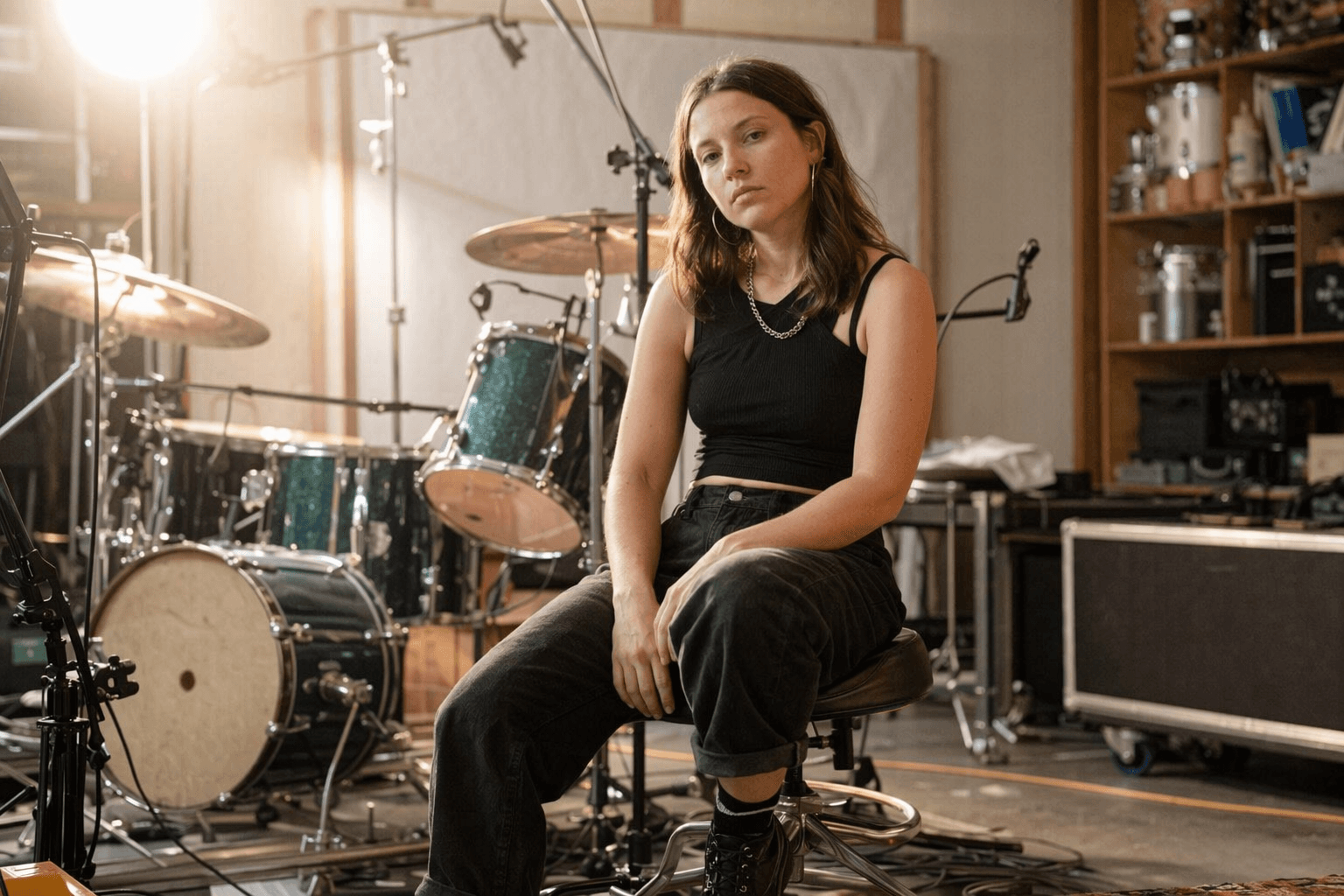
For drummers, that matters in practical terms. It shows a path where early credibility can come from performance videos, online competition exposure, and a clear sense of identity long before a label campaign or a high-profile TV slot. Trouw’s trajectory is less about one breakout moment than about stacking proof.
What her looping performances teach
Her live looping performances are the clearest sign of how far her approach extends beyond the drum throne. On YouTube, her channel features multiple live-loop uploads, including “Make Believe (Loop Version)” and “See Through (Live Loop),” and those titles say a lot about the way she builds a set. The drum part is not the end of the idea. It is the first layer in a performance that keeps growing in real time.
That is the main lesson for solo drummers who want to make loop-based shows feel tight and musical. Trouw’s work suggests a few practical habits:
- Think in parts, not just fills, so every layer has a job.
- Lock the groove early, because the loop only sounds as good as the pocket that starts it.
- Treat vocals, piano, and production choices as rhythm tools, not separate departments.
- Build visual consistency into the performance, since the audience is following a full show, not a practice clip.
The payoff is stronger internal time and more convincing arrangement. When the loop, the voice, and the kit all support the same pulse, the performance stops sounding like a stunt and starts sounding like a song.
Why she still matters in 2026
Trouw’s official site says The Diary of Elon Lust is out now in 2026, and the same site lists a 2026 U.S. tour. That keeps the story current in a way that matters to drummers: she is not just a reference point from the early viral era, but an active artist still shaping what a drummer-led project can look like right now.
Her current output reinforces the same core lesson as her earliest work. Rhythm is not just something she plays on top of a song. It is the framework that lets her write, arrange, sing, and perform as one integrated artist. That is why her career stands out in a crowded field: she has turned rhythmic instinct into a complete creative language, and she continues to use it to build shows that feel both technically disciplined and deeply musical.
This article was produced by Prism’s automated news system from verified source data, official records, and press releases, then run through automated quality and moderation checks before publishing. The system is built and supervised by the people who set the standards it runs under. Read our full AI policy.
Did this article answer your question?