How Engineers Captured Nirvana's Massive, Natural Drum Sound on Nevermind
Dave Grohl learned to play on pillows with marching band sticks — and somehow that's audible on every hit of "Smells Like Teen Spirit." Here's exactly how Butch Vig and Andy Wallace captured it.
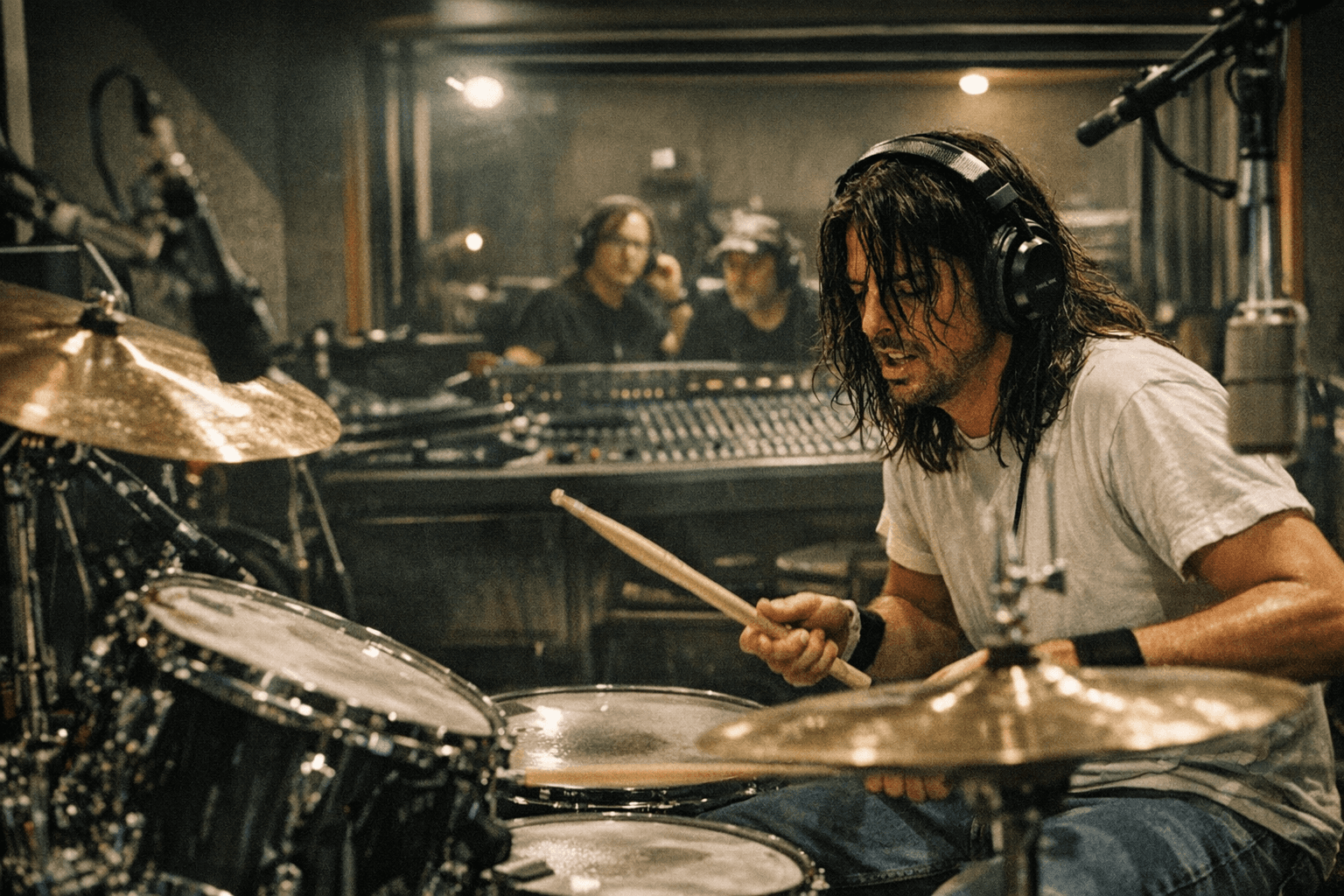
Four snare flams. That's all it takes. The moment Dave Grohl's opening fill on "Smells Like Teen Spirit" crashes in, you know exactly what record you're hearing. That sound, massive yet natural, punchy yet room-filling, didn't happen by accident. It was the product of a self-taught drummer who hit like a freight train, a producer who knew how to channel raw force, and a mix engineer with a few quiet tricks up his sleeve. From the intro flams to the tight chorus fills, Grohl's playing on "Smells Like Teen Spirit" brought in a new era of rock drums. But how they were recorded and mixed were equally important to the sound, with producer Butch Vig and mixer Andy Wallace highlighting all of that power with precision.
The Drummer Behind the Sound
As a kid, Grohl's family couldn't afford drum lessons, and he learned to play by "listening to Rush records and playing on pillows with big thick marching band sticks." Without any rebound or sound for reference, it's no surprise he became one of the hardest hitting drummers around. Dave is a self-taught drummer with a distinctive style. He's a notoriously forceful player, attacking every part of the kit. But his style is not defined by power only. Before he switched to the skins, Dave was primarily a guitarist and a songwriter, so when he sat behind the kit, he approached it like a melodic instrument, creating rhythmic hooks and always serving the song first rather than showing off his chops.
The drum part for "Smells Like Teen Spirit" is a direct reflection of that philosophy. Grohl addressed this during the Classic Albums documentary on Nevermind: "I didn't throw a bunch of drum fills in there. I tried to keep it as simple as possible. That was kind of an unspoken rule. We almost wanted them to be like children's songs. We'd tell people that the songs were intended to be as simple as possible."
This approach is outlined from the get-go, with Grohl's distinctive flams on the snare seemingly ushering in a simple four-count to casual listeners. But dig a little deeper and you'll realize he's actually playing groups of even 16th-notes between the flams on the snare, bass drum and hi-hats. And if you've ever wondered where those opening flams actually came from: Dave Grohl made a revelation to hitmaker Pharrell Williams that he owes it all to disco. "If you listen to 'Nevermind', the Nirvana record, I pulled so much stuff from The Gap Band and Cameo and Tony Thompson on every one of those songs. All that [tapping flams on his knees]. It's all disco, that's all it is. Nobody makes the connection."
The Kit
In Nirvana, Dave Grohl used various Tama drum kits: the Tama Granstar, Granstar II, and Artstar II. His early kit sound centers around a big, punchy kick drum, usually 24 inches in size. His toms, a 15-inch power tom and an 18-inch floor tom, are tuned deep and sound fat and solid. He generally played with a birch-shelled, 8x14-inch snare that sounded dry and full, and he accented all of this with strong, bright cymbals that always sat well in the mix. The thing that will jump out at most drummers is that everything is really big. Despite being 6 feet tall, Grohl was dwarfed by his drum kit's deep shells and highly placed cymbals.
The Room: Sound City's Secret
Nevermind was recorded at Sound City in Van Nuys, California. Though visually unassuming, Sound City had a rich history of great recordings from artists such as Fleetwood Mac, Tom Petty, Neil Young, and Pat Benatar. The drums were tracked in Sound City's Studio A, a great-sounding room more by accident than design. A former Vox warehouse, the more or less rectangular room with one slanted wall should not have worked, but did, and became renowned for recording killer drums.
As well as the fact it was affordable, Vig opted for Sound City based on its reputation for having a great live room when it came to recording drums. The studio also had another crucial asset: Sound City was home to a custom-built Neve 8078 recording console that played a major role in the sonics of Nevermind. In fact, Dave was so infatuated with the board that he purchased it for his personal studio, Studio 606.
Butch Vig's Mic Setup
The mic rig Vig used was deceptively simple. Butch Vig described it to MusicRadar: "It was a pretty simple setup. I told the engineer that I wanted to default to mics I knew and was used to, so I used an AKG D12 on the kick, I think I used an SM57 on the snare and possibly an AKG 451 underneath. We used Sennheiser 421s on the toms, again because I was used to those Sennheiser mics. AKG 414s as the overheads, I had them at Smart and they're great all-round condensers. I think the secret to that sound, is we had a couple of Neumann U87s [used as room mics] that were probably 15-18 feet back from the kit."
Those room mics, sitting nearly the width of a two-car garage away from the kit, are what gave the drums that chest-filling depth. But the kick drum setup is where things got creative.
The Kick Drum Tunnel
Butch employed one untraditional miking technique: a kick-drum tunnel. A kick-drum tunnel is exactly what it sounds like, a tunnel that extends out from the kick drum, the purpose of which is to capture more low end while minimizing bleed. The kick-drum tunnel used on Nevermind was constructed from two large drum cases glued together, with a blanket draped over the space between it and the kick. Butch placed the AKG D12 inside the tunnel, approximately three to four feet in, and miked the end of the tunnel with a Neumann U 47 FET.
While these days there are commercially available bass drum extenders, the solution Vig hired in for recording Nevermind was a lot more straightforward. The "extender" was in fact a laminated bass drum case with the ends cut out to form an open tube. It was placed in front of the bass drum with towels covering the seam, allowing for a farther mic position on the bass drum while eliminating some of the bleed from the rest of the kit and room. Practical, scrappy, and completely effective.
Butch Hears the Song for the First Time
Before any of this gear was set up, Vig had already heard enough to know something seismic was coming. When Vig visited Nirvana at their rehearsal room, he told Howard Stern in 2022: "They played Teen Spirit, and it just crushed me how good [Grohl] was, and how good they sounded. I started pacing around the room. Usually I take notes but I was just taking it all in. They finished the song and Kurt was like, 'What do you think, Butch?' I went 'Play it again.'"
The band recorded the basic track in three takes, and used the second take. The sheer rehearsal polish the band arrived with meant the tracking phase was fast and decisive.
Andy Wallace and the Mix
Once Vig had the tracks, the tapes went to mix engineer Andy Wallace, whose contribution to the final drum sound is both celebrated and still slightly debated. While Sound City's reputation for having a stellar live room can't be denied, famed mix engineer Andy Wallace was called in for Nevermind's final versions and interviews given in subsequent years fueled rumors that he sample-replaced some of the recorded drum sounds. The truth is somewhere in between. In 1991, sample replacement was a more difficult and crude process than it is today. Wanting greater control over the ambience without muddying the sound with hi-hat and cymbal bleed, Wallace triggered custom samples into a reverb unit from the drums, resulting in a bigger room sound where he wanted it. So Nevermind does contain drum samples, but only in the ambient part of the drum sounds.
Because the overall sound would have been so active, with so much bleed between the mics, Wallace would send a sample of a snare (inaudible in the dry mix) to the reverb instead. The actual snare Grohl played stays intact in the center of the mix. What Wallace shaped was the space around it.
Wallace himself has addressed the album's production directly: "The album has received a lot of criticism in recent years because it supposedly is over-polished, but when we were mixing the album, neither the band nor I looked at it like that. We were pretty thrilled that it sounded big and powerful and had lots of dynamics." He mixed the album at Scream Studios in Los Angeles, using an SSL G console and not a lot of outboard gear.
You can compare the two approaches directly: Vig's mixes (without Wallace's ambience samples) were made available on the 20th Anniversary Super Deluxe release of Nevermind, labelled as the Devonshire mixes, and give the opportunity to hear the difference between the two.
What You Can Actually Apply
The Nevermind drum sound is more replicable than most people assume. The core ingredients are:
- Room mics placed 15-18 feet back from the kit, running through quality condensers like the Neumann U87.
- A kick drum tunnel to extend the low end while minimizing bleed, which Vig built from two large drum cases glued together.
- A 24-inch bass drum that's ideally 16 inches deep, with a pre-muffled two-ply batter head tuned just above wrinkle.
- The snare treated with an 1176 compressor for extra snap, with a noise gate used to clean up cymbal bleed between snare hits.
- A drummer who hits hard and keeps the parts simple.
That last one is the part no plugin can replace. Butch Vig gave Grohl's drums a raw, muscular sound and a genuine live feel that hinted at the group's garage past. The engineering was world-class, but it was always in service of the performance. Everything Vig and Wallace built around those tracks was designed to let what Grohl was doing in the room hit you the same way it hit Butch in that rehearsal space: like a wall falling on you, with a groove underneath.
This article was produced by Prism’s automated news system from verified source data, official records, and press releases, then run through automated quality and moderation checks before publishing. The system is built and supervised by the people who set the standards it runs under. Read our full AI policy.
Did this article answer your question?