How New Orleans shaped the modern drum set
New Orleans turned percussion into a one-person solution. The bass pedal, hi-hat, and core kit voices still carry that practical city-born design.
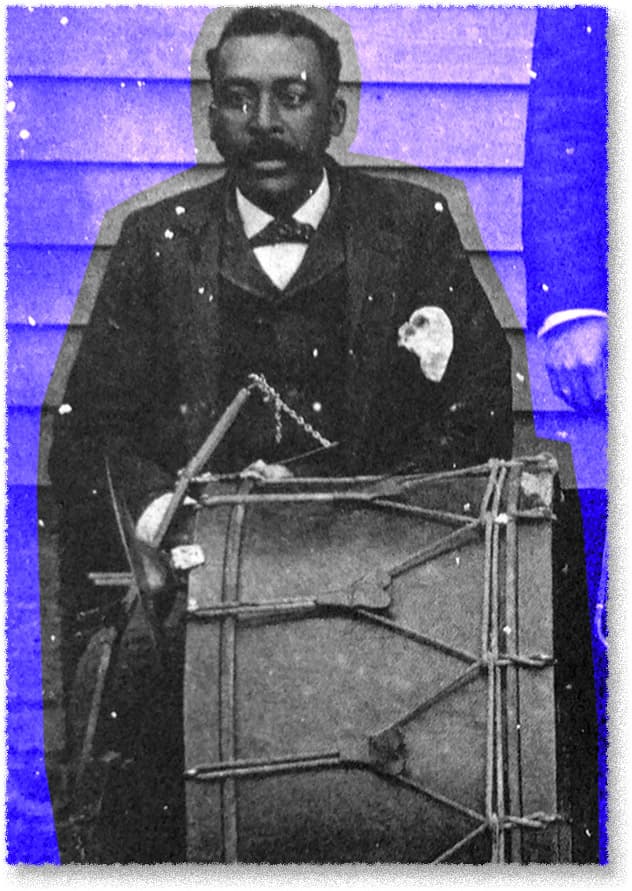
An 1896 photograph in Google Arts & Culture’s Drumsville story shows New Orleans drummer Edward “Dee Dee” Chandler using one of the earliest bass pedals with the John Robichaux band. The modern drum set grew from that kind of workaround in New Orleans, where musicians needed more sound from fewer people, on tighter stages and with tighter budgets. Separate percussion voices were fused into one setup, with one player covering bass drum, snare, cymbals, and color.
A city built the kit before the kit had a name
The New Orleans Jazz Museum’s Drumsville exhibit traces the city’s drumming story from Native people through Congo Square, African and Caribbean roots, brass bands, the bass drum pedal, and the drum kit. The Louisiana State Museum follows the same arc from Congo Square to the brass band tradition and then to the development of the drum set. It did not emerge from one scene or one style; it grew out of parade music, dance music, procession, and a city where percussion was already doing many jobs at once.
Smithsonian traces the hybrid logic through traditions around the world, including European military snare and bass drums, Chinese theater tom-toms, and cymbals whose history runs through Turkey, China, and later Europe before reaching the United States.
The bass pedal solved the real problem
The breakthrough was making one player able to reach them all. The bass drum pedal let a single drummer perform on multiple drums and cymbals with much greater facility and complexity. Vic Firth places the bass drum pedal in the 1900s, jazz brushes in 1913, and New Orleans-style drumming in 1917.
What survived into the modern kit
Britannica describes the standard drum set in popular music as typically played by one person and normally including a snare drum, tom-toms, a pedal-operated bass drum, and suspended and hi-hat cymbals. The hi-hat is a pair of cymbals operated by a foot pedal, widely used in dance music and jazz.
You can see the historical layers inside those parts:
- The bass drum pedal turned a big timekeeping drum into something one player could trigger while keeping hands free for snare and cymbals.
- The snare drum carried the military-band inheritance that already had a firm, cutting voice.
- The tom-toms brought in the color and shape associated with theater and more varied percussion expression.
- The hi-hat gave the drummer a foot-controlled cymbal pair that could lock time, open up texture, or snap the groove into motion.
How New Orleans drumming spread the template
New Orleans style jazz developed near the turn of the 20th century and was first recorded outside the city, in Chicago, Los Angeles, and Richmond, Indiana.
Baby Dodds was one of the first major jazz drummers on record, and Jo Jones pushed the instrument further by maintaining the basic pulse on a cymbal while using the other drums for punctuation.
This article was produced by Prism’s automated news system from verified source data, official records, and press releases, then run through automated quality and moderation checks before publishing. The system is built and supervised by the people who set the standards it runs under. Read our full AI policy.
Know something we missed? Have a correction or additional information?
Submit a Tip