How the talking drum turns rhythm into speech in West Africa
By squeezing pitch out of an hourglass drum, West African players turn strokes into speech-like phrases that rethink what drums can communicate.
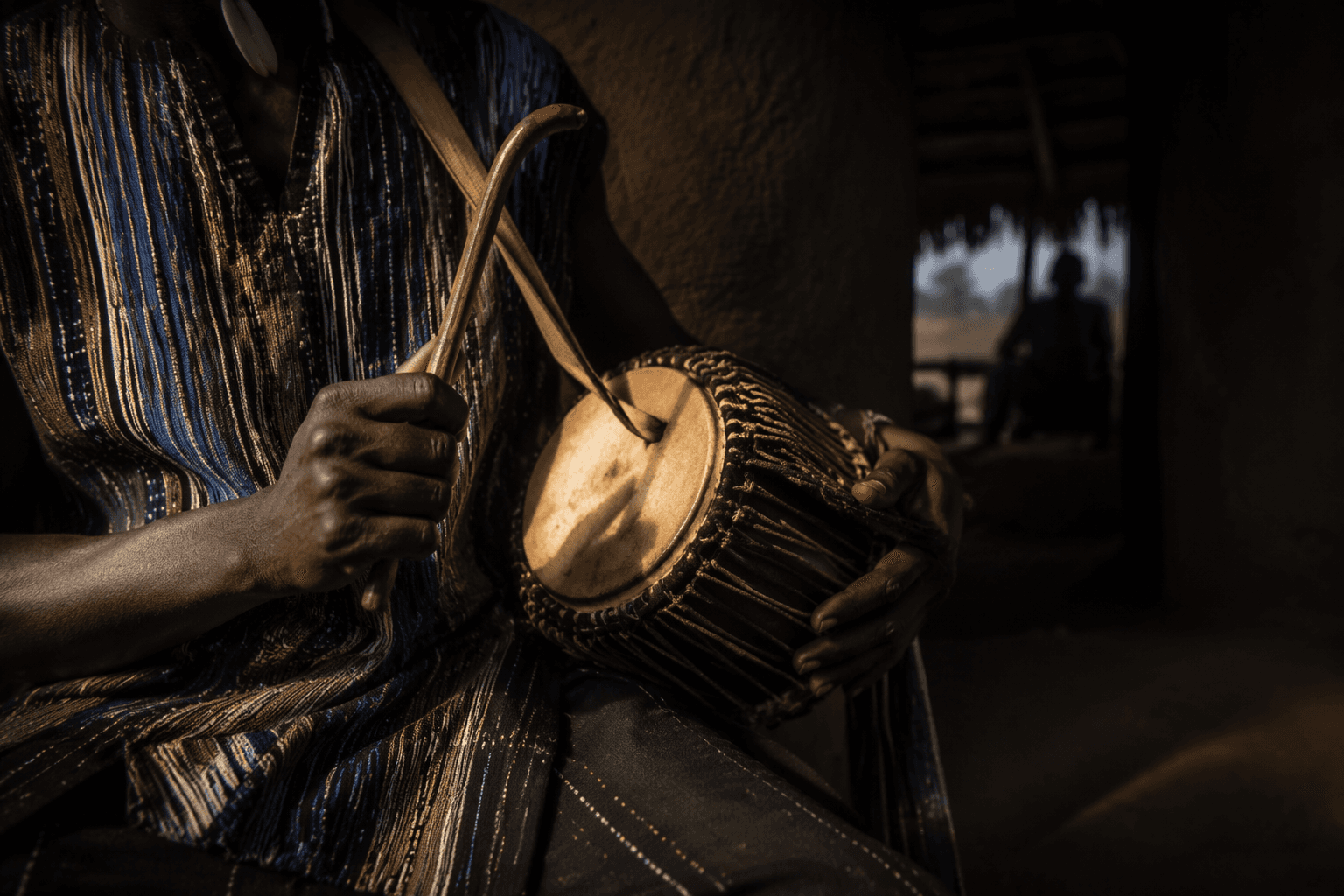
In West Africa, the hourglass-shaped talking drum bends pitch while it is being played, letting the sound rise, fall, and contour itself like speech. For tonal languages such as Yorùbá, that pitch shape is the difference between noise and meaning.
What the talking drum is
Its hourglass-shaped body has two drumheads connected by cords, and its pitch can be regulated to mimic the tone and prosody of human speech. In Yorùbá contexts it is often called dùndún, while in Ghana it is known as atumpan. The gangan or dundun originated in Oyo State in southwest Nigeria. One hand adjusts the leather tensioning thongs between the membranes while the other strikes the drum with a curved stick.
You are not hearing a static pitch with a simple attack and decay. You are hearing a membrane whose tension can change in motion, which means each stroke can be pulled upward or eased downward as the phrase unfolds.
How a drum starts to sound like speech
The talking drum’s most striking feature is pitch bending. By squeezing and releasing the cords under the arm, the player changes the tension on the drumheads in real time, and that changes the pitch while the note is ringing. The result is a sound that can approximate the rise and fall of spoken language rather than just a single percussive event.
That is especially powerful in tonal languages, where pitch differences can change word meaning. A talking drum does not literally contain words, but it can reproduce the contour of words closely enough to be understood inside the right musical and cultural code. The drum’s speech-like quality comes from acoustics and linguistic structure, not mysticism.
A 2021 Frontiers in Communication study, titled “When Music Speaks: An Acoustic Study of the Speech Surrogacy of the Nigerian Dùndún Talking Drum,” analyzed 30 spoken and sung verbal snippets. It found a high degree of correlation between Yorùbá vocalizations and the dùndún instrument. A separate 2021 scholarly paper on the representation of Yorùbá tones by a talking drum went further, concluding that drummers are able to represent syllables, lexical tones, and tonal processes of Yorùbá speech with a talking drum. The instrument models the shape of speech itself.
The code behind the message
The talking drum becomes a messenger only when players and listeners share the code. That is why the instrument sits at the intersection of music, language, and community memory. In some traditions, talking drums have been used to send messages and news between villages, including warnings of approaching enemies.
Yoruba tradition links the drum to Ayangalu, or Àyàn, the first Yorùbá drum maker and drummer and later deified as Òrìsà Àyàn. That association folds the instrument into ritual life, identity, and oral tradition, not just entertainment. A dùndún ensemble in Igbo Ora, southwest Nigeria, places the practice in a living community rather than a museum display.
A talking drum phrase is shaped to carry recognizable information, and its effectiveness depends on timing, contour, and shared knowledge.
What kit players can steal from it
The talking drum shows that rhythm is only one layer of percussion. On a drumset, you already shape meaning through dynamics, articulation, note length, and orchestration across snare, toms, and cymbals. The talking drum pushes that logic further by putting pitch contour at the center of the phrase.
A few practical ideas come straight out of that:
- Listen to the shape of a phrase, not only the downbeat. The talking drum treats rise, fall, and inflection as part of the message.
- Think in gestures. The squeeze-and-release motion is a reminder that a drum phrase can be molded while it happens, not just struck and left alone.
- Treat dynamics as communication. On a kit or electronic pads, the difference between a flat hit and a shaped one can change how the entire line reads.
- Pay attention to pitch relationships. Melodic percussion and tuned pads already work this way, but the talking drum shows how even an untuned membrane can behave like a voice when the player controls tension.
For drummers who live in the world of hybrid rigs, samples, and e-kits, the talking drum blurs the line between percussion and melody without giving up its identity as a drum.
This article was produced by Prism’s automated news system from verified source data, official records, and press releases, then run through automated quality and moderation checks before publishing. The system is built and supervised by the people who set the standards it runs under. Read our full AI policy.
Did this article answer your question?