Master These 10 Essential Drum Rudiments for Better Technique and Control
The PAS' 40 International Drum Rudiments are the global standard; these 10 are the ones that unlock everything else, with a practice routine to make them stick.
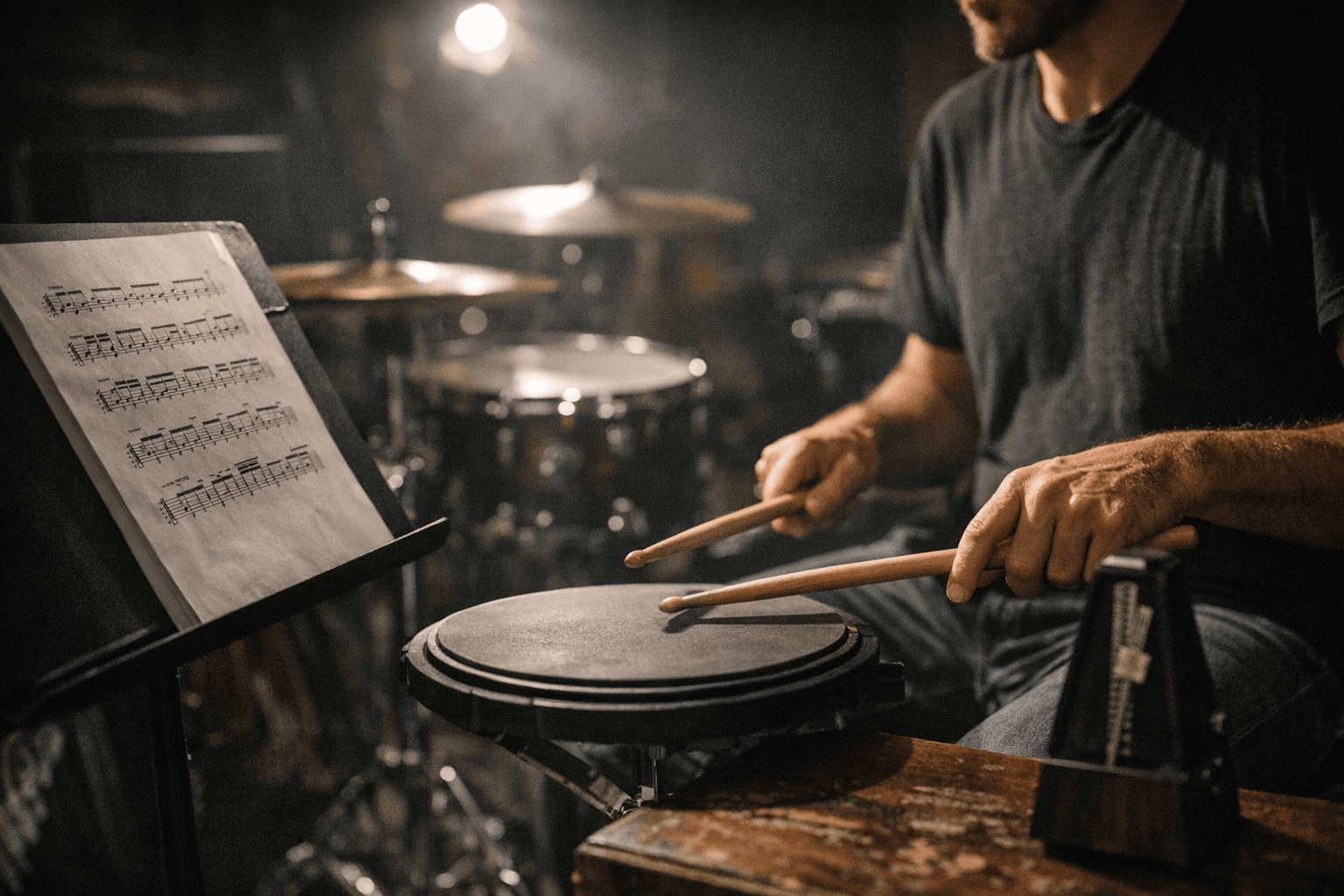
Think of rudiments as the alphabet of drumming. Before you phrase a sentence, you need letters; before you build a groove or a fill, you need the mechanical patterns that make your hands move with intention. The Percussive Arts Society (PAS) codified 40 International Drum Rudiments as the global consensus standard, used in educational programs, exams, drum corps charts, and professional auditions worldwide. Out of those 40, ten form the essential core that touches everything else: speed, rebound control, hand independence, dynamic shaping, and ornamental expression. Here is what each one demands from you, and how to practice it with purpose.
The Single Stroke Roll
RLRL. Four letters, endless depth. The single stroke roll is the foundation of speed and evenness, and it exposes every weakness in your technique with ruthless honesty. Uneven strokes, tension in the wrist, a thumb that grips too tight; the single stroke roll reveals all of it. The most productive way to practice it is the open-close-open method: start slow and deliberate to build muscle memory, accelerate with control rather than force, then return to slow tempo. Ten to fifteen minutes of focused slow work before pushing tempo will do more for your long-term speed than an hour of thrashing at max BPM. A metronome is non-negotiable here.
The Double Stroke Roll
RRLL. Where the single stroke is about alternation, the double stroke is about rebound. Each hand must produce two even strokes, and the second stroke in each pair lives or dies on how well you let the stick bounce back. Wrist and forearm economy is the technical focus: you are managing the rebound rather than forcing a second hit. Isolating paradiddles alongside double strokes helps reinforce the alternating rebound mechanic, because paradiddles demand that both hands engage the same bouncing motion in a complementary way.
The Paradiddle
RLRR LRLL. The paradiddle is arguably the single most versatile rudiment in the kit drummer's toolkit. It develops hand independence, provides a natural framework for linear phrasing, and maps beautifully onto drum-set fills across toms. The sticking pattern creates a shift in lead hand with every repetition, which is what makes it so useful for breaking up predictable right-hand-led patterns. Apply it to tom fills, ride articulations, or as a groove embellishment on the hi-hat, and you will immediately hear why educators treat it as a cornerstone of rudimental study.
The Flam and Flamacue
A grace note placed just before the primary stroke defines the flam, and the flamacue builds on that same principle with specific accent placements that create a more elaborate ornamental phrase. The timing of that grace note, its dynamic relationship to the primary stroke, and its height above the drumhead all determine whether a flam sounds musical or muddy. Practiced slowly, you begin to hear the placement and adjust the gap between grace note and primary stroke with intention. In snare solos, marching percussion charts, and backbeat embellishments on the kit, the flam transforms an ordinary stroke into something with genuine texture and color.
Drag Rudiments
The single drag and double drag sit at the intersection of pressure control, buzz, and articulation. These are not flashy rudiments, but they are essential for anyone serious about jazz brush work, contemporary snare playing, or orchestral percussion. The drag requires precise control of how much pressure your fingers apply to the stick during the grace-note pair; too much tension and the drag becomes a flam, too little and it smears into noise. Their consistent presence in jazz and contemporary snare writing reflects how much of musical drumming depends not on speed but on nuance.
The Paradiddle-Diddle
RLRRLL. The paradiddle-diddle extends the paradiddle concept with an extra double at the end of each grouping, which naturally builds hand-to-hand coordination in a way that standard alternating strokes do not. It has become a common fill device in modern playing precisely because the sticking creates unusual accent displacement, giving fills an offbeat, propulsive quality. The six-note grouping also makes it useful for working across meters, fitting neatly into compound patterns that challenge hands trained only on straight alternation.
Five-Stroke and Seven-Stroke Rolls
These multiple-stroke rolls shift the focus from pure speed to dynamic control. A five-stroke roll is two double strokes followed by an accent; a seven-stroke roll extends that with three doubles and an accent. Practicing crescendos and diminuendos across the roll is the core exercise here: you are learning to shape volume within a single phrase, which is the skill that separates mechanical roll execution from musical roll performance. Both rudiments appear constantly in snare solos, marching band charts, and orchestral percussion writing, where dynamic shaping within a roll is an expressive expectation rather than an optional flourish.
Ruff and Ratamacue Variants
Ruffs and ratamacues are ornamental rudiments, grace-note clusters that function as expressive punctuation in solos and snare lines. A ruff is typically a two-note drag preceding a primary stroke; ratamacues are longer, incorporating a triplet figure with a leading drag. They add rhythmic commentary to a phrase, the equivalent of an ornament in classical vocal writing or a grace note on a keyboard instrument. In snare features and drum solos, these variants supply the ornamentation that elevates a technically correct performance into something that sounds genuinely musical and considered.
Paradiddle-Diddle Variants and Composites
Beyond the standard RLRRLL pattern, paradiddle-diddle variants and composite rudiments serve as coordination bridges between the worlds of single strokes, double strokes, and flams. Working through these composites trains your hands to transition fluidly between sticking families, which is the precise skill needed when constructing extended fills or soloing ideas that draw from multiple rudiment types. Think of them as the connective tissue of rudimental vocabulary: they are rarely the star of the show, but they make everything else connect cleanly.
Multiple Bounce and Buzz Roll Techniques
The buzz roll is the sustained note of the snare drum. Where most rudiments are defined by discrete strokes, the buzz roll is defined by controlled pressure that produces a continuous, smooth sound from multiple rebounds per stroke. Sashaying the rebound, managing how much the stick vibrates against the head, is a tactile skill that takes time to develop, and the quality of a drummer's buzz roll often reveals how deeply they understand stick-to-head physics. On the kit, buzz roll technique extends to textured groove work, cymbal swells, and electronic pad phrasing, anywhere a sustained, seamless sound is needed.
Building a Practice Routine Around These Rudiments
Knowing the rudiments is one thing; building a structure that ingrains them is another. A focused 30-to-45-minute session can cover significant ground if organized deliberately:
- Warm-up (5 minutes): Relaxed wrist motion with 8th-note single strokes at medium tempo, no pushing, no tension.
- Rudiment focus (15-25 minutes): Pick two rudiments per session and work each through the open-close-open method with a metronome, 5-10 minutes each.
- Application (10-15 minutes): Transfer the rudiment into a musical context, a groove embellishment, a fill across toms, or a linear backbeat.
- Cool down and review (3-5 minutes): Play slower excerpts of what you practiced, log your tempos, and identify areas to revisit.
A few habits educators consistently recommend: practice with both matched and traditional grip to build versatility, and record short video or audio of your sessions. Visual feedback of stick height and foot motion regularly reveals tension you cannot feel in the moment.
PAS maintains an official listing and PDF of all 40 International Rudiments, including recommended practice notes, as the authoritative reference. Vic Firth's education materials offer play-along audio and scored practice routines for incremental progress tracking, which pairs well with the PAS framework for a complete learning system.
Rudiments are not a snare drum activity confined to a practice pad. They are compressed patterns that translate directly to fills, ride-hand articulations, groove embellishments, marching percussion shows, and studio session work. Learning them with a musical mindset, applying each pattern to actual songs and grooves you already play, is the fastest route from mechanical repetition to creative fluency.
This article was produced by Prism’s automated news system from verified source data, official records, and press releases, then run through automated quality and moderation checks before publishing. The system is built and supervised by the people who set the standards it runs under. Read our full AI policy.
Did this article answer your question?