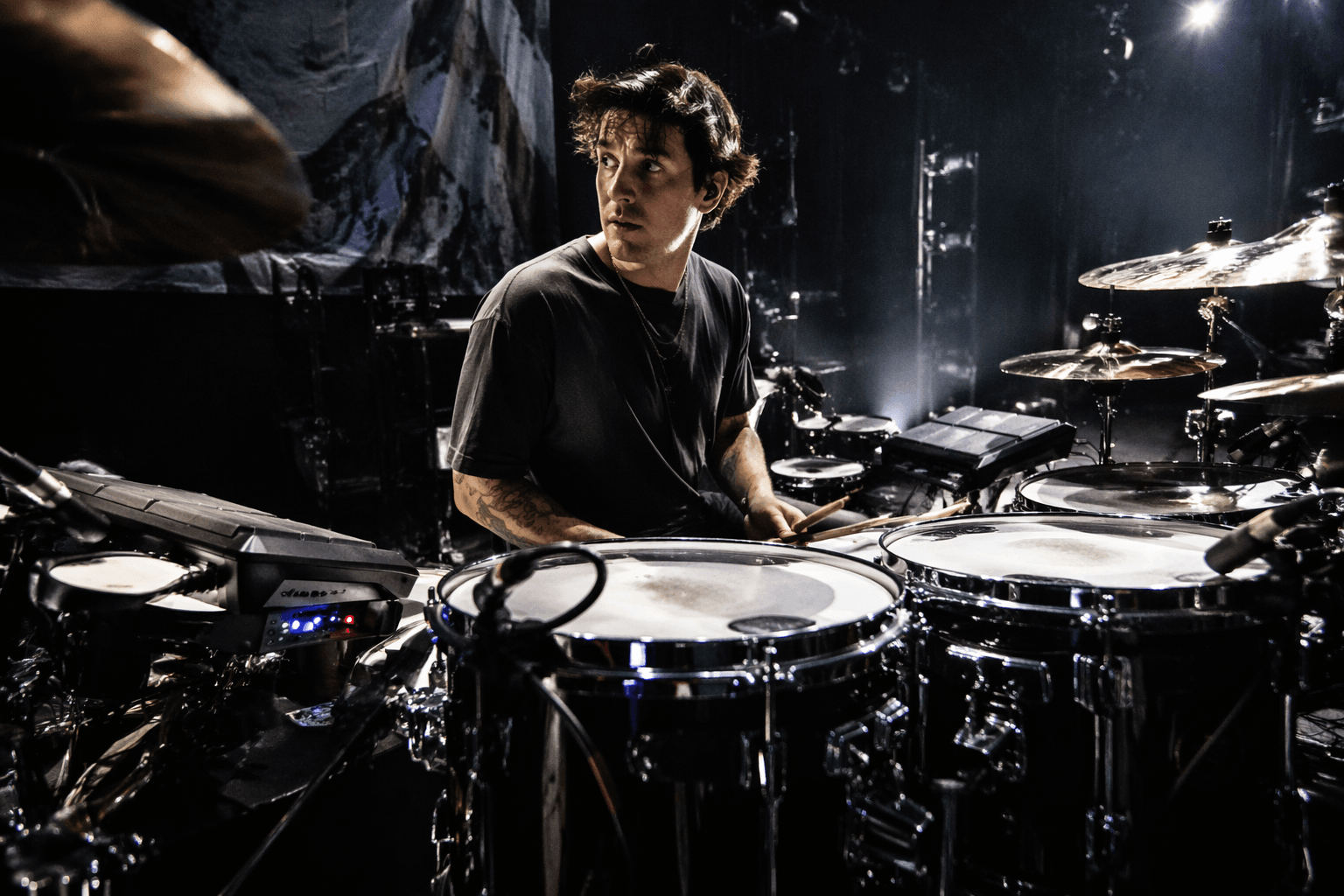
Mt. Joy’s Sotiris Eliopoulos blends indie-rock discipline with jam freedom
Sotiris Eliopoulos keeps Mt. Joy’s songs tight without boxing them in. His groove lets indie-rock hooks breathe into jam-band space.

Sotiris Eliopoulos sits in the exact spot where Mt. Joy’s identity comes into focus: he has to keep the songs locked, but never so locked that they lose the room to open up. That balance is what gives the band its live shape, and it explains why his drumming matters as much as the melodies riding on top of it. In Mt. Joy, the pulse is not just timekeeping. It is the bridge between indie-rock discipline and jam-band freedom.
A drummer built for motion, not just meter
Modern Drummer frames Eliopoulos as a player whose sound pulls from Southern California punk, Latin music, jazz, funk, traditional Greek folk and the improvisational mindset of the jam scene. That combination matters because Mt. Joy’s material depends on momentum: the groove has to stay forward-moving even when the arrangement stretches. Eliopoulos does that by staying grounded and supportive, favoring feel over flash and making sure the part serves the song before it serves the drummer.
That approach is exactly why his profile resonates with drumming readers. The most effective players in this lane know how to create lift without crowding the arrangement. Eliopoulos’ job is to hold a center strong enough for the band to expand around it, which means his hands and feet have to carry more than technique. They have to shape the band’s energy in real time.
Why Mt. Joy’s lineup puts the drums under a microscope
Mt. Joy is a five-piece built around Eliopoulos, Matt Quinn, Sam Cooper, Jackie Miclau and Michael Byrnes, and that size is part of the story. A band with that kind of lineup can sound tight enough for radio, but flexible enough to stretch on stage without falling apart. Formed in 2016, the group has had enough time to settle into a clear identity while still leaving space for live exploration.
The band’s Philadelphia roots and Los Angeles base help explain the blend at the core of its sound. That cross-regional identity suits a drummer who can pull from different traditions without turning the set into a collage. In practice, it means Eliopoulos has to keep the songs coherent while the band carries enough stylistic range to feel bigger than one lane of indie rock.
For drummers, that kind of role is deceptively demanding. The part cannot be overplayed, because the whole band depends on clarity. It also cannot be too conservative, because Mt. Joy’s live identity needs room for spontaneity. Eliopoulos solves that tension by letting the groove breathe while keeping the arrangement anchored.
What the current album cycle adds to the equation
The timing makes the profile hit harder. Mt. Joy’s official store is actively selling Hope We Have Fun on vinyl and CD, and the vinyl tracklist points to the shape of the current era. Songs such as “More More More,” “Coyote In The Middle” featuring Gigi Perez, “Wild and Rotten” featuring Nathaniel Rateliff and “She Wants To Go Dancing” give the campaign a clear set of anchor points, not just a vague promotional rollout.
That matters because drum parts age differently depending on the stage of the cycle. In a fresh album era, the drummer is not only preserving the studio feel. He is translating it for rooms that may be much larger, louder and more unpredictable than the record implied. Mt. Joy’s official store also lists 2026-era merchandise tied to the album campaign and live dates, which reinforces that this is an active touring push rather than a back-catalog victory lap.
For Eliopoulos, that means every song has to stay elastic. The record may ask for precision, but the road asks for resilience. The drummer has to keep the pocket intact while leaving enough air for the band to lean into the moments where a song can grow.
The 2026 routing shows how far that pocket has to travel
Mt. Joy’s 2026 tour schedule makes the scale of that responsibility obvious. The route includes Minnesota Yacht Club Festival in Saint Paul, Red Rocks Amphitheatre in Morrison, the Greek Theatre in Los Angeles and Madison Square Garden in New York, with additional major-room stops such as TD Garden and Huntington Bank Pavilion at Northerly Island. This is not a small-club run built on intimacy alone. It is a major-room cycle that asks the band to project the same pulse across festival stages, amphitheaters and arenas.
That kind of routing changes what a drummer has to do with dynamics. In a festival set, the groove has to land fast and clean. In a theater or arena, it has to carry longer and hold attention without becoming blunt. Eliopoulos’ style gives Mt. Joy a way to move between those contexts without losing the sense that the songs are still being played, not merely reproduced.
The best drummers in this position do not just keep time. They manage transitions, pressure and release. They know when to stay compact, when to open the hats, when to let a backbeat breathe and when to push the band forward just enough to make the next section feel earned. That is the practical value of Eliopoulos’ mix of restraint and freedom.
The feel that makes the band coherent
Mt. Joy’s appeal depends on coherence across a wide palette. Eliopoulos pulls in punk urgency, jazz sensitivity, funk pocket, Latin rhythmic awareness and Greek folk DNA, then folds all of it into a band that still needs to sound unified. That is the real skill here: not showing every influence at once, but using those influences to make the groove feel alive.
His role is especially important because the songs depend on both melody and motion. If the drums flatten out, the band loses its lift. If they push too hard, the songs can lose shape. Eliopoulos keeps that line intact by staying song-serving, giving Mt. Joy the freedom to expand without drifting away from the center that makes the songs work in the first place.
That is the tension at the heart of the story, and it is the reason Eliopoulos stands out: the same drummer who keeps the band disciplined also gives it room to wander. In Mt. Joy, that is not a contradiction. It is the engine.
This article was produced by Prism’s automated news system from verified source data, official records, and press releases, then run through automated quality and moderation checks before publishing. The system is built and supervised by the people who set the standards it runs under. Read our full AI policy.
Did this article answer your question?