Rick Allen on Survival, One-Armed Drumming, and Def Leppard's India Debut
Rick Allen lost his left arm in 1984 and rebuilt his technique from scratch. His playbook, proven across 40 years of touring, is now landing in India for the first time.

When Def Leppard opened their maiden India run in Shillong, roughly 30,000 people packed the RBDSA Sports Complex and sang every word back at the stage. "Hysteria," "Pour Some Sugar on Me," "Rock of Ages," "Photograph" - the crowd knew the catalog cold. The man anchoring that show from behind the kit had one arm. And the way he got there is one of the most instructive reinvention stories in drumming.
Rick Allen, known to Def Leppard's fanbase as "The Thunder God," joined the band in November 1978 at just fifteen years old, answering a notice-board ad his mother spotted on his behalf. Within a few years he was opening arenas alongside AC/DC. Then, in 1984, a car crash cost him his left arm. What followed was not just a survival story but a complete rebuild of technique, equipment, and mindset that every drummer dealing with a limitation can mine for practical guidance. Allen spoke about it at length in a Zoom interview conducted on March 27, 2026, one day after the Shillong show, with Mumbai still on the evening's schedule.
Rebuilding the Machine
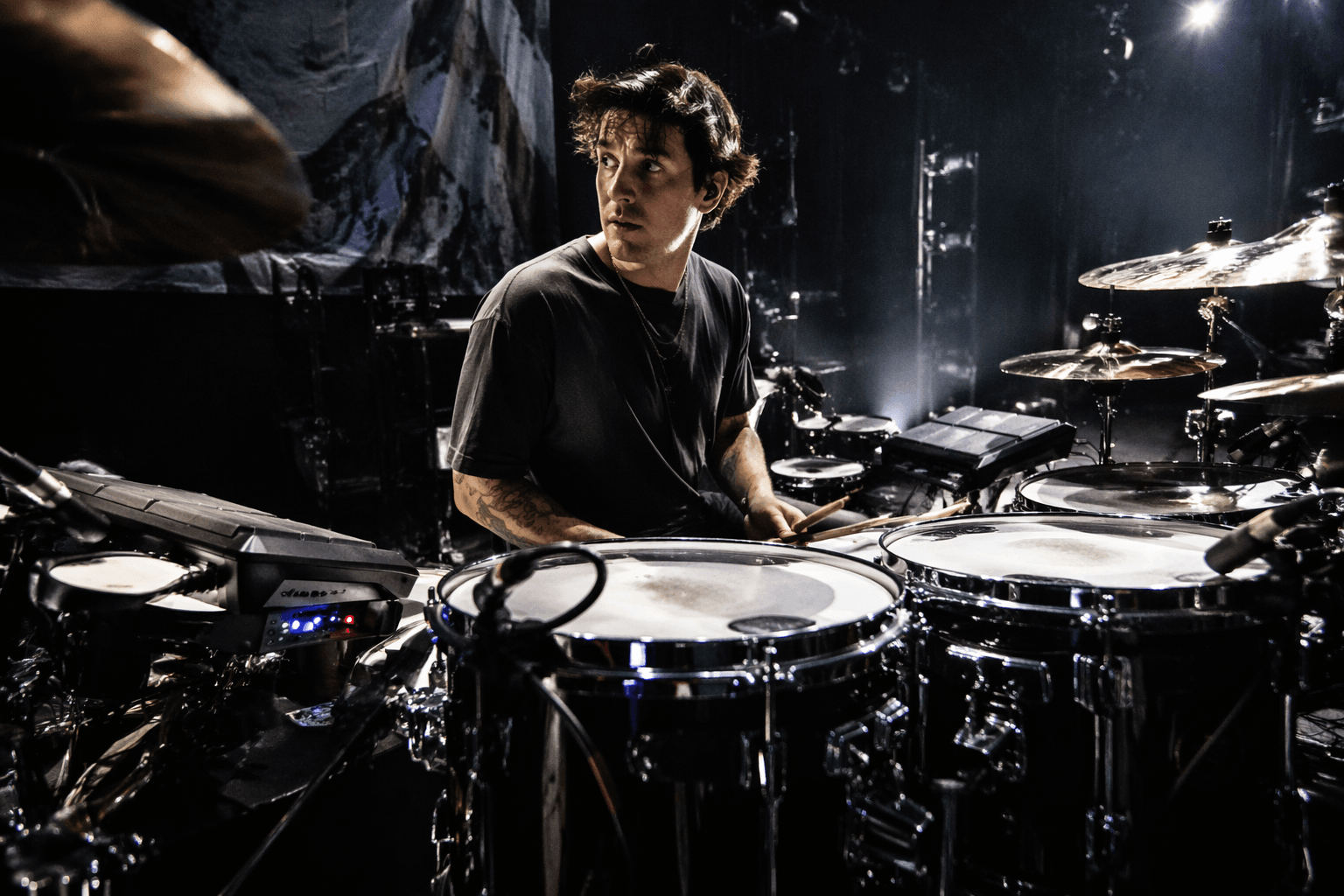
The mechanics of Allen's adaptation are genuinely worth studying. With his left arm gone, his immediate challenge was neurological: teaching his brain to redistribute the motor patterns previously handled by his left hand through his right hand and, critically, his legs. His right hand absorbed an expanded share of rhythmic complexity, while his left foot was elevated from a supporting role to the primary driver of what had been his left arm's responsibilities.
Four electronic foot pedals, arranged left to right, now handle what that arm once covered: closing the hi-hat, triggering the bass drum, firing a snare, and sounding a tom. These were not off-the-shelf purchases. The original custom setup, built around Simmons electronic pads and bespoke "Shark" foot triggers, was so historically significant that one of his 1987 Hysteria-tour kits now sits in the Rock & Roll Hall of Fame. The instrument itself became an artifact of innovation. Allen also had to develop entirely new patterns to execute the fast double-bass passages and driving rock grooves that power a Def Leppard arena show. Those are not approximations of what a two-armed drummer plays; they are original solutions built around a completely different set of physical inputs.
Making the Rules
What elevates Allen's story beyond recovery is his explicit acknowledgment that there was no map to follow. He told The Hindu that he "had to make the rules" because no template existed for a one-armed rock drummer playing at his level. That framing transforms the narrative from inspirational to instructional: limitation is a design problem, not a dead end, and the solution requires inventing the framework rather than looking for one that already exists.
His core philosophy surfaces in a single phrase he returned to repeatedly during the interview: "There's always another way to do things." It sounds simple, but for working drummers it points somewhere specific. The approach that worked before an injury, before losing access to gear, or before a physical constraint entered the picture is not the only approach. Allen's catalog of work since 1986 is the evidence.
Five Lessons From Allen's Reinvention
The interview and the broader arc of Allen's comeback distill into actionable territory for any drummer navigating physical or technical limitations:
- Remap the kit to your actual strengths. Allen did not attempt to replicate a standard setup. He identified what his body could do and built the hardware around that reality. If your strongest technique or most reliable limb is the anchor, the rest of the setup follows from there.
- Retrain deliberately and slowly. Neurological redistribution takes sustained, structured work. Allen's public return came in August 1986, more than 18 months after the accident, and his full reintegration into Def Leppard's touring schedule arrived with the 1987-88 Hysteria world tour. Any recovery-driven adaptation requires the same patience with the process.
- Develop left-foot independence as a primary skill. For most rock drummers, foot technique supports hand patterns. Allen inverted that hierarchy entirely. Drilling independent left-foot patterns, especially with bass drum sequences that don't mirror the right hand, builds the kind of fluency Allen needed to survive on a stadium stage.
- Treat double-bass patterns as vocabulary, not just technique. Allen's necessity to route rock grooves through his feet pushed him to develop nuanced foot phrasing. Transcribing those patterns is a legitimate study exercise for any drummer, regardless of physical setup.
- Aim for reinvention, not restoration. The goal Allen set was not to play exactly as he had before. It was to play. That shift reframes the entire recovery as a creative act rather than a remedial one.
India, Finally
The Shillong show carried significance beyond Allen's personal story. Def Leppard's three-city Indian run, covering Shillong, Mumbai at Jio World Garden, and Bengaluru, marked the band's first-ever performances on Indian soil, part of the Bandland on Tour concert series. For a catalog as globally omnipresent as Def Leppard's, the absence of India on their touring history had always been a conspicuous gap. Allen described Shillong as "well deserved to have the title as India's rock capital because everybody in the crowd, they knew all of the words to the songs." That kind of reception, from an audience experiencing the band live for the first time, validated what the India dates were always likely to deliver.
The broader pattern is real: Rock & Roll Hall of Fame inductees with Hysteria-era commercial peaks are still finding first-time international markets four decades in. That is not nostalgia touring. It is expansion into audiences who grew up on the records without ever having the live option.
Beyond the Kit
When The Hindu asked Allen whether he sees himself primarily as a survivor or a musician, he sidestepped the binary entirely: "I call myself a part-time rock star, full-time father, husband, and a philanthropist." The line does not diminish the drumming. It contextualizes it. Allen has spent most of his adult life as public proof of something extraordinary, but his own framing is deliberately grounded, placing the career inside a life with wider priorities than the spectacle surrounding it.
For drummers, that balance is its own kind of instruction. The technique matters. The custom kit matters. The neural retraining and the foot independence and the willingness to invent new rules all matter. And none of it exists in isolation from the person sitting behind the kit deciding, after the worst possible interruption, that there is always another way.
This article was produced by Prism’s automated news system from verified source data, official records, and press releases, then run through automated quality and moderation checks before publishing. The system is built and supervised by the people who set the standards it runs under. Read our full AI policy.
Did this article answer your question?