Thrissur Pooram’s thunderous drumming powers Kerala’s grand temple festival
Thrissur Pooram turns about 250 percussionists into one giant machine. Its 36-hour pulse, led by the Ilanjithara Melam, is a masterclass in ensemble control.
Why Thrissur Pooram hits drummers differently
Thrissur Pooram is not just a temple festival with music in it. It is a full-scale percussion event where around 250 artists lock into one communal pulse, and the result can feel bigger than many Western kit players expect from live drumming at all. Held at Thekkinkadu Maidanam and centered on Vadakkunnathan Temple in Thrissur, this is the kind of performance where rhythm is not decoration, it is the engine.
Kerala Tourism places the festival’s history at more than 200 years, and that long arc matters because Thrissur Pooram was built as a response to a dispute, not as a casual celebration. The story told by Kerala Tourism traces it back to Arattupuzha Pooram, when temples arriving late because of heavy rain were denied entry. The chiefs of Thrissur and Kuttanellur then began their own festival, and Shakthan Thampuran later unified the ten temples around Vadakkunnathan Temple into the event now known as Thrissur Pooram. That origin story still shapes the scale and the stakes.
The Ilanjithara Melam is the heart of the whole thing
If you want the share hook for drummer-readers, it is the Ilanjithara Melam. District tourism material describes it as the orchestral performance that takes place in the temple courtyard beneath the Ilanji tree, and it is the moment when the festival’s percussion identity becomes impossible to ignore. The final day is when this massed ensemble takes centrestage, and the sound is carried by chenda players leading a traditional orchestra of about 250 artists.
The instrumentation is a reminder that this is ensemble discipline, not solo display. The Ilanjithara Melam brings together chenda, kurumkuzhal, kombu and elathalam, with each instrument occupying a distinct role in the texture. For drum set players used to controlling groove from behind one kit, the striking lesson is how power comes from interlocking parts, not from individual flash.
What the scale teaches about groove, timing and control
Thrissur Pooram lasts around 36 hours, which means endurance is part of the musicianship as much as technique. The event is often described as Kerala’s biggest or most famous temple festival, but from a drummer’s perspective its real drama lies in how long the architecture of the sound can hold together under pressure. The ensemble has to sound massive without slipping out of alignment, and that requires a kind of shared timing that goes beyond count-in precision.
That communal timing is one of the clearest takeaways for kit players. In a drum set context, you are often responsible for keeping a band stable from one throne. In Thrissur Pooram, the stability comes from a public system of cues, response, and discipline spread across a large group. The effect is not a loose jam, but a giant rhythmic organism that has to breathe together.
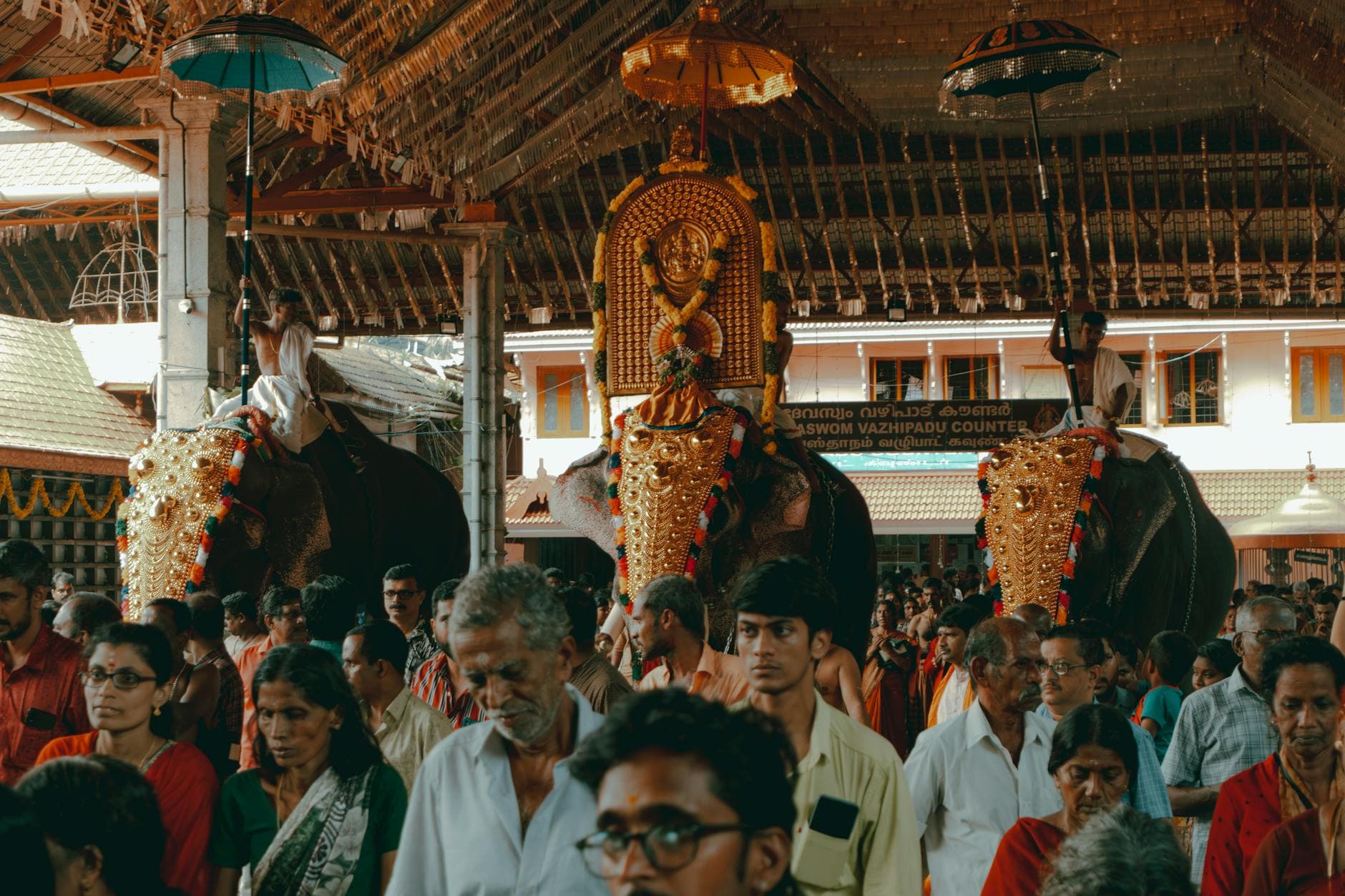
The festival’s backdrop also deepens the impact. Caparisoned elephants frame the procession, and the visual scale of the event makes the percussion feel even more consequential. On the final day, the kudamattam, the ceremonial exchange of colorful parasols, adds another layer of movement and color while the drumming keeps the ceremonial structure moving forward.
Why this festival matters beyond spectacle
Thrissur Pooram is often described as the grand blend of spiritual and cultural life in Kerala, and that is more than ceremonial language. At Vadakkunnathan Temple, one of the oldest temples in Kerala and located in the heart of Thrissur Town, percussion sits at the center of collective identity. The music is not separating itself from the crowd; it is binding the crowd to the ritual.
That is why the festival can read as a lesson in performance design. The percussion is thunderous, but it is also organized. The ensemble’s force comes from repetition, balance and a clearly shared purpose. For drummers, that combination is worth studying as carefully as any advanced independence exercise or orchestral score.
The modern festival now carries real logistical pressure
Recent years have shown that a festival this large is also a planning challenge. In 2024, crowd-control restrictions and police actions around Thrissur Pooram sparked criticism and protests. Reporting from that year described police blocking entry to the Swaraj Round from the south, west and north sides, a reminder that managing a festival built on huge public gathering can become politically sensitive fast.
By 2025, officials were stressing a broader operational package. A ministerial briefing involving Vasavan, ADGP Ajith Kumar, K Sudarsan, Ankit Asokan and representatives from Kerala Police, Suchitwa Mission, the Food Safety department and the Legal Metrology department focused on safety, transport, sanitation, road repairs, drinking water and elephant care. Pinarayi Vijayan also directed officials to formulate a security action plan that would preserve the rituals while putting stringent security measures in place. For a festival powered by mass participation, logistics are now part of the story.
What to listen for if you are coming to it as a drummer
The easiest mistake is to hear Thrissur Pooram as only volume. The better approach is to listen for structure. The Ilanjithara Melam shows how a huge ensemble can hold a single pulse, build dynamic pressure and still stay ceremonially clean. The chenda voices drive the body of the performance, while the kurumkuzhal, kombu and elathalam shape the edges and give the music its ceremonial contour.
Practical takeaways for drum-minded readers
- Listen for how the ensemble locks in without relying on a modern backbeat.
- Notice how dynamics are built through collective density rather than a kit-style fill.
- Watch how visual ritual, elephants, parasols and temple space, changes the way rhythm lands.
- Pay attention to endurance, because a 36-hour festival asks as much of planning and stamina as it does of chops.
In 2026, Thrissur Pooram was scheduled for April 26 at Vadakkunnathan Temple, with fireworks and other key rituals extending into the next day. That schedule underlines the point drummers will understand fastest: this is not a single performance but an unfolding system of sound, motion and shared timing. Thrissur Pooram endures because it turns percussion into public life, and the Ilanjithara Melam is the clearest proof of that power.
This article was produced by Prism’s automated news system from verified source data, official records, and press releases, then run through automated quality and moderation checks before publishing. The system is built and supervised by the people who set the standards it runs under. Read our full AI policy.
Did this article answer your question?